Introduction
The purpose of this article is to help patients understand what influences the lifespan of dental crowns and how to protect their investment. In general, well‑maintained crowns last 10‑15 years, with some materials such as gold or high‑strength zirconia reaching 20‑30 years when oral hygiene is optimal. Factors that shorten longevity include poor oral care, bruxism, hard or sticky foods, and an ill‑fitted restoration. For residents of Paterson, NJ, local practices such as La Marque Family Dentistry combine multilingual staff and decades of experience to provide personalized crown placement, routine check‑ups, and patient education that together support long‑term crown health.
Material Choice and Cost Implications
| Material | Strength / Aesthetic | Cost (per tooth) | Typical Longevity |
|---|---|---|---|
| Porcelain‑fused‑to‑metal (PFM) | Strong metal base, good aesthetics | $800‑$1,200 | 10‑15 years |
| Lithium disilicate (E‑max) | Highest translucency for front teeth | $900‑$1,500 | 10‑20 years |
| Zirconia | Metal‑like fracture resistance, can be layered | $1,000‑$2,000 | 15‑20 years+ |
| Gold alloy | Most durable, gentle on opposing teeth | $1,200‑$2,500 | 20‑30 years |
| Composite resin | Most affordable, lower durability | $300‑$600 | 5‑10 years |
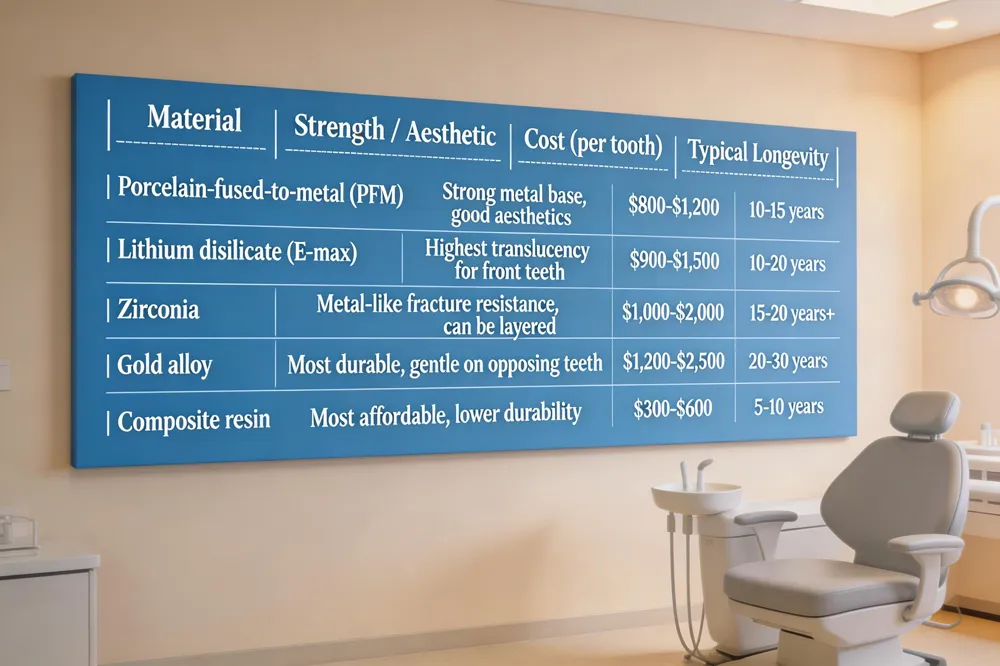 Dental crowns are fabricated from a range of materials, each balancing strength, aesthetics, and price. Porcelain‑fused‑to‑metal (PFM) crowns combine a durable metal base with a tooth‑colored porcelain overlay, making them a solid choice for back teeth where strength is essential. All‑ceramic options such as lithium disilicate (E‑max) deliver the highest translucency for front teeth, while zirconia provides metal‑like fracture resistance and can be layered for a natural look. Gold alloy crowns are the most durable and gentle on opposing teeth, ideal for molars and bruxism patients, but they lack visual appeal. Composite resin crowns are the most affordable adult option, though they are less durable and best reserved for low‑stress cases. Cost varies widely: resin crowns may cost $300‑$600 per tooth, PFM $800‑$1,200, all‑ceramic $900‑$1,500, zirconia $1,000‑$2,000, and gold $1,200‑$2,500. Zirconia is often considered the healthiest choice because it is metal‑free, biocompatible, and has low plaque affinity, supporting long‑term gum health.
Factors Directly Affecting Longevity
| Factor | Impact on Crown Lifespan | Mitigation Strategies |
|---|---|---|
| Material type | Determines baseline wear and fracture resistance | Choose high‑strength materials (zirconia, gold) for high‑stress teeth |
| Tooth location (front vs molar) | Molars experience higher occlusal forces | Use stronger materials (zirconia, gold) for molars |
| Patient habits (bruxism, chewing hard foods) | Accelerates wear, risk of cracks | Night guard, avoid hard/sticky foods |
| Oral hygiene | Poor hygiene leads to marginal decay and cement breakdown | Brush twice daily, floss, regular professional cleanings |
| Cement quality & technique | Poor cement can cause early loss | Use strong adhesive, proper isolation during cementation |
| Post‑crown restoration (root canal) | Can weaken tooth structure | Ensure good seal, maintain hygiene, consider protective guard |
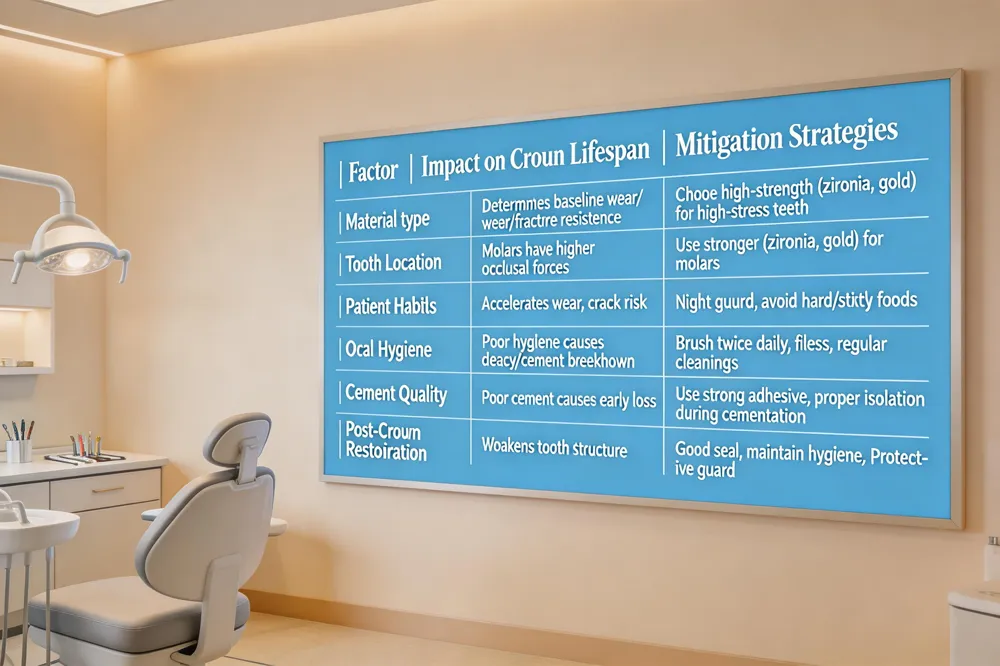 Dental crowns typically survive 10‑15 years, but material, location, and patient habits can shift that range. Front‑tooth crowns—often porcelain‑fused‑to‑metal, lithium disilicate, or high‑strength zirconia—last 5‑15 years, with material or premium zirconia extending to 20 years or more when oral hygiene is meticulous. Porcelain crowns on front teeth average 10‑15 years and may reach 20‑30 years if the patient avoids grinding, hard foods, and maintains regular cleanings (source). The common 10‑year lifespan reflects material wear (especially porcelain), marginal decay, cement degradation, and occlusal stress from bruxism or using teeth as tools (factors affecting longevity). Molars endure greater bite forces; crowns there generally last 10‑15 years, but zirconia or gold‑alloy restorations can survive 20 years+ with proper care (Cleveland Clinic). For molars, high‑strength zirconia and gold crowns offer the best durability and minimal wear on opposing teeth (material guide). After a root‑canal, crowns usually function 10‑15 years, extending toward 20 years when the tooth is well‑sealed, the patient practices diligent brushing, flossing, and uses a night guard if grinding (Dental Theory). Regular six‑month check‑ups and professional cleanings are essential to detect early decay, cracks, or marginal loss, preserving the restoration’s lifespan (Dental Depot).
Clinical Procedure and Professional Skill
| Step | Description | Approximate Time | Critical Skill |
|---|---|---|---|
| 1. Examination & X‑ray | Assess tooth health, plan restoration | 15‑30 min | Diagnostic accuracy |
| 2. Anesthesia & decay removal | Numb area, eliminate caries | 10‑20 min | Gentle tissue handling |
| 3. Tooth preparation | Reduce 1.5‑2 mm, create taper & margin | 20‑30 min | Precise reduction, margin design |
| 4. Impression / digital scan | Capture anatomy for lab or CAD/CAM | 5‑10 min | Accurate capture |
| 5. Temporary crown placement | Protect prepared tooth | 5‑10 min | Proper fit & seal |
| 6. Laboratory fabrication (or CAD/CAM) | Create permanent crown (1‑2 weeks or same‑day) | — | Material handling, milling accuracy |
| 7. Try‑in & adjustment | Check fit, occlusion, aesthetics | 10‑15 min | Fine‑tuning contacts & shade |
| 8. Cementation | Secure crown with adhesive | 5‑10 min | Clean field, proper cement selection |
| 9. Post‑cement check | Verify bite, give care instructions | 5‑10 min | Patient education |
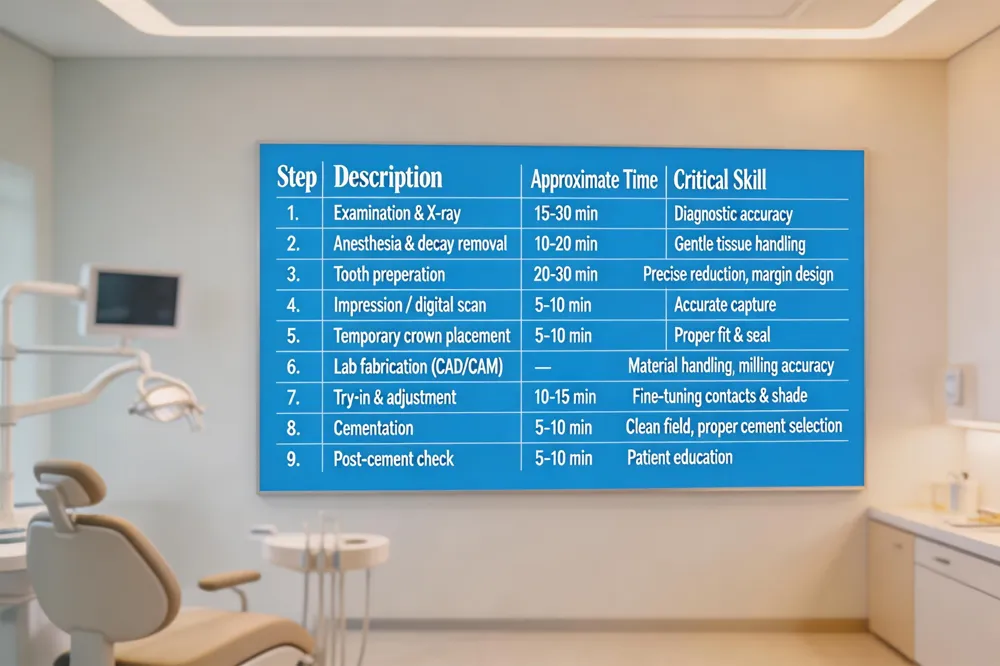 Dental crown procedure – The visit begins with a thorough exam and X‑ray, followed by local anesthesia. Decay is removed, the tooth is reshaped (≈1.5‑2 mm reduction) and a smooth, rounded preparation is made. An impression or digital scan is taken, a temporary crown placed, and the permanent crown is fabricated (1‑2 weeks). At the final appointment the temporary crown is removed, the permanent piece is checked for fit, bite and aesthetics, and then cemented with a strong dental adhesive. Proper oral hygiene and regular check‑ups can keep it functional for many years.
Preparing a tooth for a crown – After anesthesia, the dentist eliminates decay, cleans the tooth, and reduces its size to create space for the restoration while preserving as much natural enamel as possible. Proper taper and margin design are essential for a precise fit and seal.
What not to do with a dental crown? – Avoid chewing hard, sticky or crunchy foods for 24‑48 hours, do not use the crowned tooth as a tool, and refrain from aggressive flossing until the cement fully sets. Smoking and chewing tobacco should also be avoided.
Dental cap vs crown – "Cap" is an older term for the same full‑coverage restoration; today "crown" is the preferred terminology.
Disadvantages of dental crowns – They require removal of healthy enamel, can cause post‑procedure sensitivity, are costly, and may chip (porcelain) or cause allergic reactions (metal). Poor fit can lead to decay beneath the crown.
Can dental crowns cause cancer? – No. Modern crown materials are FDA‑approved, biocompatible, and have no carcinogenic properties. The cancer myth is unsupported by scientific evidence.
Patient Lifestyle and Maintenance Practices
| Habit / Lifestyle Factor | Effect on Crown | Recommended Practice |
|---|---|---|
| Brushing twice daily with fluoride toothpaste | Removes plaque, protects margins | Use soft brush, gentle strokes |
| Daily flossing (avoid aggressive flossing until cement sets) | Prevents interproximal decay | Floss carefully around crown |
| Antimicrobial mouthwash | Reduces bacterial load | Use as adjunct, not substitute |
| Dietary choices (hard, sticky, acidic foods) | Increases risk of chipping, cement erosion | Avoid ice, nuts, caramel; limit citrus/cola |
| Smoking & alcohol | Accelerates gum recession, plaque buildup | Cease smoking, limit alcohol |
| Regular dental check‑ups (every 6 months) | Early detection of cracks, decay, marginal loss | Schedule and attend appointments |
| Night guard for bruxism | Cushions forces, reduces cracks | Wear nightly, ensure proper fit |
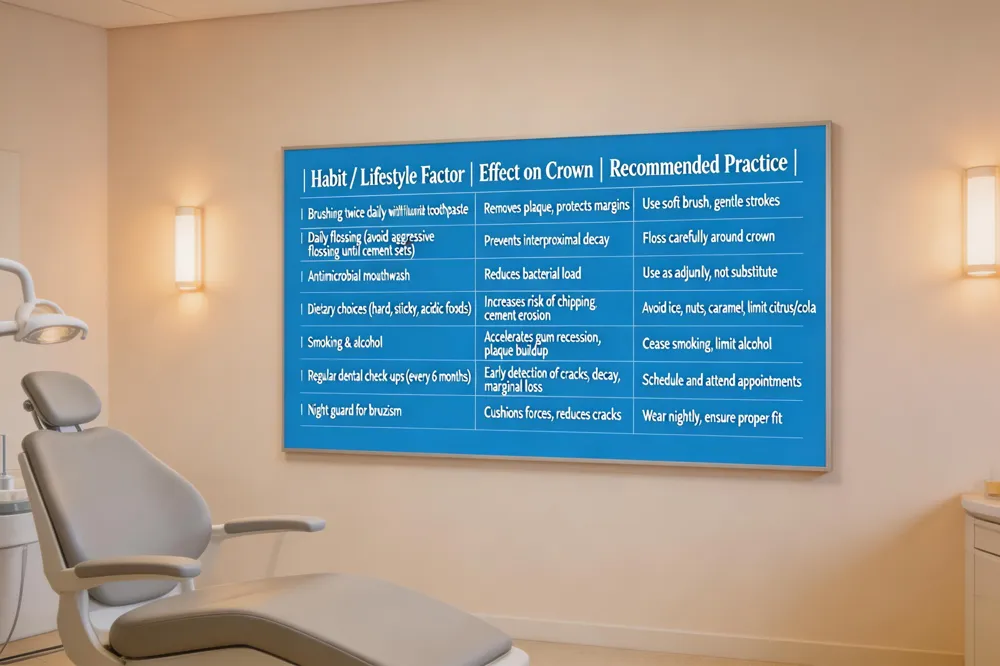 Maintaining dental crowns hinges on daily habits and periodic professional care. Oral hygiene habits such as brushing twice a day with fluoride toothpaste, daily flossing, and antimicrobial mouthwash keep plaque away from crown margins and prevent secondary decay. Dietary impacts matter: avoiding extremely hard foods (ice, nuts) and sticky substances (caramel, gum) reduces the risk of chipping or dislodgement, while limiting acidic drinks protects the bonding cement. Smoking and alcohol effects accelerate gum recession and plaque buildup, undermining crown stability. Regular check‑ups every six months enable early detection of cracks, marginal leakage, or gum disease, allowing timely interventions.
How many 70‑year‑olds still have all their teeth? Approximately 4 %–5 % retain a full natural dentition; most have lost at least one tooth due to cumulative disease and wear.
What is the 3‑3‑3 rule for teeth? It is an informal guideline recommending brushing three times daily for three minutes and avoiding food for three hours before bedtime; professional advice favors twice‑daily, two‑minute brushing.
What is the 50‑40‑30 rule in dentistry? It describes smile aesthetics: central incisors occupy ~50 % of visible width, central‑to‑lateral contacts ~40 %, and lateral‑to‑canine contacts ~30 %, guiding harmonious restorative proportions.
Special Cases: Pediatric and Advanced Materials
| Crown Type | Typical Indication | Pros | Cons | Approx. Cost |
|---|---|---|---|---|
| Pre‑formed stainless‑steel | Primary molars, high durability | Very strong, inexpensive | Metallic appearance | $100‑$200 |
| Resin‑veneered stainless steel | Primary anterior teeth, better aesthetics | Improved appearance over steel | Less durable, technique‑sensitive | $150‑$250 |
| Zirconia ceramic | Primary or permanent teeth needing aesthetics | Tooth‑colored, biocompatible, strong | Higher cost, requires milling | $300‑$500 |
| Composite strip crown | Primary front teeth, natural look | Excellent aesthetics, easy to place | Technique‑sensitive, less durable | $200‑$350 |
| Polycarbonate acrylic | Temporary or interim restorations | Low cost, easy to adjust | Low strength, short lifespan | $80‑$150 |
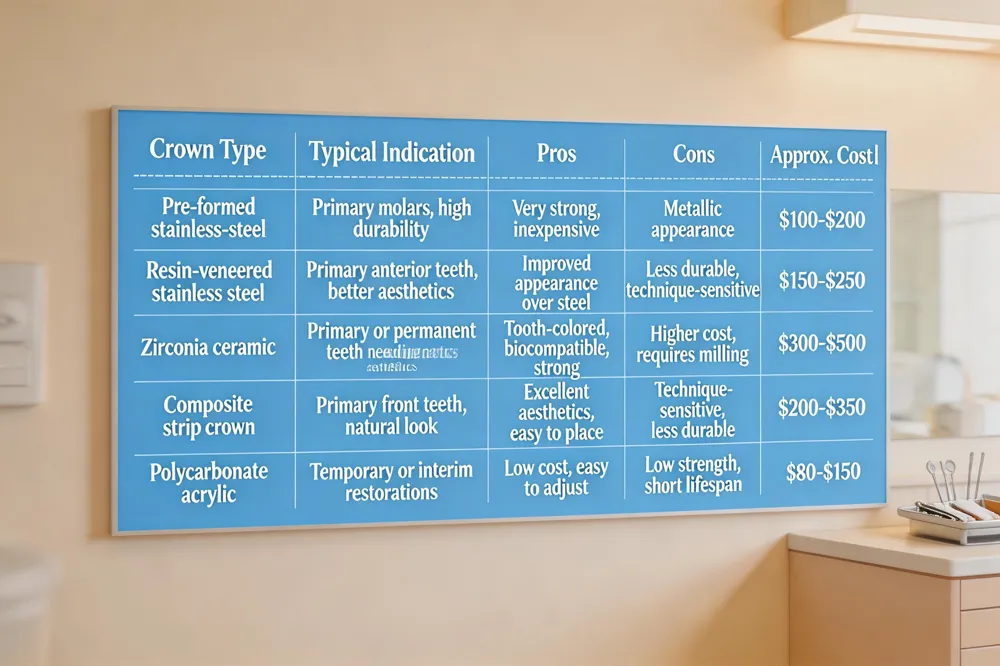 Children’s crowns fall into five categories: pre‑formed stainless‑steel crowns (durable but metallic); resin‑veneered stainless steel (better aesthetics); zirconia ceramic crowns (tooth‑colored, strong, biocompatible but costlier); composite strip crowns (natural look for front teeth, technique‑sensitive); and polycarbonate acrylic crowns (low‑cost, less durable). Selection depends on tooth location, allergy, appearance, and budget.
A zirconia crown is a high‑strength, metal‑free ceramic restoration made from zirconium dioxide. It can be milled as a monolithic piece or layered with porcelain, often lasting 15 years or more while resisting chipping. Same‑day CAD/CAM technology enables design, milling, and placement in one visit, eliminating temporary crowns.
Night guards protect crowns in bruxism patients by cushioning excessive forces, reducing cracks and loosening. Regular use of a night guard can extend crown life by up to 80 % in bruxism patients. Future trends include bio‑active ceramics that release fluoride, AI‑driven design for optimal fit, and 3‑D‑printed multi‑material crowns that blend strength with translucency. Emerging digital workflows also promise faster, more accurate milling, further improving long‑term outcomes.
Takeaway and Next Steps
Dental crowns can last 10‑30 years when the right material, precise fit, and diligent care are combined. Key factors that influence longevity include the crown material (metal or high‑strength zirconia outlast porcelain), oral hygiene habits, bite forces such as bruxism, diet (avoiding hard, sticky, and acidic foods), and the skill of the dentist in preparation and cementation. Personalized care matters—your dentist should assess tooth position, remaining structure, and lifestyle to choose the optimal material and recommend a night guard or dietary adjustments as needed. For residents of Paterson, schedule a comprehensive evaluation with a trusted local practice, maintain twice‑daily brushing and flossing, and attend regular six‑month check‑ups. Your proactive steps today protect the health of your restored tooth for years to come.