Understanding Single‑Visit Restorations
Why same‑day dentistry matters: Using CAD/CAM technology, a digital scan can be turned into a custom crown or veneer while the patient waits, eliminating temporary restorations, multiple appointments, and the inconvenience of traditional impressions. This expedites treatment, reduces chair‑time anxiety, and often lowers overall cost.
Key differences between crowns and veneers: A fixed crown is a full‑coverage cap that requires 1.5‑2 mm of tooth reduction, offers superior strength for chewing, and is ideal for cracked, root‑treated, or heavily filled teeth. A removable (or bonded) veneer is an ultra‑thin porcelain or composite shell that covers only the front surface, needs minimal enamel removal (≈0.3‑0.7 mm), and is chosen for cosmetic issues such as stains, chips, or small gaps on healthy front teeth.
What to expect during a one‑visit appointment: The dentist takes a 3‑D intra‑oral scan, designs the restoration on a computer, mills it on‑site, and then either permanently cements the crown or bonds the veneer—all within 1–2 hours. Patients receive personalized shade matching, a comfortable fit, and post‑care instructions for brushing, flossing, and, if needed, a nightguard to protect the new restoration.
Cost Comparison: Crowns, Veneers and Bonding
Cost Comparison (Paterson, NJ)
| Restoration | Typical Price per Tooth | Insurance Coverage | Key Notes |
|---|---|---|---|
| Porcelain Crown | $1,200 – $2,500 | Often considered medically necessary; 40‑60 % reimbursed | Premium materials (zirconia, all‑porcelain) drive higher end price |
| Porcelain Veneer | $800 – $1,500 | Rarely covered (cosmetic) | Thin, aesthetic; requires minimal prep |
| Composite Veneer | $500 – $1,200 (set) | Not covered | Cheaper, less durable than porcelain |
| Removable Partial‑Veneer Appliance | $500 – $1,200 (set) | Not covered | Can be taken out for cleaning; lower durability |
| Same‑Day CAD/CAM Crown/Veneer | Variable (often $1,500 – $2,200) | Same as conventional crowns/veneers | No lab fees; completed in one visit |
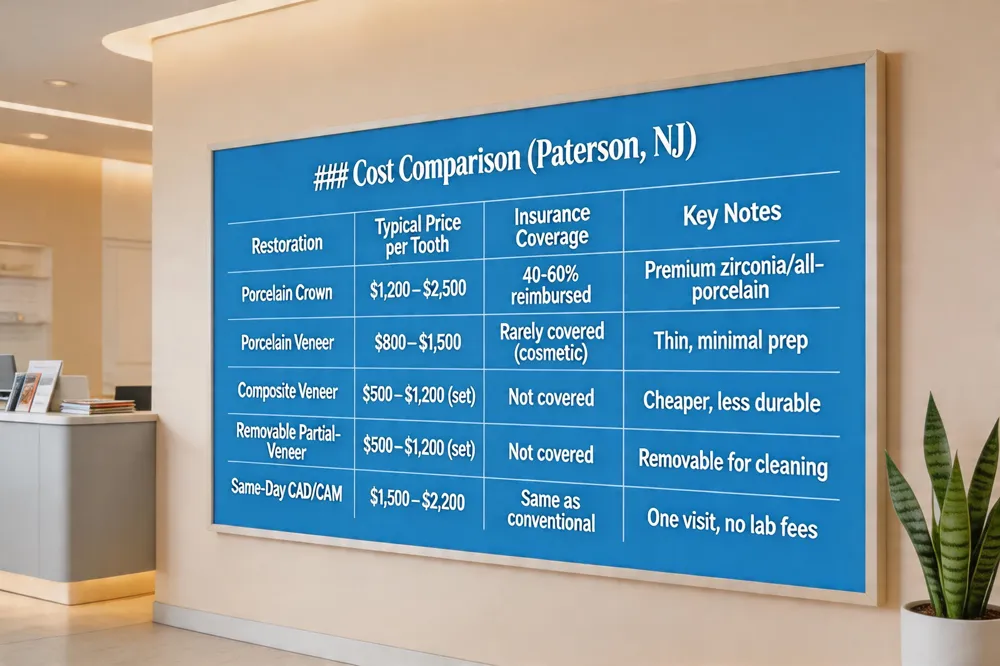 Typical price ranges in Paterson, NJ: a porcelain crown costs $1,200‑$2,500 per tooth, while a porcelain veneer runs $800‑$1,500. Composite veneers are cheaper, and removable partial‑veneer appliances cost $500‑$1,200 for a set. Factors that affect cost include material choice (zirconia, all‑porcelain, metal‑ceramic), laboratory fees, extent of tooth preparation, need for root‑canal or buildup, and whether same‑day CAD/CAM technology is used. Insurance coverage considerations: crowns are often deemed medically necessary and may be reimbursed 40‑60 % by dental plans; veneers are usually cosmetic and rarely covered, so patients pay out‑of‑pocket. $2,000 for a crown is on the higher end but reasonable for premium materials and full‑coverage restoration, especially when insurance offsets part of the fee.
Pros and Cons of Fixed Crowns and Removable Veneers
Fixed Crowns vs. Removable Veneers
| Feature | Fixed Crown | Removable Veneer |
|---|---|---|
| Strength & Durability | Full coverage, withstands heavy chewing; lasts 10‑15 + years | Thin shell, can chip or detach; lasts 7‑10 years |
| Tooth Preparation | Removes 1.5‑2 mm around entire tooth | Removes 0.3‑0.5 mm enamel on facial surface (or no prep) |
| Aesthetic Outcome | Highly natural with porcelain/zirconia; may affect speech slightly | Very natural look; may affect speech less, but less stable |
| Comfort | Permanent, no removal needed | Can be removed for cleaning; may feel less stable |
| Cost | Higher (lab fees, materials) | Lower (less material, no lab) |
| Invasiveness | More invasive | Minimal or non‑invasive |
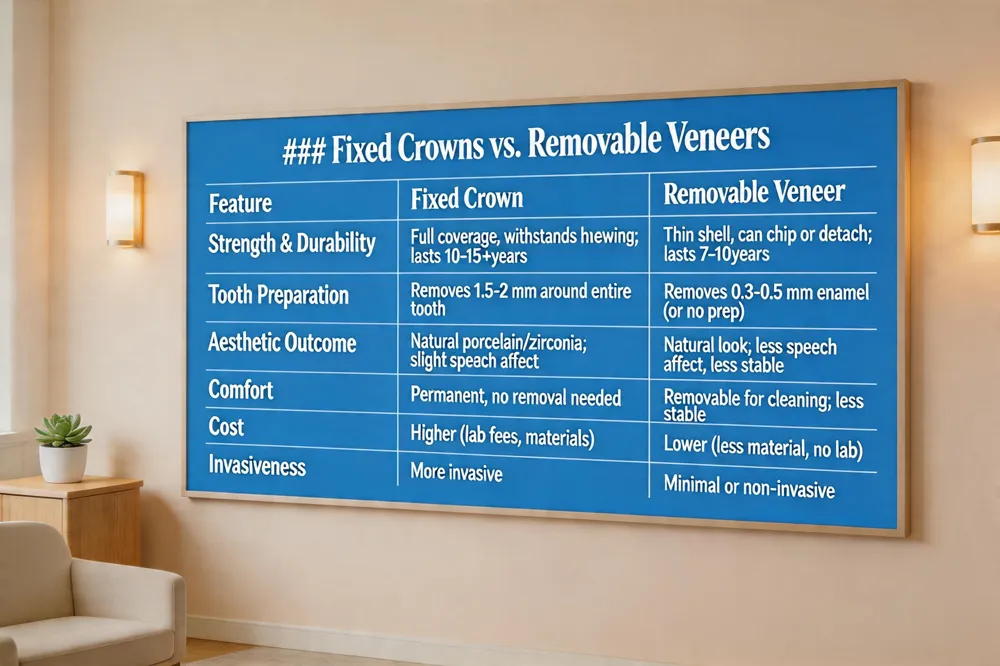 Fixed crowns and removable veneers differ dramatically in strength, preparation, aesthetics, and comfort.
Strength and durability – A fixed crown encircles the entire tooth, providing full coverage and the ability to withstand heavy chewing and grinding forces; it typically lasts 10–15 years or longer with good care. Removable veneers cover only the front surface, are thinner, and can chip or detach under excessive load, usually lasting 7–10 years.
Tooth preparation required – Crown preparation removes 1.5–2 mm of tooth structure around the whole tooth to create space for the restoration. Veneer preparation is far more conservative, often requiring only 0.3–0.5 mm of enamel reduction on the facial surface, or sometimes no prep at all.
Aesthetic outcomes and patient comfort – Crowns can be crafted from porcelain, zirconia, or metal‑ceramic to match natural teeth, but the extensive reduction may be a concern for some patients. Veneers preserve most natural tooth tissue, give a highly natural smile, and can be taken out for cleaning, though they may affect speech and feel less stable during chewing.
Fixed crown vs removable veneer pros and cons – A fixed crown offers maximum strength, long‑term durability, and full structural protection, but it is more invasive, costly, and permanent. A removable veneer is less invasive, cheaper, and reversible, yet it is less durable, may affect chewing and speech, and usually needs replacement sooner. The final decision hinges on the tooth’s condition, functional needs, budget, and the patient’s comfort with a permanent vs. a take‑out restoration.
Longevity, Materials and Smile Design Rules
Longevity & Materials
| Restoration | Typical Lifespan | Common Materials | 4‑8‑10 Rule Note |
|---|---|---|---|
| All‑Ceramic/Porcelain Crown | 15‑20 years (up to 30 years for gold) | Zirconia, all‑porcelain, metal‑ceramic, gold | – |
| Porcelain Veneer | 10‑15 years | Porcelain (thin shell) | – |
| Composite Veneer | 5‑7 years | Composite resin | – |
| Bonding (Composite) | 3‑7 years | Composite resin | – |
| Smile Design (Veneers) | – | – | 4‑8‑10 rule: 4 veneers for central/lateral incisors only; 8 for full front teeth; 10 when first premolars are visible |
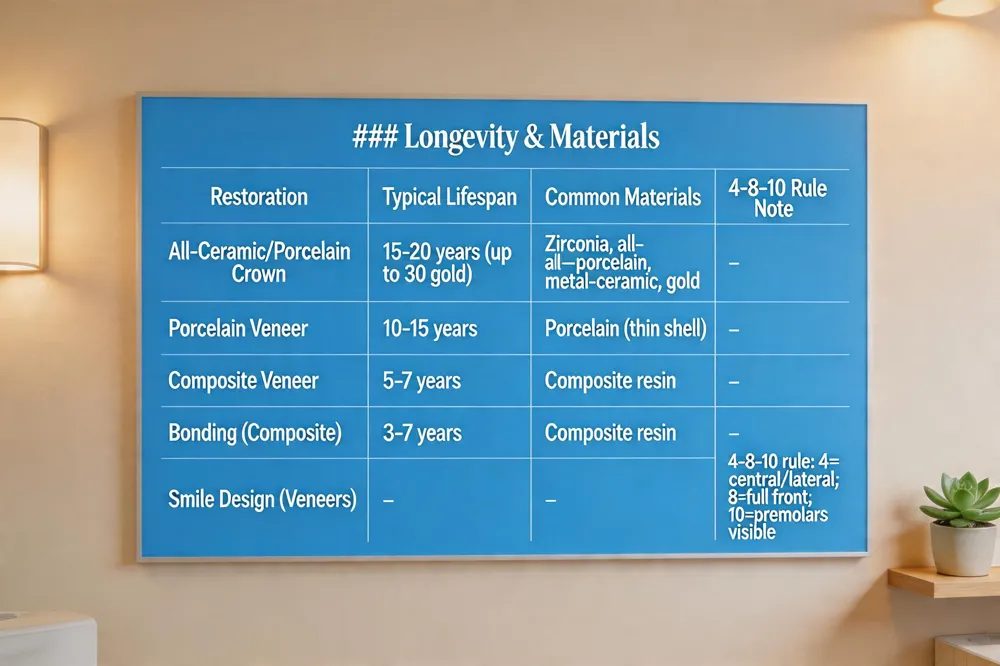 Crowns generally outlast veneers. High‑quality porcelain or all‑ceramic crowns can survive 15‑20 years, and gold crowns may last up to 30 years, while porcelain veneers typically last 10‑15 years and composite veneers only 5‑7 years. The longer lifespan comes from full‑coverage protection and stronger materials such as zirconia or metal‑based alloys, which resist chewing forces better than ultra‑thin veneer shells.
The 4‑8‑10 rule is a smile‑design guideline that matches veneer placement to the number of teeth visible in a patient’s natural smile: four veneers for just the central and lateral incisors, eight when the full upper and lower front teeth show, and ten when the first premolars are also exposed. This ensures a balanced, natural look without over‑treating.
Before treatment, teeth may be discolored, chipped, or misaligned; after porcelain veneers or crowns, the smile looks smoother, whiter, and more evenly spaced, with restored function and confidence.
Clinical Decision Making: Veneers, Crowns or Bonding?
Clinical Decision Matrix
| Restoration | Ideal Indications | Tooth Health Requirement | Aesthetic Capability | Relative Cost |
|---|---|---|---|---|
| Veneer | Front‑tooth cosmetic issues (stains, minor chips, gaps, slight mis‑alignment) | Healthy enamel, no structural damage | High shade‑matching, natural translucency | Moderate |
| Crown | Extensive decay, large fillings, fractures, post‑root‑canal, need for full coverage | Compromised tooth structure, need reinforcement | Good translucency, but less aesthetic than veneers for minor | |
| Bonding | Small chips, tiny gaps, minor reshaping, quick fix | Minimal to no reduction needed | Acceptable shade‑match for minor corrections | Low |
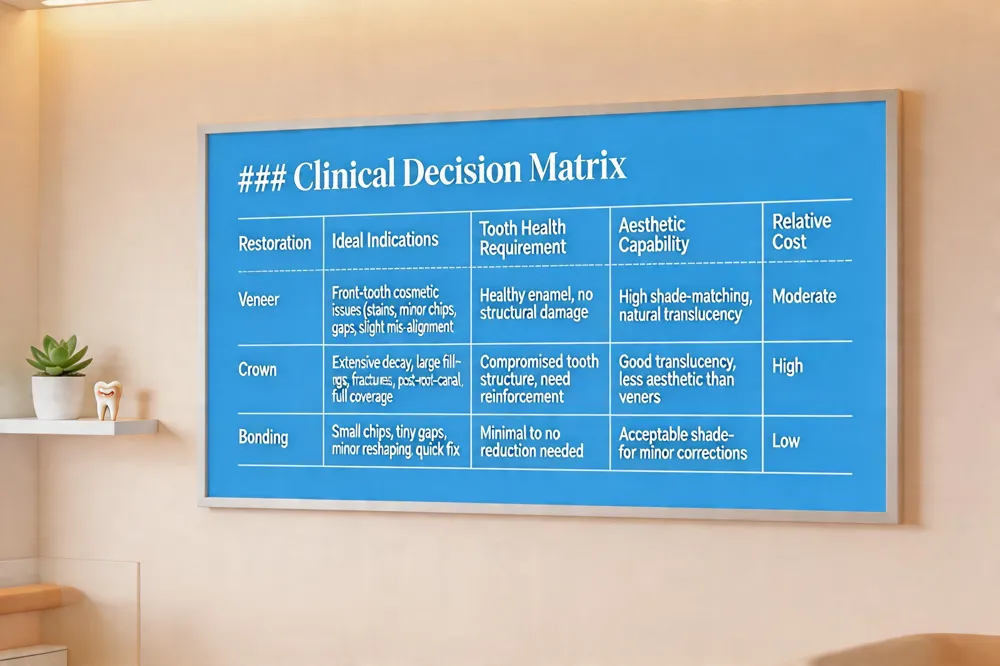 Choosing the right restoration hinges on three primary considerations: the health of the underlying tooth, the patient’s aesthetic goals, and budget constraints.
When to choose each restoration:
- Veneers are ideal for front‑tooth cosmetic issues—stains, minor chips, gaps, or slight mis‑alignment—when the tooth is structurally sound.
- Crowns are indicated for teeth with extensive decay, large fillings, fractures, or after root‑canal therapy, providing full coverage and strength.
- Bonding serves as a minimally invasive, cost‑effective fix for small chips, tiny gaps, or minor reshaping.
Factors to weigh:
- Tooth health: severe damage demands a crown; healthy enamel favors a veneer or bonding.
- Aesthetics: veneers and bonding can be shade‑matched, but crowns offer superior translucency for larger restorations.
- Budget: bonding is cheapest, veneers are moderate, and crowns are the most expensive due to material and lab fees.
Role of bonding: Composite resin bonding requires little to no tooth reduction, can be completed in a single visit, and lasts 3‑7 years, making it perfect for patients seeking a quick, reversible solution.
Bottom line: Opt for veneers when aesthetics and moderate durability are needed, crowns for structural reinforcement and long‑term function, and bonding for minor, budget‑friendly corrections. Your dentist will evaluate damage extent, desired longevity, and financial preferences to recommend the optimal treatment.
Same‑Day Restorations at David M. Mayer DMD
Same‑Day CAD/CAM (CEREC) Workflow
| Feature | Details |
|---|---|
| Technology | Chair‑side CAD/CAM with CEREC; intra‑oral scanning, digital design, on‑site milling |
| Visit Count | Single appointment (design, mill, place) |
| Materials Used | Porcelain, zirconia, composite |
| Benefits | Precise fit, natural aesthetics, reduced overall cost (no external lab), no temporary crowns |
| Language Support | English, Spanish, Arabic |
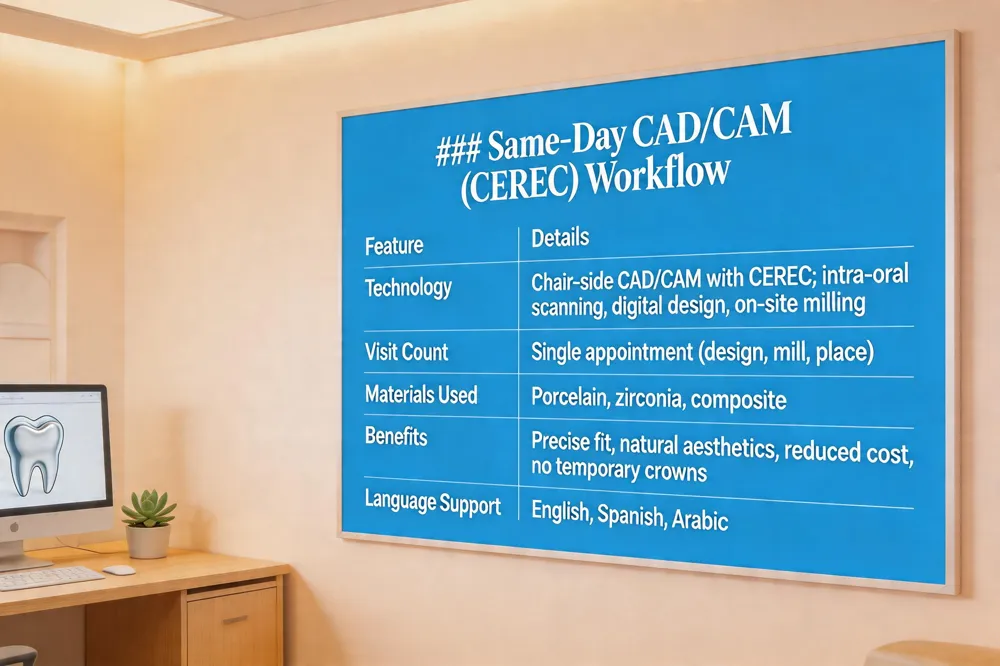 David M. Mayer DMD in Paterson, NJ utilizes chair‑side CAD/CAM and CEREC technology to design, mill, and place crowns or veneers in a single visit. After a quick intra‑oral scan, the tooth’s 3‑D image is sent to a computer where the restoration is digitally designed to match the patient’s shade and shape. An on‑site milling unit then fabricates the porcelain, zirconia, or composite restoration while the patient waits, eliminating the need for temporary crowns or multiple appointments. The benefits of this one‑visit workflow include precise fit, natural aesthetics, reduced treatment time, and lower overall cost since no lab fees or extra visits are required. The practice’s multilingual team—fluent in English, Spanish, and Arabic—ensures clear communication and a comfortable experience for a diverse patient base, offering compassionate care and personalized explanations of the same‑day option.
Local Practice and Emergency Care Information
Practice & Emergency Info
| Service | Details |
|---|---|
| Address | 32 Hine Street, downtown Paterson, NJ (main office) |
| Emergency Line | (973) 742‑1991 |
| Emergency Services | Same‑day treatment for severe pain, broken teeth, infections, etc. |
| Additional Location | 318 21st Ave, Paterson, NJ 7501 (alternate office) |
| Multilingual Team | English, Spanish, Arabic |
| Nearby Alternative | Park Dental – 21 Mill Street, Suite 3 (bilingual staff, extended hours) |
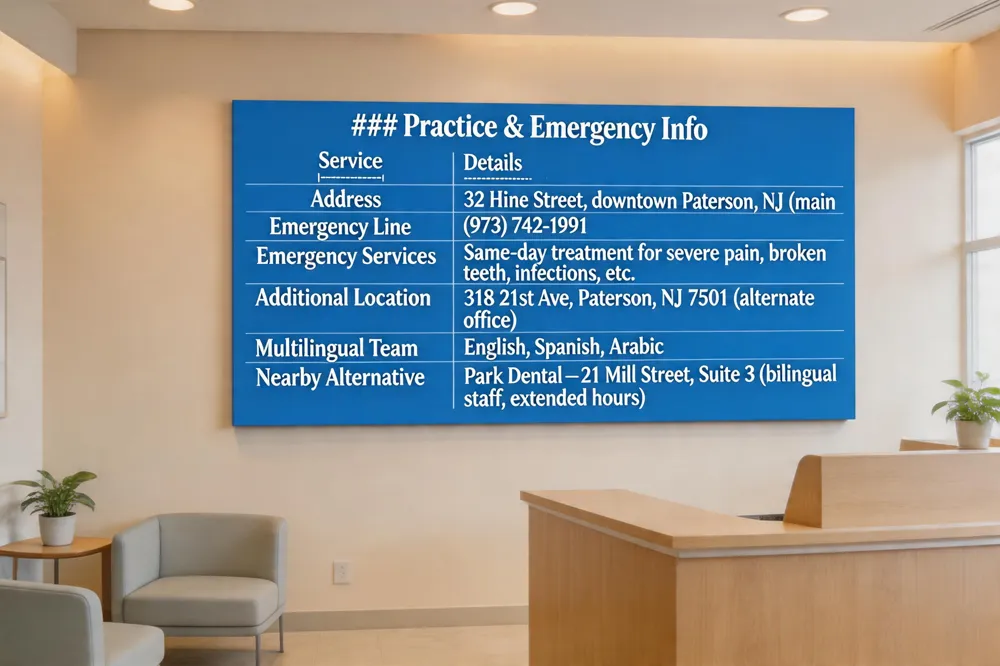 David M. Mayer DMD serves Paterson, NJ from a conveniently located office at 32 Hine Street, downtown Paterson. The modern clinic offers a full suite of adult, family and pediatric services—including routine cleanings, same‑day crowns, implants and denture repairs—delivered by a multilingual team (English, Spanish, Arabic) fluent in English, Spanish and Arabic. For urgent oral problems, Dr. Mayer provides same‑day emergency care throughout Paterson, NJ, treating severe pain, broken teeth, infections and more in a single visit when possible. Patients can reach the emergency line at (973) 742‑1991 or visit the office at 318 21st Ave, Paterson, NJ 7501. Nearby, Park Dental at 21 Mill Street, Suite 3 offers comparable comprehensive care with bilingual staff and extended hours, making it a convenient alternative for emergency and routine appointments in the Paterson community.
Making the Right Choice in One Visit
Choosing between a fixed crown and a removable veneer hinges on three main factors: the amount of structural damage, the patient’s aesthetic goals, and functional needs such as chewing strength or bruxism. Crowns provide full coverage, durability, and are ideal for heavily restored, cracked or root‑treated teeth, while veneers preserve most natural tooth structure and excel for minor cosmetic concerns on healthy front teeth. Modern CAD/CAM technology lets both restorations be designed, milled, and placed in a single appointment, eliminating temporary prostheses and reducing overall treatment time. At David M. Mayer DMD, our multilingual team uses same‑day digital scanning and chair‑side milling to deliver a personalized solution that matches your smile, budget, and lifestyle. Schedule a consultation today to discuss the best option for your unique needs.