Why Stress‑Free Emergency Care Matters
Dental anxiety affects up to 36 % of adults and often leads patients to postpone or avoid treatment. When fear intensifies, oral hygiene may decline, cavities go untreated, and minor issues become serious emergencies, increasing pain, infection risk, and overall health costs. A stress‑free emergency experience breaks this cycle. By preparing a dental emergency kit, knowing the office’s after‑hours line, and practicing relaxation techniques such as deep breathing, patients reduce panic and arrive ready for prompt care. Clear communication with a multilingual, compassionate team allows procedures to be explained, sedation options to be offered, and distractions like music or headphones to be used, further easing nerves. When anxiety is managed, dentists can focus on rapid diagnosis, digital imaging, and definitive treatment—whether re‑implanting a knocked‑out tooth, placing a temporary crown, or draining an abscess. The result is faster pain relief, lower complication rates, and a stronger, lasting trust between patient and provider.
Understanding What Qualifies as a Dental Emergency
| Emergency Type | Key Features |
|---|---|
| Uncontrolled oral bleeding | Persistent bleeding that cannot be stopped with pressure; may indicate laceration or vascular injury |
| Knocked‑out (avulsed) tooth | Tooth completely displaced from socket; requires immediate re‑implantation or preservation |
| Cracked or fractured tooth | Visible fracture or pain on biting; risk of pulp exposure |
| Rapidly spreading abscess | Facial or jaw swelling, fever, pus; threat of deep‑space infection |
| Severe toothache unresponsive to OTC meds | Pain lasting >24 hrs, throbbing, may indicate pulpitis or infection |
| Soft‑tissue injuries (deep cuts to lips, cheeks, gums) | Requires suturing or hemostasis to prevent infection |
| Lost or broken restoration exposing pulp | Crown, filling, or bridge broken exposing dentin/pulp causing pain |
| Facial swelling threatening airway | Rapid expansion causing breathing difficulty; emergency airway management needed |
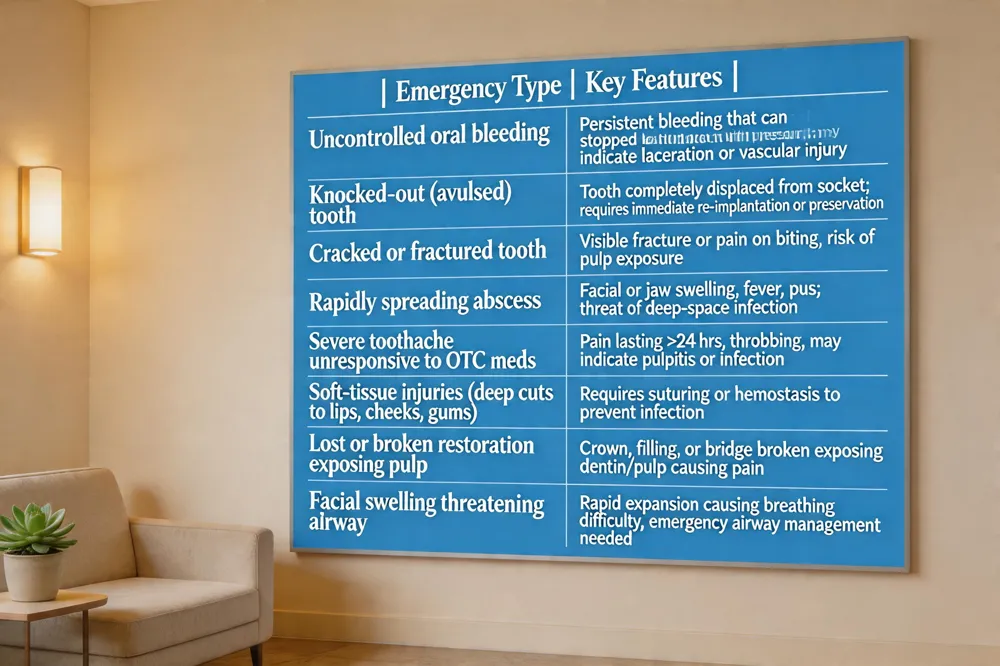 A dental emergency is any oral condition that demands immediate professional attention to stop bleeding, control severe pain, prevent infection, or protect the airway. Common urgent conditions include uncontrolled oral bleeding, a knocked‑out or loosely displaced tooth, a cracked or fractured tooth, and facial swelling that threatens breathing. Severe toothache that does not respond to over‑the‑counter medication, a rapidly spreading dental abscess, and deep soft‑tissue injuries such as a busted lip or a deep cut in the gums also require prompt care. Infections that cause fever, pus, or quick swelling, as well as lost or broken restorations (crown, filling, bridge) that expose the pulp or cause pain, are classified as emergencies. Delaying treatment can lead to complications such as tooth loss, deep‑space infection, systemic spread of bacteria, or airway compromise.
Examples of dental emergencies include:
- A relentless toothache that persists despite ibuprofen or acetaminophen.
- Traumatic injuries like a cracked or broken tooth, a knocked‑out (avulsed) tooth, or a partially displaced (extruded) tooth.
- Rapidly swelling abscesses, facial or jaw pain, and uncontrolled bleeding after trauma.
- Lost or damaged restorations that expose the tooth or cause irritation.
- Severe soft‑tissue injuries (deep cuts to lips, cheeks, or gums) and broken braces or wires that puncture oral tissues.
Prompt evaluation and treatment are essential to preserve oral health, prevent infection, and avoid more extensive, costly procedures later.
Managing Dental Anxiety During Emergencies
| Strategy | Description |
|---|---|
| Clear communication & language options | Dentist speaks slowly, uses patient’s preferred language (English, Spanish, Arabic) and explains each step |
| Relaxation & breathing techniques | Deep breathing, visualization, guided imagery before and during treatment |
| Distraction tools | Headphones with music/audiobooks, TV screen to shift focus away from dental drill |
| Sedation options | Nitrous oxide, oral sedatives, IV sedation for moderate‑to‑severe anxiety |
| Behavioral approaches | Gradual exposure, positive reinforcement, “stop‑signal” hand gesture for patient control |
| Multilingual support | Staff fluent in English, Spanish, Arabic to reduce language‑related stress |
| Pre‑visit preparation | Provide written instructions, FAQ sheets, and visual aids to set expectations |
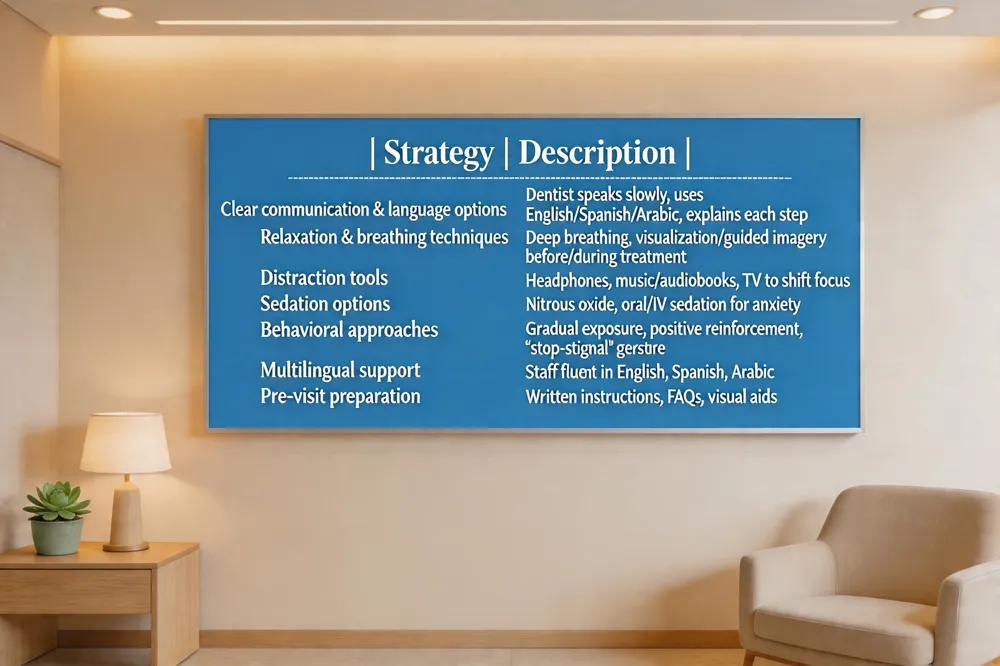 Clear communication and language options are the foundation of a calm emergency visit. Dentists greet patients in a friendly tone, speak slowly, and often use the patient’s preferred language—English, Spanish, or Arabic—to explain what will happen step‑by‑step. Knowing the plan reduces fear of the unknown and lets patients ask questions before treatment begins.
Relaxation, breathing, and distraction techniques are next tools. Deep breathing and visualization techniques calm nerves before and during visits. Many offices provide headphones for music, audiobooks and even a TV screen, allowing the mind to focus away from the drill. These simple methods lower heart rate and pain perception.
When anxiety is moderate to severe, sedation and behavioral strategies are offered. Nitrous oxide, oral sedatives, or IV sedation can keep patients relaxed yet conscious. Behavioral approaches such as gradual exposure—starting with short, non‑invasive appointments—positive reinforcement after each successful visit, and a “stop‑signal” hand gesture let patients control the pace of care.
How do dentists deal with anxious patients? Dentists first create a calm environment by speaking clearly and kindly, often in the patient’s preferred language, and explaining each step of the procedure so the patient feels informed and in control. They use gentle, minimally invasive techniques and may offer coping tools such as deep‑breathing, guided imagery or distraction devices to reduce stress. When anxiety is moderate to severe, they can provide pharmacologic options—including nitrous oxide, oral sedatives, or IV sedation to keep the patient relaxed yet conscious. Behavioral strategies like progressive exposure, positive reinforcement, and a “stop‑signal” system let patients pause if they become uncomfortable. Together, these communication, comfort, and sedation measures help anxious patients receive necessary dental care safely and comfortably.
Financial Options When You Have No Insurance or Money
| Option | Details |
|---|---|
| Same‑day cash‑price estimate | Transparent pricing provided before treatment begins |
| Flexible payment plans | Low‑interest or interest‑free installments spread over weeks/months |
| Sliding‑scale discounts | Reduced fees based on income or financial hardship |
| Third‑party financing (e.g., CareCredit) | Credit line approved at point of service for larger procedures |
| Community health centers & charitable clinics | Referrals to free or reduced‑fee emergency dental services |
| Dental‑school programs | Access to supervised student care at minimal cost |
| Medicaid & insurance eligibility assistance | Guidance on applying for public insurance programs |
| 211 resource referral | Phone/online service for locating local low‑cost providers |
| OTC pain management guidance | Ibuprofen, cold compress, warm salt‑water rinse while awaiting care |
| Multilingual cost counseling | Explanation of all fees in English, Spanish, or Arabic upfront |
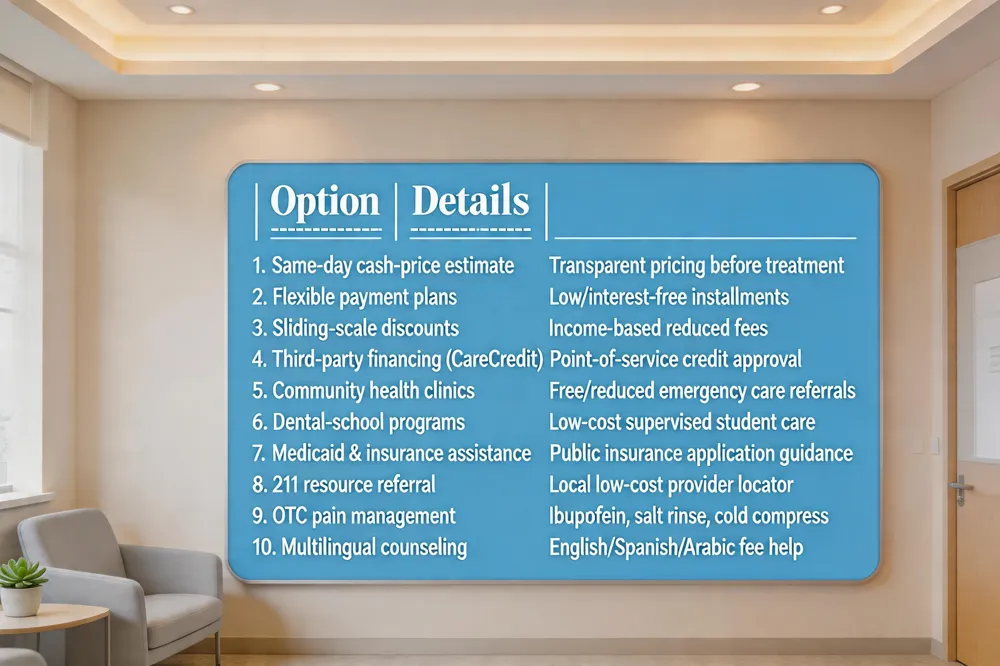 Dental emergencies can be frightening, especially when you lack insurance or funds. Our Paterson office offers low‑cost emergency treatment pathways that begin with a same‑day appointment and a transparent cash‑price estimate. We provide a range of financing options—including flexible payment plans, sliding‑scale discounts, and third‑party financing such as CareCredit—to ensure you can receive prompt care without delay. If you cannot afford treatment, we will refer you to community health centers, charitable clinics, and dental‑school programs that provide free or reduced‑fee emergency services. You can also call 211 or visit 211.org for a list of local low‑cost providers. While awaiting care, manage pain with OTC ibuprofen, a cold compress, and a warm salt‑water rinse. Our multilingual team (English, Spanish, Arabic) will walk you through every step, explain all costs up front, and help you explore Medicaid eligibility or other insurance options. Call us today or schedule online; we are committed to delivering compassionate, affordable emergency dental care for everyone, regardless of insurance status.
What to Expect During Your Emergency Dental Visit
| Step | What Happens |
|---|---|
| Triage (phone) | Symptoms, pain level, medical history, medications confirmed |
| Arrival & check‑in | Contact and insurance details verified; multilingual staff assist |
| Initial exam | Focused oral exam; dentist assesses urgent issue |
| Digital X‑rays | Immediate imaging to detect hidden cracks, infection, bone loss |
| Pain control | Local anesthesia, numbing gel, nitrous oxide or oral sedation as needed |
| Diagnosis explanation | Plain‑language discussion of findings and treatment options |
| On‑site treatment | Temporary crown, filling, root canal, abscess drainage, stabilization, or extraction |
| After‑care instructions | Soft diet, ice packs, salt‑water rinses, medication guidance |
| Prescription & follow‑up | Medications prescribed; appointment scheduled for definitive care |
| Documentation | Treatment notes and cost summary provided in preferred language |
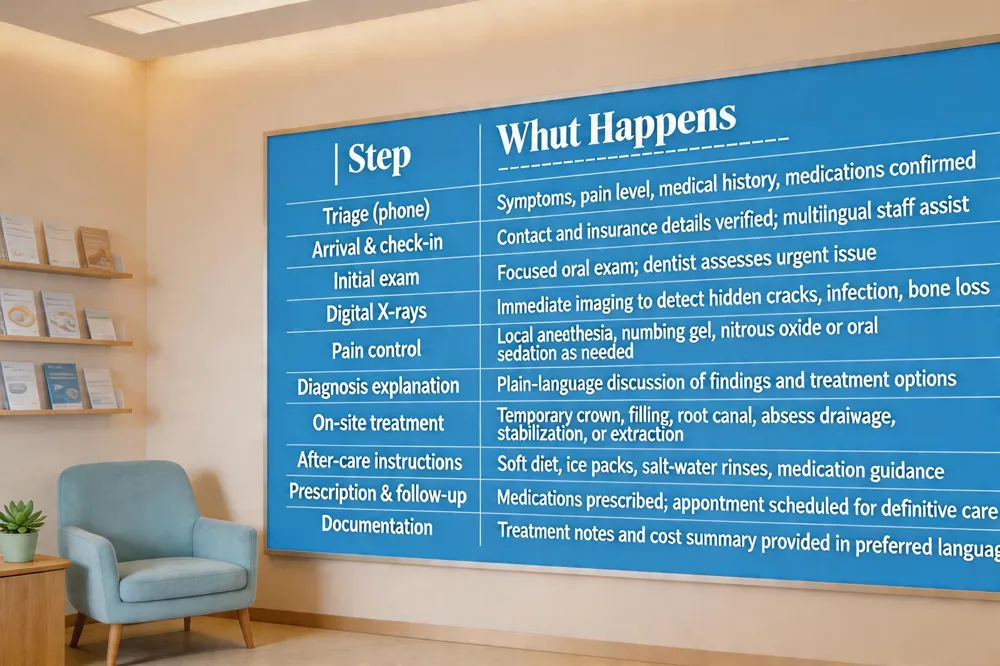 When you call for an emergency, the office will triage quickly—confirming your symptoms, pain level, medical history, and any medications. On arrival, staff verify your contact and insurance details, then bring you to a treatment room where the dentist conducts a focused exam. Digital X‑rays are often taken immediately to reveal hidden cracks, infections or bone loss. Pain is addressed right away with local anesthesia, numbing gel, or, when needed, nitrous oxide or oral sedation. The dentist then explains the diagnosis in plain language and proceeds with on‑site treatment—whether it’s a temporary crown, a filling, root‑canal therapy, abscess drainage, tooth stabilization, or extraction. After the procedure you receive clear after‑care instructions (e.g., soft‑diet, ice packs, salt‑water rinses) and any prescriptions, plus a follow‑up appointment to complete definitive care and monitor healing.
Finding Immediate Help: 24‑Hour and Nearby Services
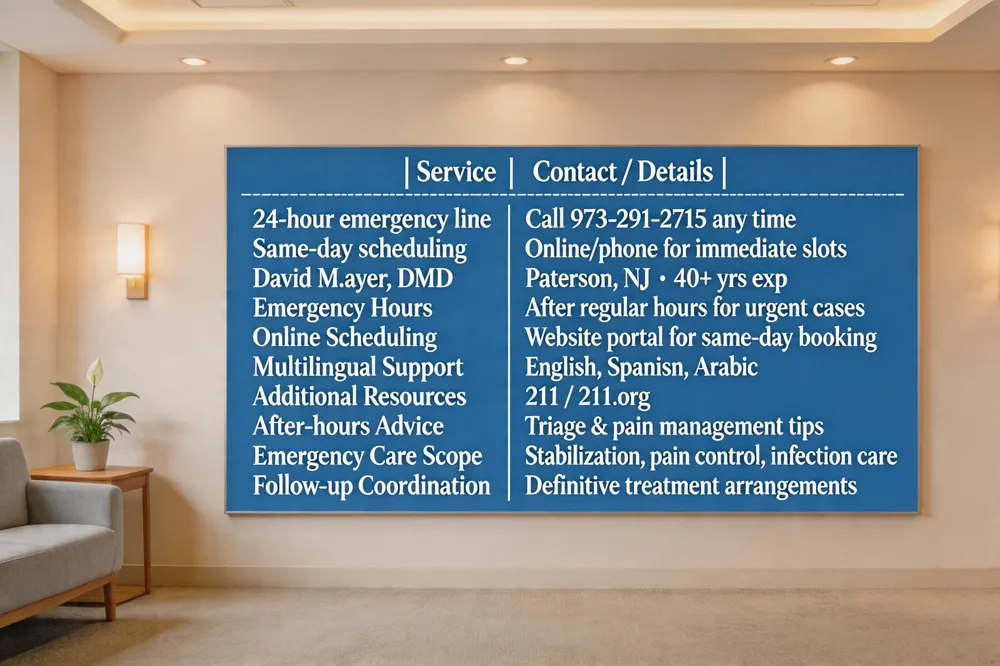
| Service | Contact / Details |
|---|---|
| 24‑hour emergency line | Call 973‑291‑2715 any time for on‑call dentist advice |
| Same‑day appointment scheduling | Online tool or phone to secure immediate slot; multilingual team assesses condition |
| Local emergency dentist (David M.ayer, DMD) | Serves Paterson, NJ & surrounding areas; 40+ years experience |
| Emergency office hours | Open after regular hours for urgent cases like severe pain, knocked‑out teeth, abscesses |
| Online scheduling | Website portal for quick same‑day appointment booking |
| Multilingual support | Services offered in English, Spanish, and Arabic |
| Additional resources | 211 or 211.org for list of low‑cost community providers |
| After‑hours advice | Phone line provides triage and pain‑management tips until appointment |
| Emergency care scope | Tooth stabilization, pain control, infection drainage, temporary restorations |
| Follow‑up coordination | Arrangements for definitive treatment after initial emergency care |
 After‑hours emergency line:
If you need urgent dental treatment at any hour, our Paterson office is ready to help. We provide same‑day appointments and have a 24‑hour answering line that routes you to an on‑call dentist for immediate advice and care. Call our after‑hours number, 973‑291‑2715, or use our online scheduling tool to secure a same‑day appointments slot.
After‑hours emergency line:
If you need urgent dental treatment at any hour, our Paterson office is ready to help. We provide same‑day appointments and have a 24‑hour answering line that routes you to an on‑call dentist for immediate advice and care. Call our after‑hours number, 973‑291‑2715, or use our online scheduling tool to secure a same‑day appointments slot.
Same‑day appointment scheduling: Our multilingual team (English, Spanish, Arabic) assesses conditions such as severe tooth pain, knocked‑out teeth, pocketcesses, or broken restorations and begins treatment right away. Fast, compassionate care eliminates waiting for regular office hours and reduces the risk of complications.
Local availability of emergency dentists: David M.ayer, DMD offers emergency dental care for patients in Paterson, NJ, and surrounding areas. With over 40 years of experience, state‑of‑the‑art technology, and a full‑service practice, we handle dental emergencies ranging from broken teeth to abscesses. Call (973) 291‑2715 or schedule online for immediate assistance.
Staying Prepared for Future Emergencies
Keeping a well‑stocked emergency dental kit at home—and in a travel bag—gives you the tools to protect a knocked‑out tooth, control bleeding, and manage pain while you await professional care. The kit should include a small sealed container (or a cup of milk) for a displaced tooth, sterile gauze, over‑the‑counter pain relievers such as ibuprofen, a cold‑compress pack, temporary filling material or dental cement, and a list of your dentist’s emergency contact information. Equally important is scheduling regular dental check‑ups; routine exams and cleanings catch cavities, weakened restorations, and gum disease before they become urgent problems. Finally, practice good oral hygiene every day—brush twice with fluoride toothpaste, floss daily, and limit sugary foods—to strengthen teeth and gums, dramatically reducing the likelihood of emergencies.