Introduction: The Rise of Bio‑Ceramic Crowns
Bioceramic materials such as zirconia and lithium disilicate have become staples of modern restorative dentistry because they combine high biocompatibility, bioactivity and and natural‑looking translucency. Advances in digital technology— intra‑ scans scanners broken CAD,AM design software, and chair‑side milling or high‑resolution 3D printing—allow clinicians to capture a precise 3‑D model of the prepared tooth, design the crown on a computer, and fabricate it in a single visit. This same‑day workflow eliminates temporary restorations, reduces travel and missed‑work appointments, and shortens overall treatment time. For patients, bio‑ceramic crowns offer metal‑free, hypoallergenic restorations that mimic the optical properties of enamel, reduce inflammation, and support faster tissue healing. The combination of superior aesthetics, durability, and streamlined digital fabrication is reshaping the patient experience and setting a new standard for crown care.
Understanding Bio‑Ceramic Materials
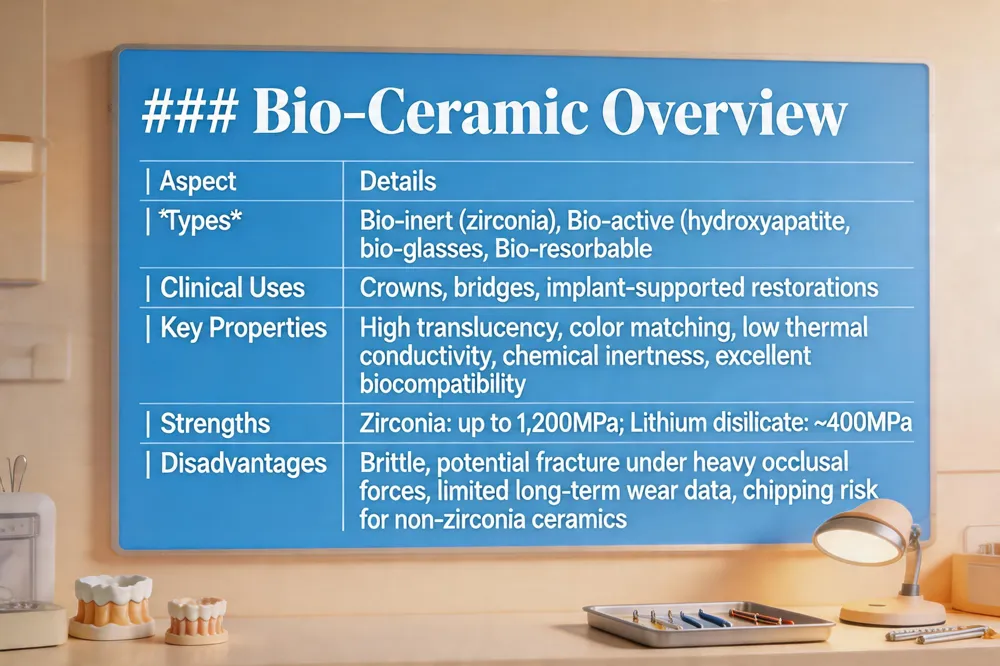
Bio‑Ceramic Overview
| Aspect | Details |
|---|---|
| Types | Bio‑inert (e.g., zirconia), Bio‑active (hydroxyapatite, bio‑glasses), Bio‑resorbable |
| Clinical Uses | Crowns, bridges, implant‑supported restorations |
| Key Properties | High translucency, color matching, low thermal conductivity, chemical inertness, excellent biocompatibility |
| Strengths | Zirconia: up to 1,200 MPa; Lithium disilicate: ~400 MPa |
| Disadvantages | Brittle, potential fracture under heavy occlusal forces, limited long‑term wear data, chipping risk for non‑zirconia ceramics |
 Bioceramics in dentistry
Bioceramics are inorganic, non‑metallic materials engineered for high biocompatibility. They can be bioinert (e.g., zirconia crowns), bioactive (hydroxyapatite, bio‑glasses) that promote osseointegration, or bioresorbable. In restorative care they serve as crowns, bridges, and implant‑supported restorations, offering durability, natural esthetics, and reduced inflammatory response.
Bioceramics in dentistry
Bioceramics are inorganic, non‑metallic materials engineered for high biocompatibility. They can be bioinert (e.g., zirconia crowns), bioactive (hydroxyapatite, bio‑glasses) that promote osseointegration, or bioresorbable. In restorative care they serve as crowns, bridges, and implant‑supported restorations, offering durability, natural esthetics, and reduced inflammatory response.
Dental ceramics classification Dental ceramics fall into three groups: glass‑matrix (glass‑ceramics like lithium disilicate), polycrystalline (zirconia, Y‑TZP), and resin‑matrix hybrids (nano‑filled composites). Each class balances translucency and strength, guiding material choice for anterior versus posterior sites.
Properties of dental ceramics Key properties include high translucency, color matching, low thermal conductivity, chemical inertness, and excellent biocompatibility. Zirconia provides fracture strengths up to 1,200 MPa for posterior load‑bearing, while lithium disilicate offers ~400 MPa with superior esthetics. Surface polishing yields plaque‑resistant, wear‑compatible margins.
Disadvantages of bioceramics and ceramic crowns Bioceramics can be brittle and may fracture under heavy occlusal forces; some formulations have limited long‑term wear data. Ceramic crowns, particularly non‑zirconia types, are more prone to chipping, may be costlier than metal‑ceramic options, and require careful shade matching to avoid aesthetic issues over time.
Same‑Day Digital Workflow
Same‑Day Crown Workflow
| Step | Technology | Outcome |
|---|---|---|
| Scanning | Digital intra‑oral scanner | Accurate 3‑D intra data |
| Design | CAD/CAM software | Virtual crown design with precise margins |
| Fabrication | On‑site milling or 3‑D printing | Crown milled/printed in a single visit |
| Materials | High‑translucency lithium disilicate (E‑MAX) – superior aesthetics & strength | |
| Statistics | ~30 % of adults 70 + retain most/all teeth |
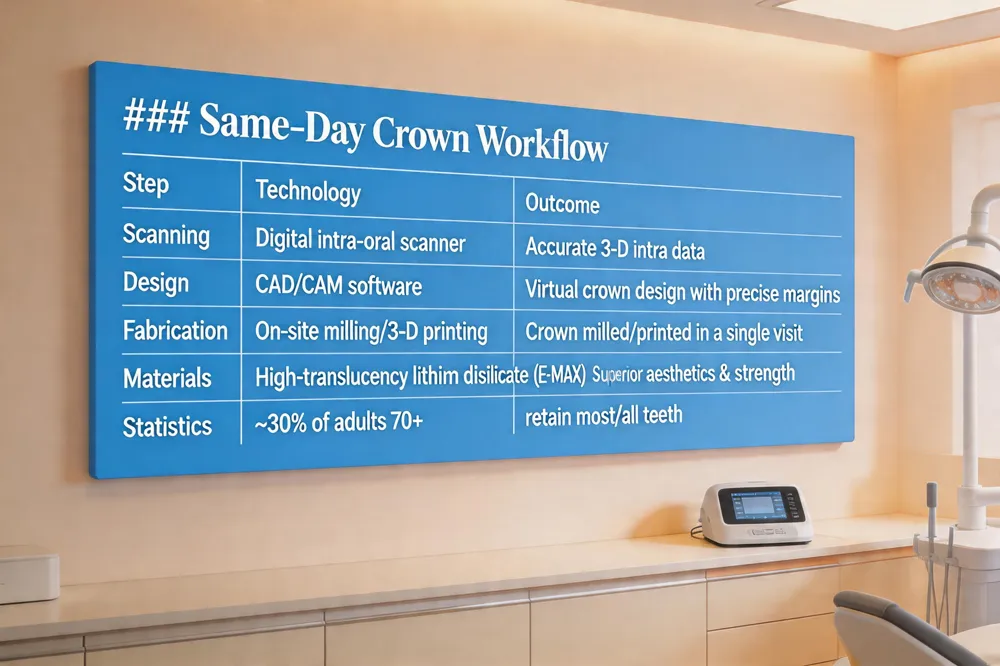 What is the new technology for crowns? It combines digital intra‑oral scanning, CAD/CAM design, and on‑site milling or 3‑D printing to produce a precise, biocompatible restoration in a single visit.
What are the three types of dental crowns? All‑ceramic (e.g., zirconia, lithium disilicate), porcelain‑fused‑to‑metal (PFM), and full‑metal crowns.
What is the newest material for crowns? High‑translucency lithium disilicate (E‑MAX) offers superior aesthetics and strength, making it the cutting‑edge choice for both anterior and posterior restorations.
How many 70‑year‑olds still have all their teeth? Approximately 30 % of adults aged 70 + retain most or all of their natural teeth, reflecting a major improvement in oral health over past generations.
Clinical Applications in Restorative Dentistry
Clinical Applications
| Application | Preferred Material | Reason |
|---|---|---|
| Posterior load‑bearing | Zirconia (900‑1200 MPa) | Highest flexural strength, wear resistance |
| Anterior esthetics | Lithium disilicate (360‑400 MPa) | Superior translucency, color matching |
| Endodontic sealing | Bioceramic sealer (calcium‑silicate) | Bio‑active hydroxyapatite layer, radiopaque, expands ≤0.2 % |
| Castable restorations | High‑purity ceramic powders | Precise anatomy, strong, biocompatible |
| Hybrid/nano‑reinforced crowns | Nano‑filled glass‑ceramics | Combines toughness of zirconia with esthetics of lithium disilicate |
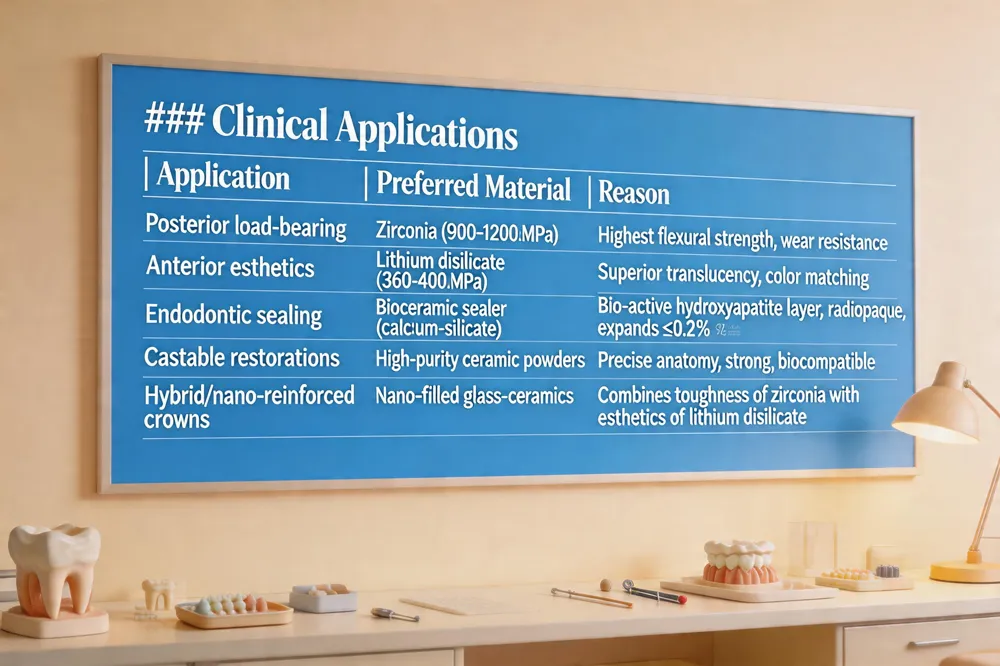 Bio‑ceramic crowns have become the material of choice for both anterior and posterior teeth. Zirconia’s high flexural strength (900‑1200 MPa) makes it ideal for posterior load‑bearing molars, while lithium disilicate’s superior translucency and 360‑400 MPa strength provide natural aesthetics for front‑tooth restorations. Advanced CAD/CAM workflows enable same‑day milling, preserving tooth structure and eliminating temporary crowns.
Bioceramic sealer – Bioceramic sealers are bioactive, calcium‑silicate pastes that set on contact with canal moisture, forming a thin hydroxyapatite layer that chemically bonds to dentin. Radiopaque, resin‑free, and non‑discoloring, they flow into intricate anatomy, expand slightly (≤0.2 % volume) to fill micro‑gaps, and provide a durable, long‑lasting seal for root canals.
Bioceramics in endodontics – These materials serve as root‑fillers, sealers, and repair cements. Their bioactive chemistry promotes hydroxyapatite formation, enhancing periapical healing and allowing reliable, seal obturation and perforation repair. The hydraulic nature ensures setting in moist environments and reduces postoperative sensitivity.
Castable ceramics – High‑purity ceramic powders mixed with a binder can be digitally designed and cast to exact anatomy, delivering strong, biocompatible restorations with natural translucency. Same‑day workflows reduce laboratory time and cost.
Hybrid and nano‑reinforced materials – Emerging nano‑filled glass‑ceramics and polymer‑infused hybrids combine the toughness of zirconia with the aesthetics of lithium disilicate, offering improved wear resistance and reduced brittleness for both anterior and posterior crowns.
Material Choices: Advantages & Limitations
Material Comparison
| Material | Advantages | Limitations |
|---|---|---|
| Zirconia | Very high strength (900‑1200 MPa), wear resistance, suitable for posterior teeth | Can cause opposing enamel wear, opacity in thin sections, brittle when too thin, higher cost |
| Lithium Disilicate (E‑MAX) | Excellent translucency, esthetics, adequate strength (360‑400 MPa) for anterior & short‑span posterior | Lower fracture‑toughness than zirconia, risk of chipping under high loads or bruxism |
| Hybrid Bio‑Ceramics / Nano‑Reinforced | Improved toughness, good wear compatibility, esthetics | Higher cost, limited long‑term clinical data |
| Traditional Ceramic (non‑zirconia) | Good esthetics | Higher fracture risk, especially in molars or bruxism patients, shade‑matching challenges |
| Bioceramic Sealers | Bio‑active, radiopaque, chemical bond to dentin | Fragility under high loads, slow degradation, limited long‑term wear data |
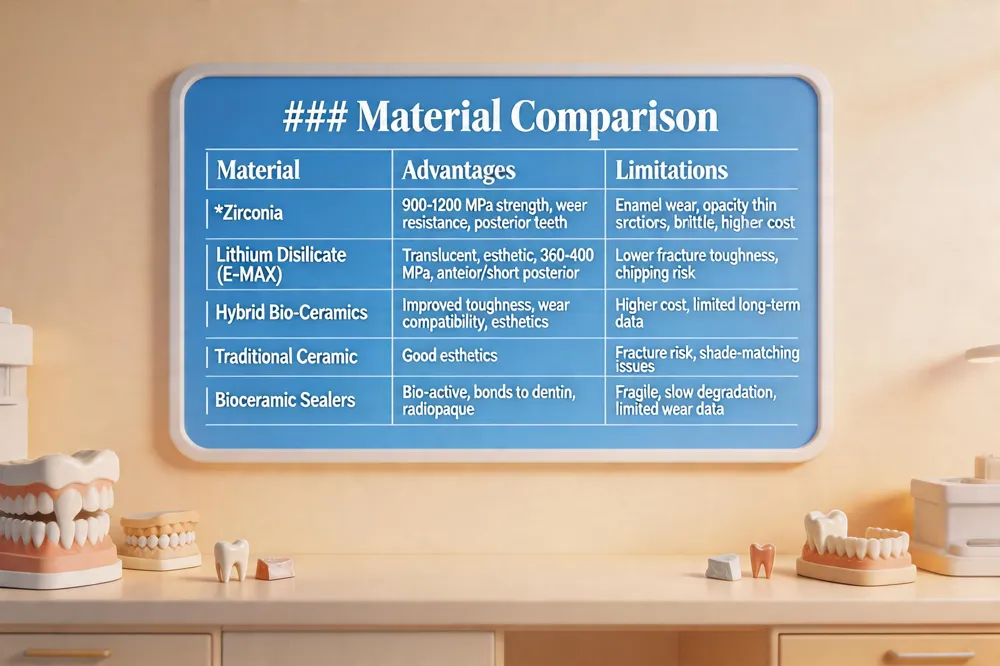 Zirconia crowns deliver high strength (900‑1200 MPa) and, with newer translucent forms, a natural look for posterior and many anterior teeth. Their wear resistance suits heavy chewing, but hardness can increase opposing enamel wear and adjustments need special tools. Thin zirconia may appear opaque and risk fracture.
Lithium disilicate (E‑max) crowns provide excellent translucency and color matching, flexural strength 360‑400 MPa, suitable for front and short‑span back teeth. They are less fracture‑tough than zirconia and can chip under high loads or bruxism.
Hybrid bio‑ceramics and nano‑reinforced glass‑ceramics blend polymer and ceramic, boosting toughness while keeping esthetics. They show good wear compatibility but remain costly and lack extensive long‑term data.
Zirconia crowns disadvantages: increased enamel wear, possible opacity in aesthetic zones, brittleness when too thin, higher cost, and difficult adjustments.
Ceramic crowns disadvantages: higher fracture risk, especially in molars or bruxism patients; higher cost; sensitivity to hard foods; shade‑matching challenges.
Bioceramic disadvantages: fragility under high loads, slow degradation affecting tissue integration, and limited long‑term wear data.
Overall, selecting right right material balances strength, aesthetics, and patient‑specific factors.
Patient‑Centric Care at Dr. David M.ayer’s Practice
Patient‑Centric Highlights
| Feature | Details |
|---|---|
| Multilingual Staff | English, Spanish, Arabic – clear communication for diverse community |
| Digital Technology | Chair‑side CEREC, high‑resolution 3‑D printing – same‑day milling of zirconia & lithium disilicate crowns |
| Insurance & Coverage | Accepts insurance; Medicaid (NJ FamilyCare) covers same‑day crowns for eligible patients |
| Quality vs. Chains | Boutique practice offers individualized planning, advanced digital workflow, and compassionate care compared to standardized chain clinics |
| Cost Efficiency | Eliminates temporary restorations and multiple visits, reducing overall treatment time and travel burden |
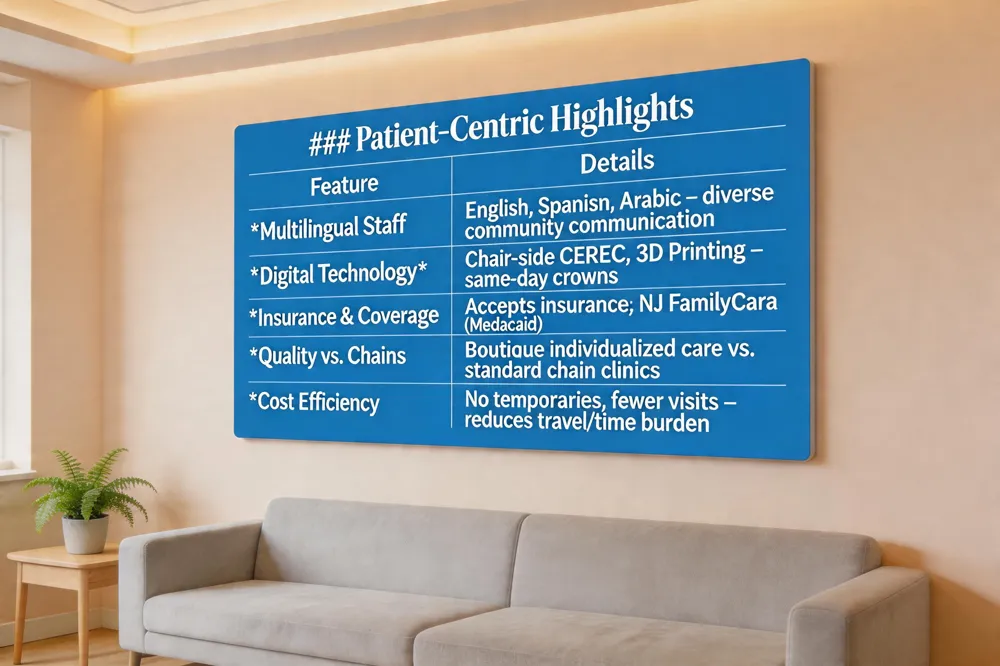 At Dr. David M.ayer’s office in Paterson, NJ, the team speaks English, Spanish, and Arabic, ensuring clear communication for the city’s diverse community. The practice leverages chair‑side CEREC and high‑resolution 3‑D printing to fabricate bio‑ceramic zirconiada lithium‑disilicate crowns in a single visit, eliminating temporary restorations and reducing travel time. Because the crowns are milled from biocompatible, radiopaque materials, patients enjoy natural translucency, high strength, and minimal allergic risk. Insurance is accepted, and Medicaid (NJ FamilyCare) covers same‑day crown procedures for eligible adults and children, making advanced restorative care affordable for low‑income families. Compared with large national chains, Dr. M.ayer’s boutique practice offers individualized treatment planning, a compassionate multilingual staff, and the latest digital workflow—features often lacking in protocol‑driven chain clinics.
Is Aspen Dental good for crowns? Aspen Dental provides crowns at an average price of about $1,269 per tooth with options like zirconia, porcelain, or PFM, and offers financing. However, its standardized, multi‑location model may not deliver the personalized, multilingual, and cutting‑edge digital services available at Dr. M.ayer’s local practice, which can result in a higher‑quality, patient‑centered crown experience.
Looking Ahead: The Future of Bio‑Ceramic Crowns
Future bio‑ceramic crowns will leverage nano‑engineered zirconia and lithium disilicate to boost fracture resistance while preserving translucency. Researchers are embedding calcium‑phosphate and fluoride ions that release slowly, encouraging remineralization of adjacent enamel. Additive manufacturing will shift toward sustainable 3‑D printing, using recyclable resins and reducing waste. Clinics will continue prioritizing patient‑first, technology‑driven workflows, offering same‑day, biocompatible restorations that enhance comfort, aesthetics, and long‑term oral health and provide lasting confidence for every smile everywhere.