Why Modern Crowns Matter
Today's dental crowns combine cutting‑edge materials with streamlined digital workflows, delivering results that were impossible just a decade ago. Zirconia and lithium disilicate dominate the market because they offer exceptional strength, biocompatibility and natural translucency, while hybrid ceramic‑resin blocks and emerging bio‑active ceramics further expand aesthetic and therapeutic options. In‑office CAD/CAM scanning eliminates messy impressions and, when paired with AI‑assisted design software, predicts optimal morphology and shade for each patient, reducing human error and chair time. The same‑day workflow—capture, design, mill or 3‑D print, and place a crown in a single visit—provides immediate restoration, eliminates temporary appliances, and improves comfort. Patients benefit from fewer appointments, faster relief of pain or function, and a more predictable outcome, while clinicians enjoy higher accuracy, less laboratory dependence, and the ability to offer minimally invasive or no‑prep solutions. In short, modern crowns enhance durability, aesthetics and the overall patient experience.
Same‑Day Crown Technology and Digital Workflows
Same‑Day Crown Workflow Summary
| Feature | Description | Benefits |
|---|---|---|
| Intra‑oral scanning | Captures a 3‑D digital impression of the prepared tooth | Eliminates conventional impressions, reduces patient discomfort |
| AI‑assisted design software | Predicts optimal morphology, shade, and margin placement using occlusion data | Faster design time, higher accuracy, reduced adjustments |
| Chair‑side milling (zirconia / lithium disilicate) | CNC milling of high‑strength ceramic blocks | Same‑visit fabrication, precise fit, strong material properties |
| High‑resolution 3‑D printing | Prints temporary or permanent ceramic crowns | Rapid production, minimal waste, customizable layering |
| Materials ( | omer composites, glass‑ionomer, resin‑based for zirconia | Tailored to material and clinical situation |
| Cost (U.S.) | $1,000 – $1,500 per crown (varies by material & practice) | Immediate aesthetics, reduced infection risk, convenience |
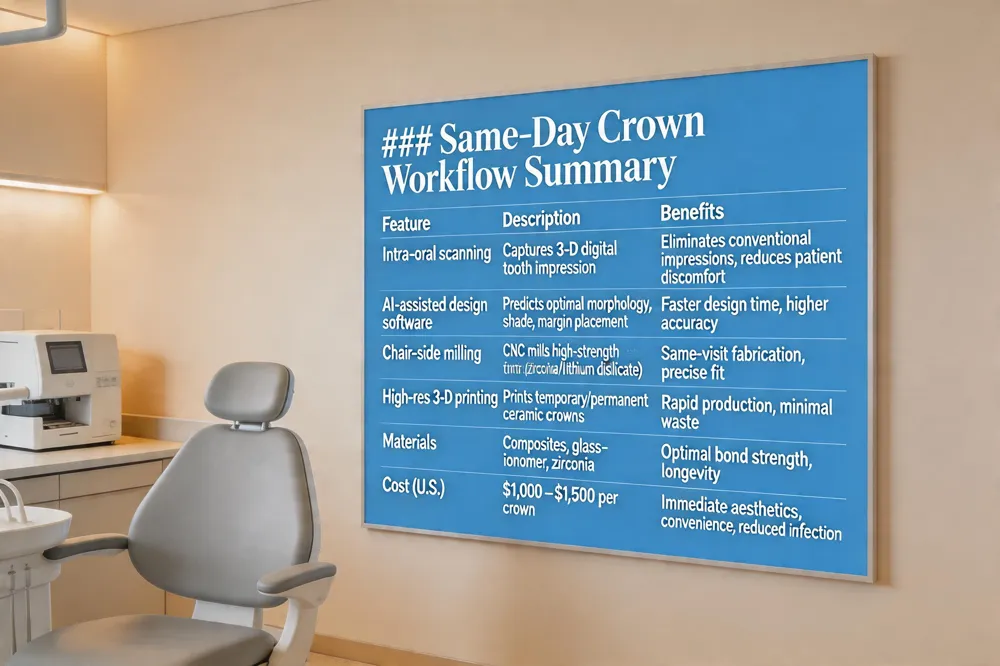 Modern crown treatment revolves around CAD/CAM systems such as CEREC and Planmeca FIT, which capture intra‑oral scans and create a 3‑D digital impression of the prepared tooth. The digital model drives either chair‑side milling of high‑strength zirconia or lithium disilicate blocks, or high‑resolution 3‑D printing of temporary and permanent ceramic crowns. AI‑assisted design software predicts optimal morphology and shade, using patient‑specific occlusion data to automate margin placement and color matching, which reduces chair time and the need for adjustments.
What is the new technology for crowns? The newest approach integrates intra‑oral scanning, AI‑driven design, and CAD/CAM milling or additive manufacturing to fabricate precise, biocompatible crowns in a single visit, eliminating traditional impressions and laboratory delays.
Are same‑day crowns worth it? Yes—most patients benefit from the convenience, reduced infection risk, and immediate aesthetics, especially when the case is suitable for all‑ceramic materials. High‑stress posterior restorations may still require lab‑fabricated options.
How much is a same‑day crown? Costs typically range from $1,000 to $1,500 in the U.S., with many insurance plans covering a portion; material choice and practice pricing affect the final amount.
Step‑by‑step dental crown procedure: 1) Clinical exam and imaging; 2) Local anesthesia and tooth preparation; 3) digital scan or impression; 4) In‑office design and milling/printing; 5) Temporary crown placement (if needed); 6) Final crown try‑in, adjustment, cementation, and polishing. This streamlined workflow delivers accurate fit, natural appearance, and faster treatment for patients.
Materials Spotlight: Zirconia, Lithium Disilicate, and Emerging Hybrids
Material Comparison Table
| Material | Strength (MPa) | Aesthetics (Translucency) | Typical Use | Approx. Longevity |
|---|---|---|---|---|
| High‑strength Zirconia | 900‑1,200 | Medium‑high (multi‑layered shades) | Posterior stress‑bearing, anterior aesthetic when translucent | 10‑15+ years (with good hygiene) |
| Lithium Disilicate (E‑max) | 360‑400 | Very high (life‑like translucency) | Anterior crowns, veneers, short‑term posterior | 7‑12 years (depends on occlusion) |
| Zirconia‑reinforced Lithium Silicate (Hybrid) | 500‑600 | High (porcelain‑like) | Both anterior & posterior, balanced strength & beauty | 10‑15 years |
| Polymer‑infiltrated Network (PICN) | 200‑300 | Moderate | Patients needing flexibility, reduced brittleness | 8‑12 years |
| Bioactive Ceramics | 300‑500 | Moderate | Cases needing fluoride/calcium release for remineralization | 10‑15 years |
| PEEK | 150‑200 | Low‑moderate (requires veneering) | Metal‑free option for patients with metal sensitivity | 10‑15 years |
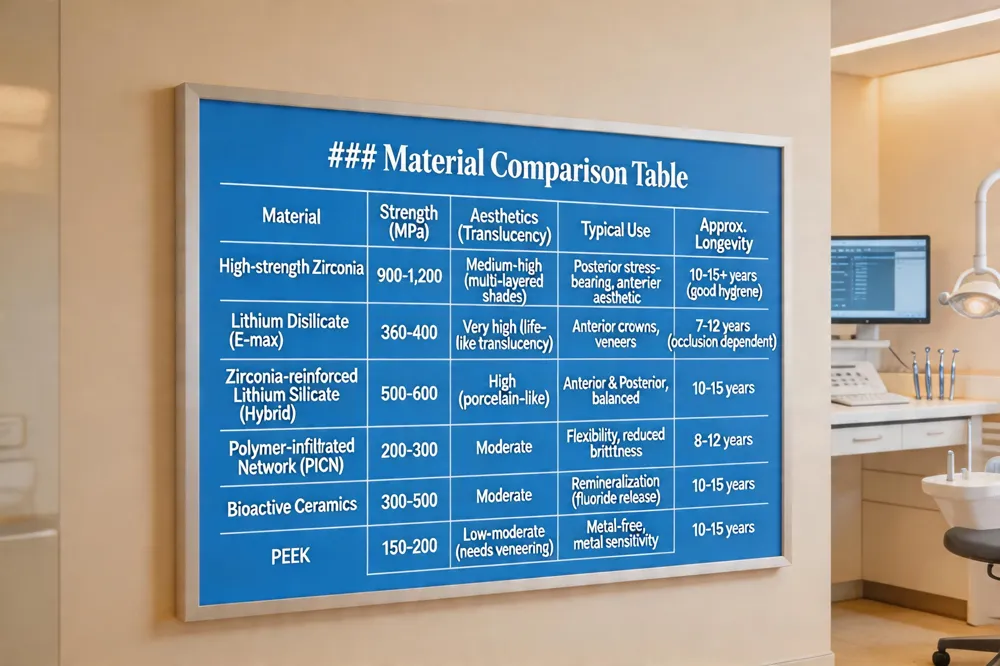 High‑strength zirconia crowns have become the workhorse of modern dentistry. Made from zirconium dioxide (ZrO₂), they deliver metal‑like durability while offering increasingly translucent, multi‑layered shades that mimic natural enamel. This translucency allows zirconia to be used for both posterior stress‑bearing restorations and anterior aesthetic cases, with long‑term survival rates often exceeding ten years when oral hygiene is maintained.
Lithium disilicate (E‑max) crowns provide unrivaled translucency and color depth, making them the top choice for front‑tooth aesthetics. Advanced crystal‑size refinements give these crowns improved fracture resistance, though they remain slightly less robust than zirconia in high‑force zones.
Hybrid ceramics, such as zirconia‑reinforced lithium silicate, blend the strength of a zirconia core with a porcelain‑like outer layer, delivering a balance of durability and lifelike appearance. Polymer‑infiltrated network (PICN) materials further combine ceramic hardness with resin flexibility, reducing brittleness and improving stress distribution.
Emerging bioactive ceramics release therapeutic ions (e.g., fluoride, calcium) to promote remineralization around the crown margin, while polyetheretherketone (PEEK) offers a metal‑free, lightweight alternative with a modulus of elasticity close to dentin, ideal for patients with metal sensitivities.
Zirconia crown – A strong, biocompatible ceramic restoration that can last 10‑15 years or more, providing both durability and a natural look.
Best overall material – High‑strength zirconia is the most versatile choice for most adults, balancing longevity, aesthetics, and metal‑free safety.
Healthiest material – High‑quality porcelain (ceramic) crowns are non‑toxic, biocompatible, and bond well to tooth structure, eliminating metal‑related risks.
Dental crown material comparison – Gold crowns excel in strength, full porcelain offers the best aesthetics, porcelain‑fused‑to‑metal combines durability with appearance, composite resin is low‑cost and short‑term, while zirconia provides a strong, tooth‑colored, metal‑free option.
Best material for ultimate cosmetics – Full porcelain restorations (including lithium disilicate) deliver the most lifelike appearance for highly visible teeth.
Traditional vs. Modern Crown Options
Crown Options Overview
| Option | Composition | Advantages | Disadvantages | Typical Cost Range |
|---|---|---|---|---|
| Metal (Gold/Base‑metal) | Pure metal or alloy | Highest durability, gentle bite, excellent fit | Poor aesthetics, possible metal allergy | $1,200‑$2,500 |
| Porcelain‑Fused‑to‑Metal (PFM) | Metal substructure + porcelain veneer | Good strength + decent aesthetics | Visible metal line, porcelain chipping risk | $800‑$1,500 |
| All‑Ceramic (Zirconia) | Monolithic zirconia block | Metal‑free, high strength, improved translucency | Slightly less aesthetic than lithium disilicate | $1,000‑$1,800 |
| All‑Ceramic (Lithium Disilicate) | Pressed/etched lithium disilicate | Superior translucency, excellent aesthetics | Lower fracture resistance in high‑stress areas | $1,200‑$2,000 |
| Stainless‑Steel (Pediatric) | Metal alloy | Very low cost, easy placement | Not aesthetic, limited to temporary/children | $100‑$300 |
| Composite Resin (Temporary) | Resin‑based material | Low cost, quick placement | Short‑term, less durability | $150‑$400 |
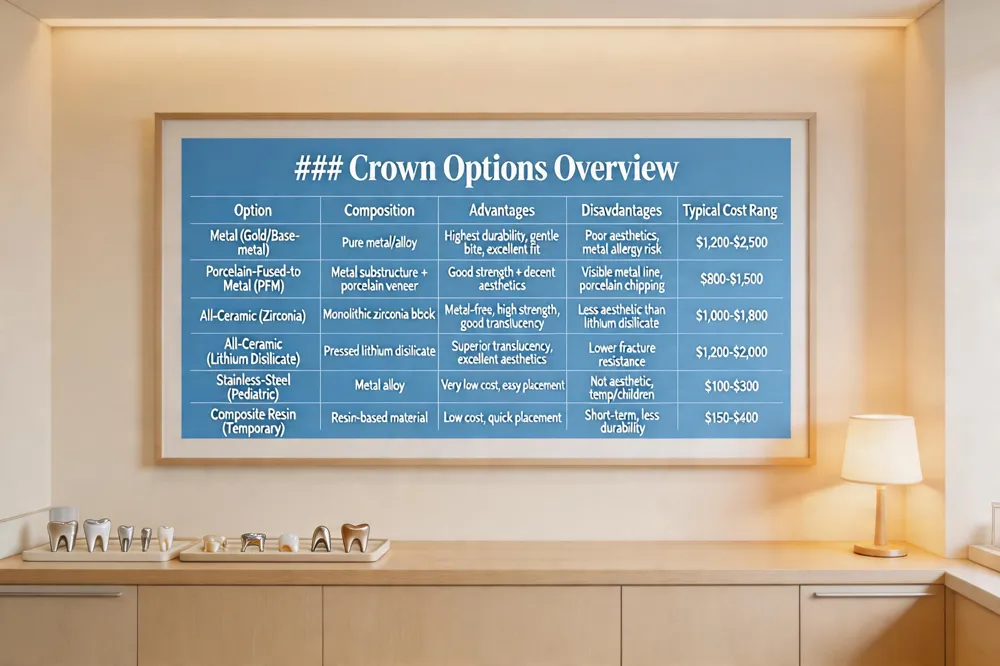 When choosing a restoration, patients often compare Metal crowns and gold crowns with newer all‑ceramic solutions. Metal crowns—especially gold alloys—provide unmatched durability and a gentle bite on opposing teeth, but their metallic hue limits them to back teeth. Porcelain‑fused‑to‑metal (PFM) crowns blend a strong metal substructure with a natural‑looking porcelain veneer, offering a balance of strength and aesthetics at a mid‑range price. All‑ceramic crowns, notably zirconia and lithium disilicate, have become the preferred choice for both anterior and posterior teeth due to their high fracture resistance, biocompatibility, and improved translucency that mimics natural enamel.
Tooth cap vs crown A tooth cap (onlay/inlay) repairs only the damaged portion of a tooth, covering the biting surface and one or two sides while preserving most of the natural structure. A full crown encases the entire tooth, providing complete protection and strength. Caps require less tooth reduction, are quicker to place, and tend to be less expensive, but crowns are indicated for heavily decayed, cracked, or root‑canal‑treated teeth where maximum durability is needed.
Disadvantages of dental crowns Crowns can be costly ($1,000‑$3,500+), may not be fully covered by insurance, and require removal of healthy enamel. Patients may experience post‑procedure sensitivity, gum irritation, or, if cement fails, bacterial decay beneath the restoration. Metal crowns can cause allergic reactions or a dark gum line; porcelain crowns may chip or wear opposing teeth.
Cost comparison Gold crowns are generally more expensive than porcelain crowns because of gold’s intrinsic value and labor‑intensive casting. Stainless‑steel crowns are the cheapest option, mainly used for temporary or pediatric restorations. Among permanent adult crowns, PFM crowns are the most budget‑friendly, while all‑ceramic, zirconia, and lithium disilicate crowns fall into mid‑range to premium price categories.
Types of dental crowns and cost
- Metal (gold/base‑metal): durable, lowest cost, limited aesthetics.
- PFM: metal core + porcelain, moderate price, good aesthetics.
- All‑ceramic (porcelain or lithium disilicate): best aesthetics, higher cost.
- Zirconia: high strength, improved translucency, mid‑range to premium cost.
These options allow dentists to tailor treatment to a patient’s functional needs, aesthetic goals, and budget.
Preparation, Placement, and Longevity
Step‑by‑Step Crown Procedure & Key Points
| Step | Description | Key Considerations |
|---|---|---|
| 1. Clinical exam & imaging | Assess tooth health, take radiographs or CBCT | Identify decay, root status, occlusion |
| 2. Anesthesia & tooth preparation | Remove decay, shape tooth for space | Preserve as much enamel as possible; consider no‑prep options |
| 3. Digital scan or impression | Intra‑oral scanner creates 3‑D model | Ensure complete margin capture; AI can aid margin detection |
| 4. In‑office design & milling/printing | CAD software designs crown, CAM mills or 3‑D prints | Verify shade match, occlusal contacts before fabrication |
| 5. Temporary crown placement (if needed) | Protect prepared tooth while permanent is fabricated | Use bioactive liner to reduce sensitivity |
| 6. Final crown try‑in, adjustment, cementation | Seat crown, adjust contacts, remove excess cement | Use resin cement for zirconia, glass‑ionomer for metal‑based crowns |
| 7. Polishing & final check | Polish margins, verify bite | Educate patient on hygiene to extend longevity |
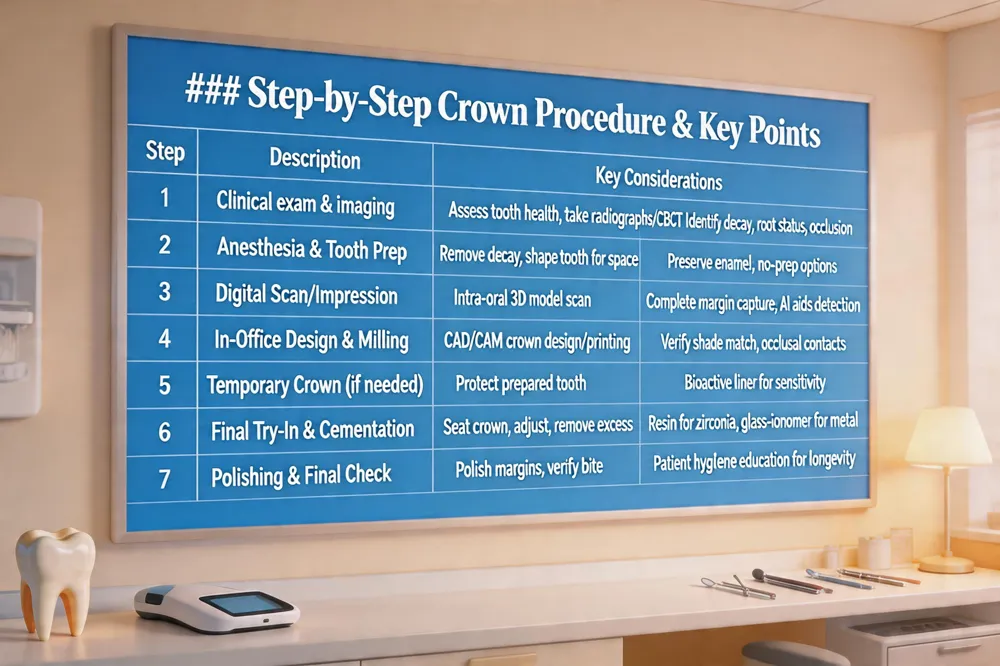 Tooth preparation and adhesive systems – The procedure begins with a local anesthetic, removal of decay, and careful reshaping of the tooth to create space for a crown. Modern minimally‑invasive or no‑prep techniques rely on high‑strength ceramics such as zirconia and lithium disilicate, which can be bonded directly to enamel using universal adhesives with nano‑filled fillers. These adhesives improve retention and reduce the need for extensive tooth reduction.
Cementation techniques and temporary crowns – After a digital impression or intra‑oral scan, a temporary crown protects the prepared tooth while the permanent restoration is milled or 3‑D printed. Permanent cementation uses resin‑based or glass‑ionomer cements, selected for the material—zirconia crowns often receive resin cement for optimal bond strength. The final crown is seated, excess cement removed, and the bite adjusted for comfort.
Sensitivity, gum health, and bioactive liners – Post‑procedure sensitivity is minimized by precise margin placement and the use of bioactive glass‑ceramic liners, which promote remineralization and seal integrity. Maintaining good oral hygiene and regular check‑ups preserves gum health and extends crown longevity, which can exceed 15 years when cared for properly.
Safety concerns and cancer myths – Contemporary crown materials—porcelain, ceramic, zirconia, and approved metal alloys—are biocompatible and have no carcinogenic properties. Extensive research disproves any link between crowns and cancer; regular hygiene remains the key preventive measure.
FAQs:
- Preparing a tooth for a crown: Administer anesthesia, remove decay, shape the tooth, clean, scan, place a temporary crown, then cement the permanent crown.
- Dental crown cost: $900‑$2,200 per tooth, varying by material; insurance covers ~50 %; financing available.
- Zirconia crown cost: $1,200‑$2,500 per tooth; similar insurance coverage and financing options.
- Can dental crowns cause cancer?: No, scientific evidence shows no cancer risk from modern crown materials.
- Step‑by‑step dental crown procedure: Exam → anesthesia → preparation → impression/scan → temporary crown → permanent crown fitting and cementation.
Patient‑Centric Care and Future Directions
Emerging Innovations & Patient Impact
| Innovation | Description | Clinical Impact |
|---|---|---|
| AI‑driven shade matching & design | Algorithms analyze scans, spectrophotometer data for color coordinates | Reduces chair‑time, improves aesthetic consistency |
| Multilingual digital smile‑design | Visual treatment plans displayed in multiple languages | Enhances informed consent, patient comfort in diverse populations |
| Bioactive & smart crowns | Release therapeutic ions; embed sensors for bite force & temperature monitoring | Promote remineralization, early detection of problems |
| 3‑D printed temporary crowns | Resin‑ceramic composites printed in <20 min | Faster turnaround, less material waste, eco‑friendly |
| Sustainable practice initiatives | Use of recyclable materials, reduced carbon footprint | Aligns with patient values, potential cost savings |
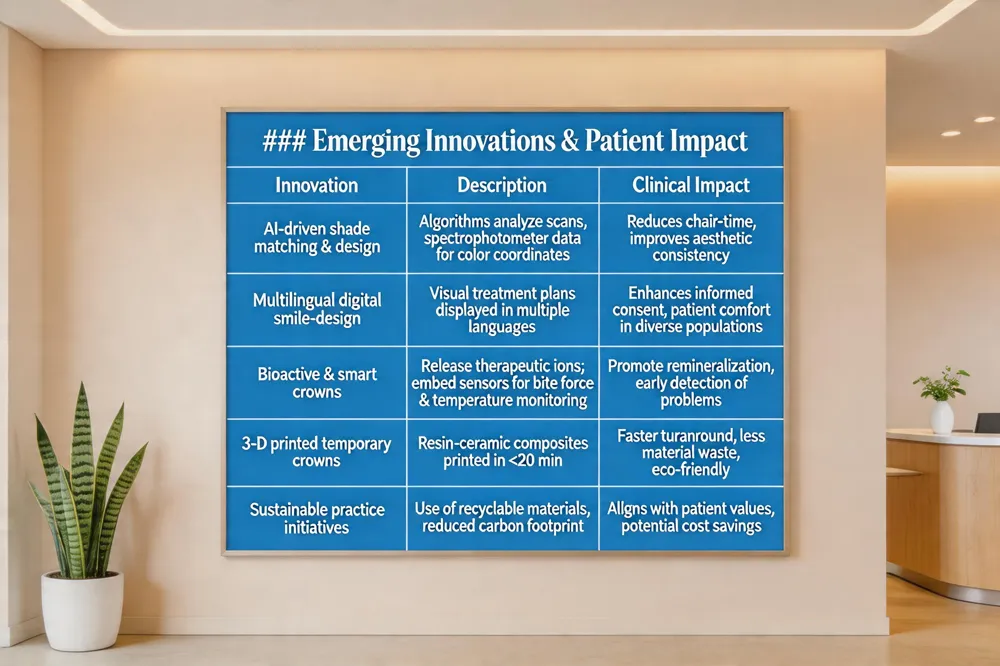 Modern dental practices are reshaping the crown experience through technology, inclusivity, and sustainability.
AI‑driven shade matching and design – Advanced CAD software now incorporates artificial‑intelligence algorithms that analyze a patient’s digital scan, occlusion data, and spectrophotometer readings to suggest optimal crown morphology and precise color coordinates. This reduces chair‑time, minimizes manual adjustments, and delivers a seamless, natural appearance that blends effortlessly with surrounding teeth.
Multilingual communication and accessibility – Practices in diverse communities (e.g., Paterson, NJ) employ teams fluent in English, Spanish, and Arabic, using digital smile‑design tools that patients can view in their preferred language. Clear, culturally‑sensitive explanations of treatment options improve informed consent and foster trust.
Bioactive and smart crown technologies – Emerging bio‑active ceramics release fluoride or calcium ions to promote remineralization at the crown‑tooth interface, while sensor‑embedded “smart” crowns can monitor bite force, temperature, and bacterial activity, alerting patients and clinicians to early signs of decay or overload.
3‑D printed temporary crowns and sustainability – Additive manufacturing creates accurate, multilayered temporary crowns from resin‑ceramic composites in under 20 minutes, dramatically cutting material waste compared with traditional acrylic temporaries. The reduced carbon footprint aligns with eco‑friendly practice goals.
Frequently asked questions
- What is the 3‑3‑3 rule for teeth? Brush three times a day for three minutes each, and avoid eating or drinking for three hours before bedtime to support oral health.
- What is the 3‑3‑3 rule in dentistry? Take 600 mg ibuprofen (three 200 mg tablets) three times daily for no more than three days to control dental inflammation.
- Is Aspen Dental good for crowns? Aspen Dental offers custom‑fabricated crowns in zirconia, porcelain, and PFM, with transparent pricing (average $1,269) and same‑day emergency options, making it a reliable choice for many patients.
- Dental crown material comparison – Gold crowns provide superior strength but lack aesthetics; all‑ceramic crowns excel in appearance but are less durable; PFM balances strength and look; composite resin is cost‑effective for short‑term use; zirconia offers a metal‑free blend of durability and translucency for both anterior and posterior restorations.
Looking Ahead at Paterson
Recent breakthroughs have reshaped dental crown care. High‑strength zirconia and lithium disilicate now combine durability with natural translucency, while multilayered and graded‑z‑ia mimic the enamel‑dentin gradient for flawless aesthetics. Chairside CAD/CAM systems such as CEREC and Planmeca FIT capture intra‑oral scans, allowing same‑day design, milling, and placement of ceramic or hybrid crowns. 3‑D printing adds rapid, waste‑free production of temporary and permanent restorations, and artificial‑intelligence algorithms predict optimal morphology and shade from patient‑specific occlusion data. At our Paterson practice we employ a fully digital workflow: a painless scanner records the tooth, AI‑assisted software creates a virtual mock‑up, and an on‑site mill fabricates a monolithic zirconia or e‑max crown in under two hours. The final restoration is bonded with a universal adhesive, ensuring a comfortable, long‑lasting fit. We invite you to schedule a personalized consultation to discuss which modern material and technique best matches your smile and lifestyle.