Why Crown Success Matters in Modern Dentistry
Patients expect a crown to look natural, fit comfortably, and last many years without pain or frequent repairs. When a restoration meets those expectations—matching shade, maintaining a stable bite, and resisting fracture—it reinforces the patient’s confidence in the provider and encourages adherence to oral‑hygiene routines. Clinically, a well‑prepared tooth, accurate digital impression, and high‑quality cement create a tight marginal seal that prevents secondary caries and periodontal irritation, directly influencing long‑term success rates reported in recent practice‑based studies. A practice that consistently delivers such outcomes builds a reputation for reliability, attracts referrals, and differentiates itself in a competitive market, especially when it leverages in‑office milling, experienced clinicians, and thorough patient education. Ultimately, successful crowns enhance functional health, aesthetic satisfaction, and the overall perception of dental care, making them a cornerstone of modern, patient‑centered dentistry.
Hidden Clinical and Practice Factors That Shape Crown Success
Summary of Clinical & Practice Influences
| Factor | Effect on Crown Recommendation | Key Data / Observation |
|---|---|---|
| Dentist experience (≥5 years) | Increases likelihood of recommending single‑unit crowns | Practitioners with ≥5 yr experience recommend crowns more often than newer clinicians |
| Practice type (private) | Higher recommendation rates | Private‑practice settings favor crown placement versus corporate or public clinics |
| Workload (busy practice) | Decreases recommendation rates | High patient volume and limited time reduce crown proposals |
| Geographic region | Regional variation in recommendation frequency | Southwest = highest Crown Factor scores; Midwest & Northeast = lower recommendation rates |
| CAD/CAM milling (in‑office) | More frequent recommendations & tighter marginal fits | Digital workflow leads to better fit, lower bacterial infiltration risk |
| Insurance mix (private) | Positive association with successful placements | Private‑insurance dominance correlates with higher success rates |
| Failure rate | Low early, rises over time | ~3 % failures within 10 yr; ~15 % by 25 yr |
| Most common failure cause | Decay under the crown (marginal leakage) | Leading reason for crown failure |
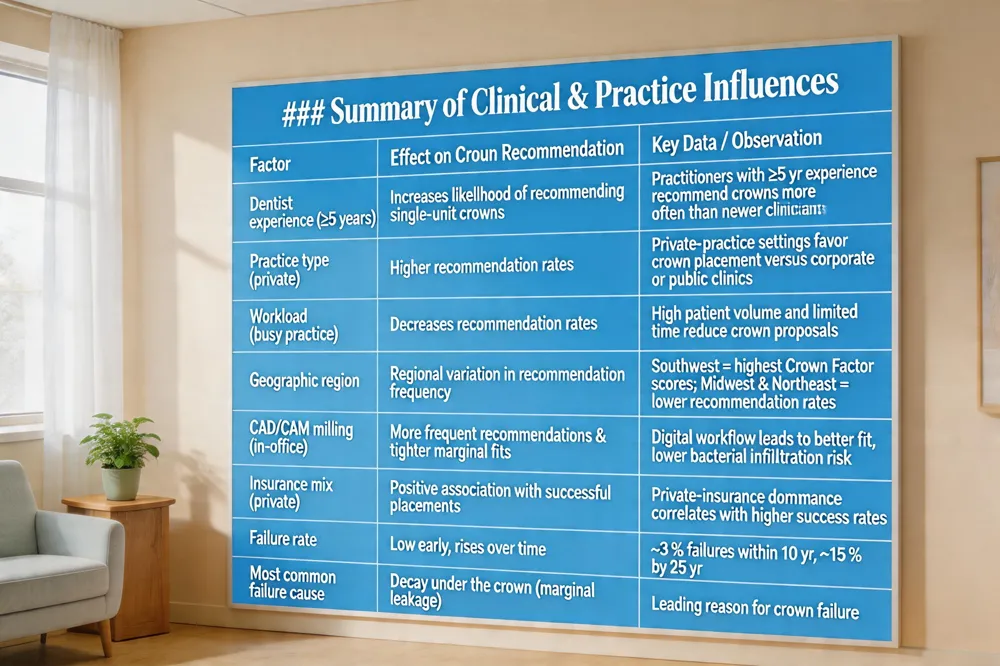 Dentist experience, practice type, and workload all influence crown outcomes. The National Dental Practice‑Based Research Network found that dentists with five or more years of practice and those in private‑practice settings are more likely to recommend single‑unit crowns, while busy practices and limited insurance coverage reduce recommendation rates.
Geographic region also matters; clinicians in the Southwest have the highest Crown Factor scores, whereas those in the Midwest and Northeast recommend crowns less often.
In‑office milling versus lab outsourcing is another key factor. Practices equipped with CAD/CAM milling units tend to recommend crowns more frequently and achieve tighter marginal fits, which lower the risk of bacterial infiltration and secondary caries. Statistical analysis (chi‑square and multiple regression) confirmed that digital workflow adoption and private‑insurance mix are positively associated with successful crown placements.
What is the failure rate for dental crowns? Long‑term studies show a low failure rate—about 3 % within the first 10 years and roughly 15 % by 25 years. Most failures stem from decay under the crown, fracture, or poor oral hygiene.
What is the most common cause of crown failure? Decay beneath the restoration is the leading cause, often due to marginal leakage or inadequate hygiene.
Why do dentists push for crowns? Crowns protect weakened teeth, restore function, and prevent further damage after extensive decay, fracture, or root‑canal treatment.
What happens when a crown fails? The crown may loosen, crack, or detach, exposing the tooth to plaque, pain, and infection. Treatment involves assessing damage, cleaning decay, and either re‑cementing, repairing, or fabricating a new crown.
What is the 50‑40‑30 rule in dentistry? It describes ideal visual proportions in a smile: central incisor ≈ 50 % of visible height, lateral incisor ≈ 40 %, and canine ≈ 30 %.
Choosing the Right Crown Material and Understanding Costs
Material Options, Longevity & Typical Costs
| Material | Typical Longevity (years) | Aesthetic Rating | Approx. Cost (Paterson, NJ) | Insurance Coverage |
|---|---|---|---|---|
| Zirconia (high‑strength ceramic) | 15‑20+ | High (metal‑free, good translucency) | $1,500‑$2,500 | ~50 % (restorative) |
| Lithium‑disilicate (all‑ceramic) | 10‑15 | Very high (excellent shade matching) | $1,500‑$2,500 | ~50 % |
| Porcelain‑fused‑metal (PFM) | 10‑15 | Moderate‑high (metal substructure) | $1,200‑$1,800 | ~50 % |
| Metal‑only (gold/alloy) | 20‑30+ | Low (purely functional) | $900‑$2,500 | ~50 % |
Key cost components
- Dentist fee (prep & placement): $150‑$300
- Lab fabrication fee: $300‑$800
- Material surcharge: PFM $200, All‑ceramic $400, Zirconia $500‑$600
Same‑day CAD/CAM benefit: Eliminates temporary crown & second lab visit, saving $150‑$250 in lab fees.
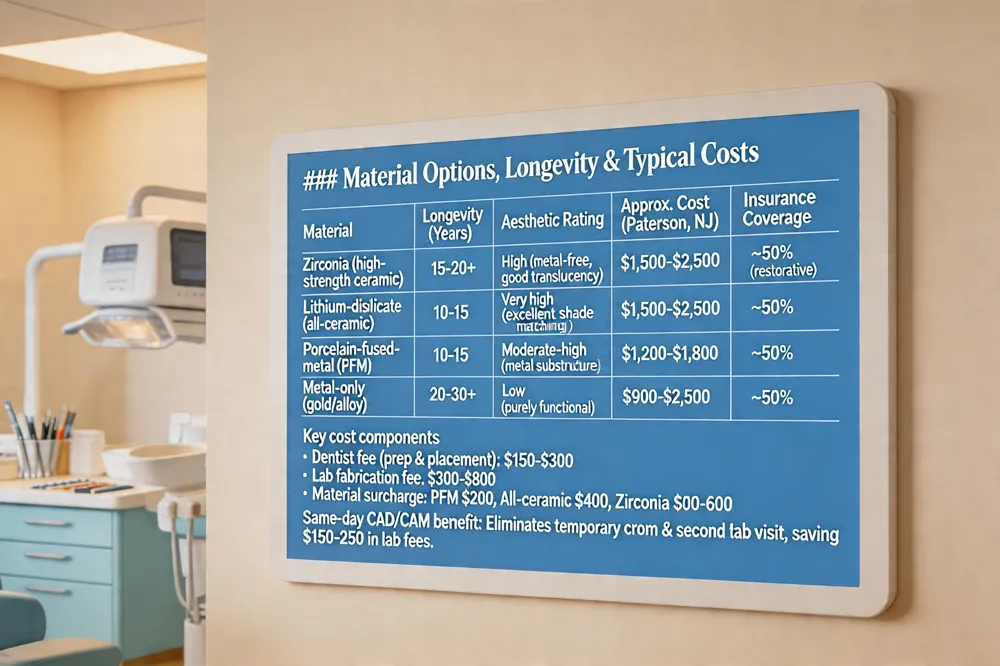 When selecting a crown, patients balance durability with aesthetics. High‑strength ceramics such as zirconia provide a metal‑free, biocompatible option that can endure chewing forces for 15‑20+ years while mimicking natural tooth translucency. All‑ceramic (lithium‑disilicate) crowns offer superior shade matching for front teeth but are slightly less fracture‑resistant than zirconia. Porcelain‑fused‑metal (PFM) crowns combine a metal substructure for strength with a tooth‑colored porcelain veneer, giving a good compromise of durability and appearance. Metal‑only crowns (gold or alloy) are the most durable, lasting 20‑30+ years, yet they lack the aesthetic appeal of ceramic options.
Cost varies by material and location. In Paterson, NJ, a crown typically ranges from $1,200 to $2,500. PFM crowns fall around $1,200‑$1,800, all‑ceramic or zirconia crowns $1,500‑$2,500, and metal crowns $900‑$2,500. Insurance often covers about 50 % of restorative procedures, reducing out‑of‑pocket expenses.
A crown encircles the entire tooth, requiring 1.5‑2 mm of reduction, and restores structural integrity for cracked or heavily restored teeth. A veneer is a thin shell bonded only to the front surface, needing only ~0.5 mm reduction and suited for minor cosmetic concerns. Crowns are generally more durable (10‑15+ years) and typically covered by insurance, whereas veneers are cosmetic and usually paid out‑of‑pocket.
Zirconia crowns stand out for their strength, metal‑free composition, and ability to be milled in‑office for same‑day placement, reducing appointments and costs. However, any crown demands significant tooth removal, can cause post‑procedure sensitivity, and may involve higher fees. Poor fit, inadequate oral hygiene, or bruxism can lead to chipping, loosening, or secondary decay, underscoring the need for regular check‑ups and a custom night guard when grinding is present.
Technical Precision: From Tooth Preparation to Digital Workflow
Tooth Preparation & Digital Workflow Steps
| Step | Description | Typical Measurements / Notes |
|---|---|---|
| Anesthesia & decay removal | Ensure pain‑free, clean substrate | — |
| Tooth reduction | Create space for crown thickness | 1.5 mm total reduction (≈1 mm enamel, 0.5 mm dentin) |
| Margin design | Rounded, smooth finish for impression | – |
| Impression | Conventional PVS or intra‑oral scanner | Scanners eliminate dimensional error |
| CAD/CAM design | Digital file sent to milling unit | Millimeter accuracy, tight marginal fit |
| Milling (in‑office or lab) | Fabricate crown from selected material | Same‑day possible with in‑office unit |
| Fit check & adjustment | Verify occlusion, contacts, marginal seal | Adjust as needed before cementation |
| Cementation | Clean, dry field; use resin‑modified GIC or permanent resin cement; polymerize | Prevent micro‑leakage |
| Bite verification & instructions | Final occlusal check; post‑op care | — |
Bad‑fit symptoms: Chewing pain, temperature sensitivity, “off” bite, inflamed gums, gaps, loose restoration.
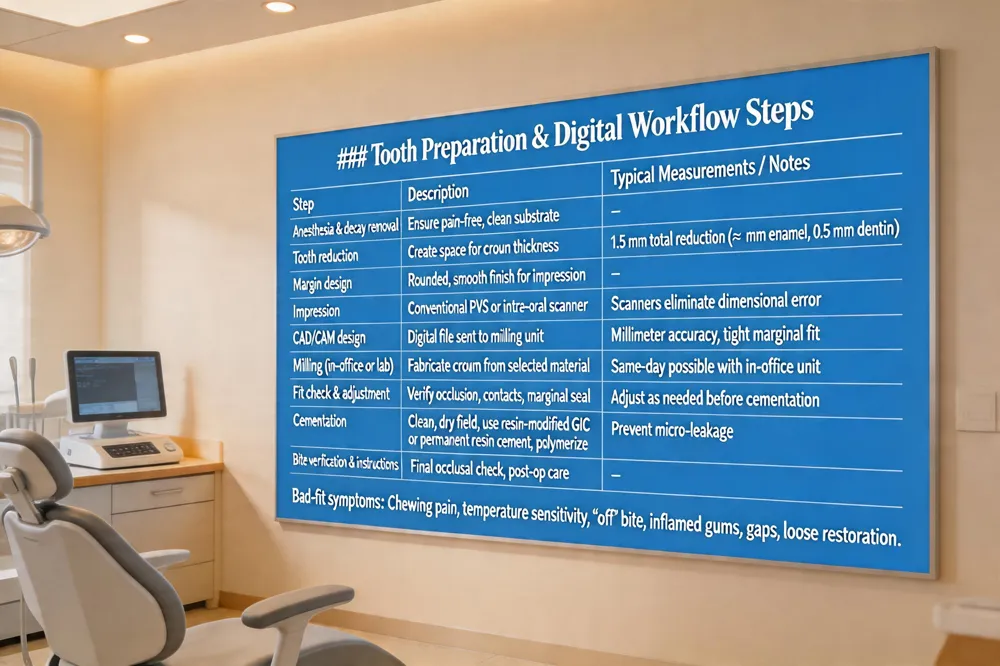 Accurate tooth reduction creates space for a durable crown while preserving healthy structure. Typically 1–1.5 mm of enamel is removed all around, followed by a smooth, rounded margin that guides the impression. Conventional polyvinyl‑siloxane impressions work, but intra‑oral scanners eliminate dimensional error and capture precise bite relationships. When the digital file is sent to a CAD/CAM unit, the crown can be milled in‑office or at a lab with millimeter accuracy, producing a tighter marginal fit and reducing adjustment time. Cementation protocols matter: clean, dry field, appropriate resin‑modified glass ionomer or permanent resin cement, and polymerization to secure the bond and prevent micro‑leakage.
Bad fitting crown symptoms include chewing pain, temperature sensitivity, an “off” bite, inflamed gums, gaps or a loose restoration. Feeling the edge of a crown usually means the margin is high or uneven; polishing can smooth it, but discomfort warrants a dentist visit. Preparing a tooth for a crown starts with anesthesia, decay removal, 1.5 mm reduction, impression or scan, crown placement, and cementation after fit check. The procedure follows this sequence, ending with bite verification and instructions. Leaking crown symptoms are temperature sensitivity, gum swelling, food trapping, bad taste. When a crown does not meet gum line, food can collect, causing irritation; adjustment, replacement, or periodontal treatment may be needed.
Patient Habits, Maintenance and Longevity Strategies
Maintenance Rules & Lifestyle Recommendations
| Habit / Rule | Action | Rationale |
|---|---|---|
| 2‑2‑2 rule | Brush twice daily (2 min), floss/interdental clean twice daily, dentist visit twice a year | Maximizes plaque control & early issue detection |
| 3‑3‑3 rule | Brush three times daily (3 min), avoid eating/drinking for 3 hr before bedtime | Reduces nightly bacterial exposure |
| Oral‑hygiene | Soft‑bristled brush, floss, antibacterial mouthwash | Removes plaque that can infiltrate margins |
| Diet | Avoid ice, hard candy, pens, nuts; limit sugary/acidic drinks; avoid sticky foods | Prevents cement stress, fracture, and decay |
| Bruxism management | Custom night guard if grinding/clenching | Dissipates excess forces, protects crown |
| Professional care | Dental exam & cleaning at least twice a year (ideally every 6 mo) | Early detection of marginal gaps, recession, wear |
| Signs of failure | Pain, looseness, food trapping, bad taste, gum swelling | Prompt professional evaluation needed |
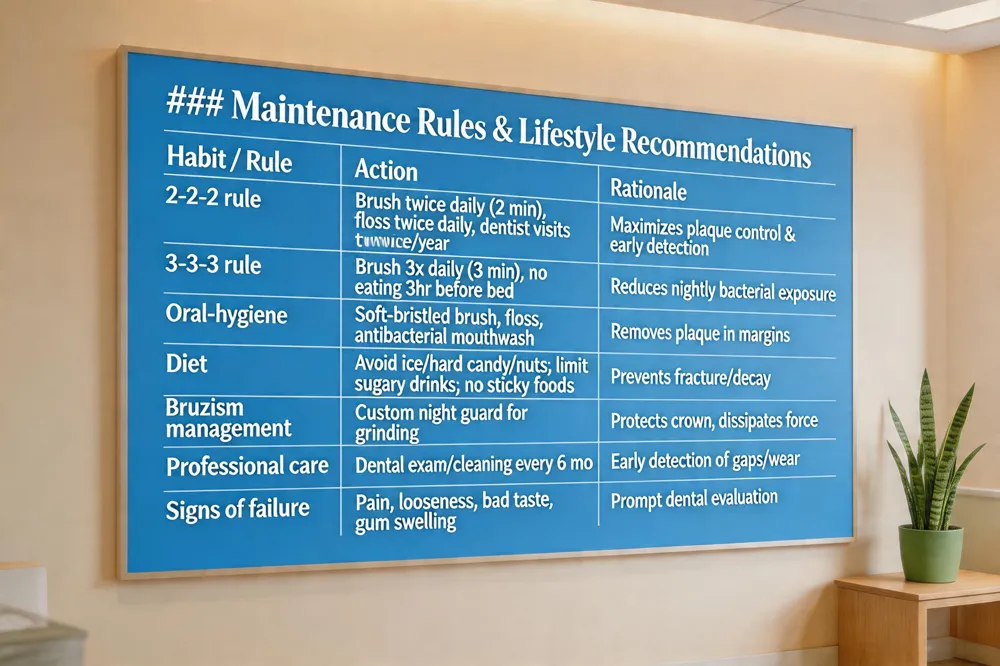 A crown’s success depends as daily habits and regular professional oversight.
Oral‑hygiene routines – Brush twice a day with a soft‑bristled brush for at least two minutes, floss or use interdental brushes daily, and finish with an antibacterial mouthwash. This removes plaque that can infiltrate the crown margin and cause secondary decay.
Diet and sticky foods – Avoid chewing ice, hard candy, pens, nuts, or using the crown as a tool. Limit sugary and acidic drinks, and steer clear of very sticky substances (caramel, taffy) that can pull at the cement and increase fracture risk.
Bruxism management – If you grind or clench, a custom night guard dissipates excessive forces and protects the crown from chipping or loosening.
Regular professional care – Schedule a dental exam and professional cleaning at least twice a year. Early detection of marginal gaps, gum recession, or wear allows timely adjustment or recementation, extending the crown’s life.
2‑2‑2 rule – Brush twice daily for two minutes, clean between teeth twice daily, and see the dentist twice a year. This evidence‑based routine maximizes plaque control and early intervention.
3‑3‑3 rule – Brush three times a day for three minutes each session and avoid eating or drinking for three hours before bedtime to reduce nightly bacterial exposure.
Can a tooth crown go bad? Yes. Decay at the margin, weakened cement, cracks from grinding, or gum recession can cause pain, looseness, or loss of the crown. Prompt professional care can repair or replace the restoration before more extensive treatment is needed.
How to make crowns last a lifetime? Follow diligent oral hygiene, attend six‑month check‑ups, avoid hard or sticky foods, wear a night guard if you grind, and address any sensitivity or loosening immediately. Consistent care can keep a crown functional and aesthetic for decades.
Financial Aspects, Insurance and Warranty Considerations
Financial Breakdown & Coverage Overview
| Cost Component | Typical Range | Notes |
|---|---|---|
| Dentist’s preparation & placement fee | $150‑$300 | Includes anesthesia, reduction, bonding |
| Laboratory fabrication fee | $300‑$800 | Depends on lab and material complexity |
| Material surcharge | PFM $200; All‑ceramic $400; Zirconia $500‑$600 | Adds to total price |
| Total crown cost (Paterson, NJ) | $1,200‑$2,500 (varies by material) | Insurance may cover 50 %‑80 % |
| Insurance coverage | 50 %‑80 % for medically necessary crowns | Higher for metal‑based, lower for all‑ceramic |
| Same‑day CAD/CAM savings | $150‑$250 reduced lab fees | Eliminates temporary crown & second visit |
| Warranty | 1‑2 yr limited (defects in material/workmanship) | Manufacturer or practice‑provided |
| When replacement is free | Manufacturing defect or insurance‑covered medically necessary failure | Routine wear/chip is patient‑responsibility |
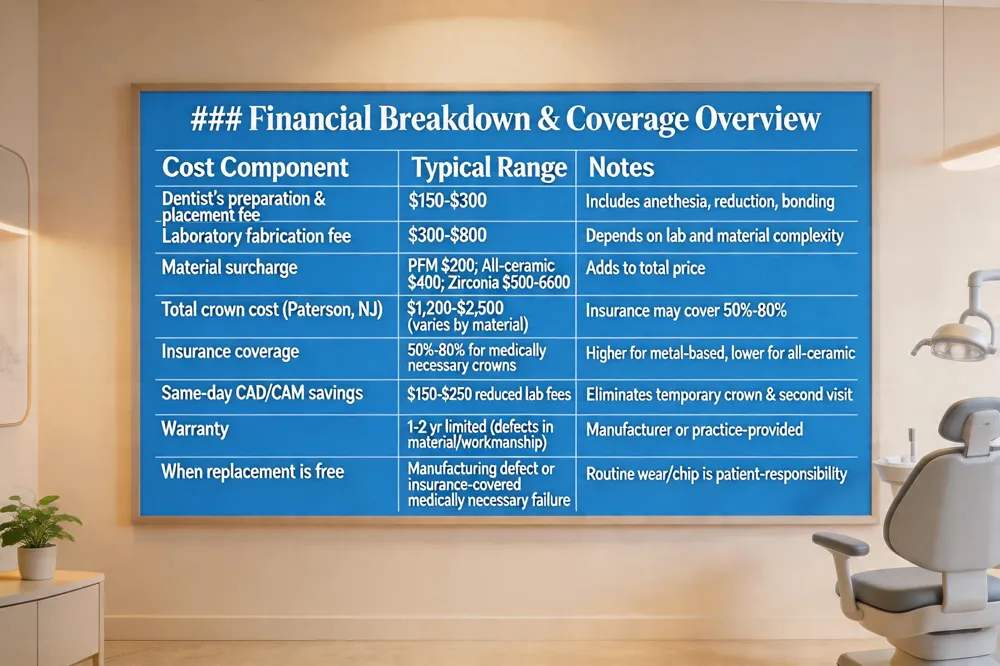 Dental crowns are a significant investment, and understanding the financial landscape helps patients make informed choices.
Insurance coverage percentages – Most dental insurance plans cover 50 % to 80 % of the cost for a crown when it is deemed medically necessary, such as after a root canal or for a fractured tooth.
Coverage varies by plan, with some offering higher reimbursement for metal‑based crowns and lower for all‑ceramic options.
Cost breakdown for materials and lab work – The total price consists of three main components: the dentist’s fee for preparation and placement (≈ $150‑$300), the laboratory fee for fabricating the crown (≈ $300‑$800), and the material surcharge (porcelain‑fused‑metal ≈ $200, all‑ceramic ≈ $400, zirconia ≈ $500‑$600). Larger restorations or custom shade matching can add $100‑$200.
Same‑day CAD/CAM cost benefits – Practices that use in‑office CAD/CAM milling eliminate the need for a temporary crown and a second lab visit, often reducing overall lab fees by $150‑$250 and shortening the treatment timeline. The upfront technology fee is usually bundled into the crown’s price, making same‑day crowns a cost‑effective option for many patients.
Warranty and free replacement policies – Some offices offer a limited warranty that covers defects in material or workmanship for 1‑2 years.
What dental player is shouldn't crown because – A dentist will replace a crown at no charge only when the crown fails because of a manufacturing defect or if the underlying tooth is damaged and the work is covered by your insurance or a warranty.
Routine wear, chips, or aesthetic concerns that arise from normal use are generally considered the patient’s responsibility and will involve a co‑pay or out‑of‑pocket fee.
It’s important to review your dental plan’s specific coverage for crowns and any “fit‑and‑finish” guarantees the practice offers.
If you experience pain, looseness, or visible damage, schedule a prompt exam so the dentist can determine whether the replacement is medically necessary and potentially covered.
Otherwise, expect to pay the usual cost, which can vary based on material, complexity, and your insurance benefits.
Putting It All Together for Long‑Lasting Crowns in Paterson
Successful crowns depend on more than just the material; the National Dental Practice‑Based Research Network shows that dentist experience, practice setting, and laboratory workflow all affect outcomes. Dentists with five‑plus years of experience, private‑practice offices, and in‑office milling capabilities are more likely to recommend and deliver well‑fitted single‑unit crowns. Patient factors are equally critical—consistent oral hygiene, avoidance of hard or sticky foods, management of bruxism with a night guard, and prompt treatment of gum disease protect the restoration and the underlying tooth. Regular check‑ups allow early detection of marginal decay or occlusal issues, extending the crown’s lifespan to 15‑20 years or more. If you live in Paterson and want a crown that blends durability with natural aesthetics, schedule a personalized consultation at The The Dental Mission. Our multilingual team will assess your needs, discuss material options, and create a treatment plan that maximizes long‑term success.