Why Teledentistry Matters Today
During the COVID‑19 pandemic, dental offices quickly adopted real‑time video and store‑and‑forward teledentistry to keep patients safe while still providing urgent care. The rapid shift proved that remote triage can assess pain, swelling and trauma, allowing dentists to prescribe analgesics or antibiotics and schedule same‑day in‑office treatment only when necessary. This model is especially valuable for underserved communities that face transportation barriers, limited provider availability, or long wait times. By eliminating travel, teledentistry cuts costs and reduces missed work or school hours, expanding access to timely dental advice. In Paterson, New Jersey, a multilingual team fluent in English, Spanish and Arabic uses secure video platforms to communicate clearly with diverse families, ensuring that language is no longer a barrier to emergency dental care. This approach also strengthens patient trust and promotes oral health equity.
Understanding Teledentistry Models and Platforms
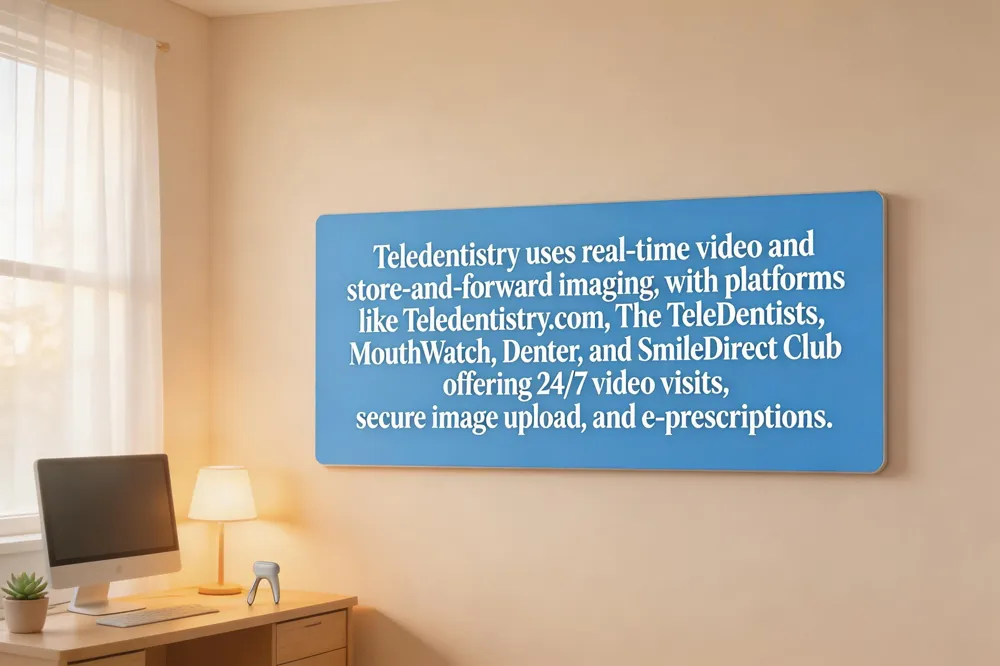 Teledentistry relies on two interaction models. Real‑time video conferencing lets a dentist see the patient live, assess oral conditions, review radiographs, and discuss treatment plans instantly—ideal for same‑day emergency triage. Store‑and‑forward imaging, patients upload high‑resolution photos, intra‑oral scans, or radiographs for asynchronous review, which can be combined with a brief video call to improve diagnostic accuracy. Popular platforms include Teledentistry.com, The TeleDentists, MouthWatch, Denter, and SmileDirect Club. These services offer 24/7 video consultations, secure image upload, prescription delivery, and many integrate intra‑oral cameras for clearer imaging.
What are the most common teledentistry platforms? The leading platforms are Teledentistry.com, The TeleDentists, MouthWatch, Denter, and SmileDirect Club, all providing video visits, photo‑based assessments, and emergency prescription services, often with insurance coverage.
Is teledentistry legit? Yes. It is a regulated, HIPAA‑compliant care modality recognized by state dental boards and the ADA. While it cannot replace hands‑on procedures, it reliably supports diagnosis, triage, treatment planning, and orthodontic monitoring, with many insurers reimbursing the service.
Emergency Triage and Same‑Day Care Coordination
 Real‑time video lets a dentist see the oral cavity and radiographs, enabling rapid assessment of pain or trauma. Using a triage protocol, the clinician classifies the call as emergency, urgent or non‑urgent and decides whether analgesics, a prescription, or immediate in‑person treatment is required. When an emergency is identified—such as uncontrolled toothache or a broken crown—the practice schedules a same‑day office slot and sends prescriptions to a local pharmacy, reducing travel time and costs.
Why is teledentistry important? It bridges geographic and socioeconomic gaps, giving underserved patients direct access to licensed dentists, lowers infection risk and shortens wait times, thus reducing oral‑health disparities.
Can I get an emergency dentist online? Yes—our 24/7 portal lets you upload photos, describe symptoms and receive triage, pain‑relief advice, and e‑prescriptions; if needed we arrange a same‑day in‑person visit.
What conditions are classified as urgent dental treatment? Severe uncontrolled tooth or facial pain, spreading infection or swelling, uncontrolled bleeding, a broken adult tooth causing intense pain, and persistent oral lesions that could indicate serious disease.
Practical Patient Concerns: Prescriptions, Insurance, and Access
 Teledentistry platforms can issue prescriptions for antibiotics, analgesics, and other non‑controlled dental medications, but only after a licensed dentist completes a real‑time video exam and verifies the condition. Some services waive the consultation fee when the visit is covered by insurance; otherwise a modest copay is charged, and controlled substances are never prescribed online.
The Paterson, NJ practice (David M.ayer, DDS) is an in‑network provider for Delta Dental, allowing members to use their benefits for routine and emergency care. The office also accepts a broad range of major dental plans, though it does not participate in Medicaid. Patients on Medicaid should confirm coverage with any virtual‑dental service beforehand, as many platforms restrict reimbursement to in‑person visits.
Limitations of teledentistry include the inability to perform tactile examinations, potential image‑quality issues, and reliance on stable internet and suitable devices. Privacy safeguards such as HIPAA‑compliant encryption are required, and some insurers still limit reimbursement for remote consultations, which can lead to out‑of‑pocket expenses.
Optimizing Oral Health: Guidelines and Follow‑Up
 The 3‑3‑3 rule is an intensive oral‑hygiene guideline: brush three times a day, spend at least three minutes per session, and avoid acidic foods or drinks for three hours before bedtime. It promotes thorough plaque removal while allowing the mouth time to recover from dietary acids, though most clinicians still recommend the baseline of twice‑daily, two‑minute brushing with a soft‑bristled brush to prevent enamel wear.
The 50‑40‑30 aesthetic proportion rule guides smile design: the central incisor occupies roughly 50 % of the visible tooth width, the lateral incisor about 40 %, and the canine about 30 %. Applying these ratios helps dentists create harmonious restorations that look natural and balanced.
Virtual follow‑up after procedures leverages secure video or store‑and‑forward platforms to assess healing, reinforce oral‑hygiene instructions, and adjust treatment plans without requiring a physical visit. This approach reduces travel time, speeds pain relief, and improves patient satisfaction while maintaining HIPAA‑compliant privacy.
Implementation Success in Paterson, NJ
 In Paterson, New Jersey, the dental practice has leveraged a multilingual team fluent in English, Spanish, and Arabic to eliminate language barriers and ensure clear communication during virtual triage. State‑of‑the‑art technology—including high‑resolution intra‑oral cameras and secure, HIPAA‑compliant video platforms—allows dentists to capture detailed images and conduct real‑time examinations that rival in‑office assessments. These tools feed directly into a streamlined same‑day emergency workflow: a patient initiates a teledentistry visit, the clinician quickly evaluates pain severity, reviews radiographs or photos, and decides whether to prescribe medication, arrange a same‑day in‑office procedure, or refer to a specialist. This integrated approach reduces travel time, accelerates pain relief, and maximizes chair‑side capacity while maintaining privacy and informed‑consent standards.
The Future of Same‑Day Dental Care
Advances in artificial‑intelligence image analysis are poised to sharpen teledentistry diagnostics, allowing algorithms to flag caries, periapical lesions, and orthodontic problems within seconds of a photo upload. As insurers broaden coverage for synchronous video visits and store‑and‑forward consultations, reimbursement parity with in‑person care will make virtual triage financially viable for more practices. This insurance momentum, combined with secure, HIPAA‑compliant platforms, will expand same‑day emergency access for underserved populations—rural residents, low‑income families, and multilingual communities who previously faced long travel distances or appointment backlogs. By integrating AI‑enhanced assessments, robust payer support, and inclusive outreach, dental teams can deliver rapid, accurate, and equitable emergency treatment for all patients.