Why Bite Alignment Matters
A properly aligned bite is a cornerstone of oral health. When the upper and lower teeth meet in harmony, chewing forces are distributed evenly across the dental arch, protecting each tooth from excess wear, fracture, or periodontal stress. An imbalanced bite can lead to a cascade of problems: chronic jaw or facial pain, frequent headaches, uneven tooth wear, gum recession, and even temporomandibular joint (TMJ) disorders. Patients often notice symptoms such as clicking or popping of the jaw, difficulty biting into foods, cheek biting, or a sensation that the bite feels “off.”
Restorative dentistry plays a pivotal role in correcting these issues. Customized dental crowns, bridges, and implants can rebuild lost tooth height, reshape worn surfaces, and re‑establish a stable occlusal plane. By carefully contouring crowns to match the patient’s bite dynamics, dentists can guide misaligned teeth into proper positions, reduce abnormal forces, and prevent adjacent teeth from drifting. Modern CAD/CAM technology and digital bite registration allow for precise fabrication, minimizing the need for post‑placement adjustments. When combined with orthodontic evaluation, restorative solutions provide a less invasive, long‑term pathway to a comfortable, functional bite that supports overall oral health and patient well‑being.
Understanding Dental Crowns: From Preparation to Placement
 Preparing a tooth for a crown
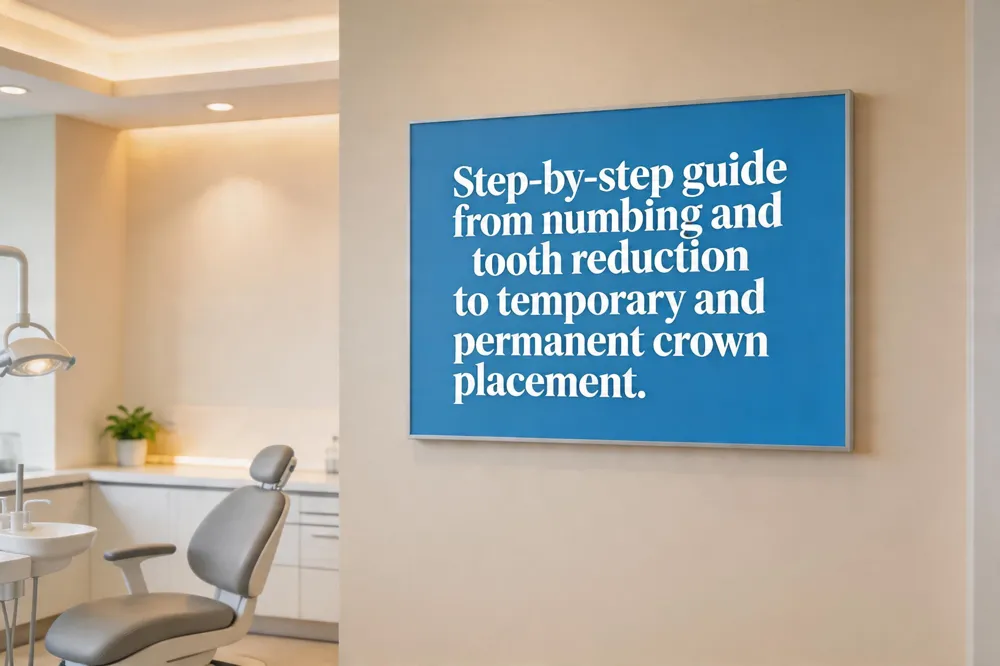
The dentist first numbs the area with a local anesthetic. Decay, old fillings, or damaged structure are removed using a dental drill, then the tooth is cleaned and disinfected. The remaining tooth is shaped and smoothed to create space for the crown and ensure proper margins. A digital scan or traditional impression is taken, and a temporary crown is placed to protect the tooth while the permanent restoration is fabricated.
Preparing a tooth for a crown
The dentist first numbs the area with a local anesthetic. Decay, old fillings, or damaged structure are removed using a dental drill, then the tooth is cleaned and disinfected. The remaining tooth is shaped and smoothed to create space for the crown and ensure proper margins. A digital scan or traditional impression is taken, and a temporary crown is placed to protect the tooth while the permanent restoration is fabricated.
Step‑by‑step dental crown procedure
- Consultation: examination, X‑rays or digital scan to confirm a crown is needed.
- Anesthesia and tooth reduction: a small amount of enamel is removed; an impression or intra‑oral scan captures exact dimensions.
- Temporary crown placement while the custom crown is made (usually 1–2 weeks).
- Permanent crown try‑in and adjustment for fit and bite, then cementing and polishing.
- Occlusion check, after‑care instructions, and follow‑up appointment.
Types of dental crowns and cost Metal crowns (gold‑platinum or base‑metal alloys) are the most durable, costing roughly $800‑$1,200, but lack natural aesthetics. Porcelain‑fused‑to‑metal crowns combine a metal core with tooth‑colored porcelain for $1,000‑$1,500. All‑ceramic options, such as full porcelain or zirconia, offer the most lifelike appearance and range from $1,500‑$3,000. Prices vary by material, tooth location, and lab fees.
Why does it take 2 weeks to make a crown? The crown is custom‑crafted in a dental laboratory. After the impression or digital scan is sent, skilled technicians design and fabricate a restoration that fits precisely, a process that typically requires 1‑2 weeks.
Bite Alignment Benefits and How Crowns Help
 Dental crowns do more than protect a weakened tooth; they can actively improve bite alignment. By restoring the proper height, shape and and contour of a damaged or worn tooth, a crown helps the upper and lower teeth meet evenly, distributing chewing forces across the arch and reducing pressure on neighboring teeth and the temporomandibular joint (TMJ). This correction can relieve jaw pain, improve chewing efficiency, and prevent further wear.
Symptoms of bite problems after crowning – Patients may notice a high‑spot sensation, clicking or popping when chewing, sore jaw muscles, or lingering sensitivity to hot and cold. Gum irritation, localized swelling, or a feeling that one side of the bite is higher than the other also signal an uneven fit.
Crown adjustment and pain management – A crown adjustment is a precise reshaping of the restoration (or opposing teeth) using articulating paper and fine grinding to eliminate high spots. The procedure is usually painless and completed in a single visit. Mild discomfort after adjustment is normal and subsides within a few days; persistent sharp pain or swelling warrants a follow‑up.
Impact on TMJ and chewing efficiency – Properly contoured crowns create a uniform occlusal surface, which balances bite forces, reduces strain on the TMJ, and enhances masticatory efficiency. When the bite is stable, patients experience less fatigue while chewing and a lower risk of TMJ‑related symptoms.
In summary, crowns can correct minor bite irregularities, alleviate TMJ stress, and improve chewing function—provided they are accurately fabricated and, if needed, promptly adjusted.
Financial Considerations and Value of Crowns
 Dental crowns in the United States typically range from $800 to $3,000 per tooth, with most averages falling between $1,100 and $2,000 depending on the material—porcelain‑fused‑to‑metal, all‑ceramic, zirconia, gold, or base‑metal. The quoted price includes laboratory fabrication, the dentist’s preparation and placement time, local anesthetic, and any temporary crown. Most insurance plans cover roughly 50 % of the cost after deductibles, and many Paterson, NJ practices (including Paradise Valley Dental) offer financing and same‑day milling to reduce out‑of‑pocket expenses.
Is $2,000 a lot? For a high‑quality porcelain or zirconia crown, $2,000 falls squarely within the typical $1,500‑$3,000 range. Considering a well‑placed crown can last 15‑20 years, the annual cost breaks down to about $80‑$300—comparable to other long‑term dental investments.
Disadvantages and long‑term value: Crowns require removal of healthy enamel, which permanently alters the tooth and may increase sensitivity. They are more expensive than fillings and can chip, crack, or become loose if cement deteriorates, potentially leading to decay. Poor fit can cause bite issues, gum irritation, or dark lines at the gum line. Despite these drawbacks, a properly fitted crown protects the tooth, restores function, and helps maintain a stable bite, offering lasting value when combined with regular oral hygiene and routine check‑ups.
Aesthetic Transformations: Front Teeth Crowns Before and After
 Front‑tooth crowns dramatically improve a smile’s visual appeal. Before treatment, a tooth may be discolored, chipped, misaligned, or even missing, creating an uneven or aged appearance. Using digital impressions, a custom porcelain or all‑ceramic crown is fabricated to match the exact shade, shape, and translucency of adjacent teeth. The crown is bonded in a single visit with state‑of‑the‑art adhesive techniques, delivering a seamless, natural look, restored strength, and proper bite alignment.
A crown (full‑cover cap) encases the entire visible portion of the tooth, offering maximum protection and durability, while a dental cap (onlay/inlay) only covers the biting surface and one or two sides, preserving more healthy structure. Caps are less invasive and often less costly, but crowns are preferred for severely cracked, broken, or heavily restored teeth and for supporting bridges or implants.
Patients at our Paterson, NJ practice experience compassionate, multilingual care (English, Spanish, Arabic) and benefit from over 40 years of expertise combined with digital scanning and CAD/CAM technology. The result is a brighter, confidently aligned smile achieved efficiently and comfortably.
Safety, Longevity, and Follow‑Up Care
 Dental crowns are a safe, long‑term solution for restoring damaged teeth. Current scientific evidence shows no link between crown materials—porcelain, ceramic, zirconia, or approved metal alloys—and cancer; these materials are rigorously tested for biocompatibility and approved by the FDA. After cementation, a crown can be gently adjusted if it feels high, uneven, or causes bite discomfort. Using fine diamond burs or polishing kits, the dentist trims excess material and re‑polishes the surface, usually in a single visit. Minor mis‑fits may require crown removal and replacement, but prompt adjustments prevent gum irritation, sensitivity, and future complications.
Once a crown is placed, most patients notice the bite settling within a few days to a week. The jaw muscles adapt to the new contour, and temporary pressure or sore spots are normal. Persistent pain, swelling, or sharp sensitivity beyond a few days warrants a follow‑up for re‑evaluation and possible further adjustment.
Regular check‑ups are essential for monitoring occlusion, crown integrity, and oral health. Dentists often recommend a nightguard for patients who grind (bruxism) to protect the restoration and maintain a stable bite. Over time, a well‑fitted crown preserves tooth structure, distributes chewing forces evenly, and contributes to long‑term oral health by preventing decay, shifting, and TMJ strain.
Putting It All Together for a Healthier Bite
Dental crowns play a central role in achieving and maintaining a stable, comfortable bite. By restoring the original height, shape, and strength of a damaged tooth, crowns create a uniform occlusal surface that distributes chewing forces evenly across the arch. This prevents adjacent teeth from drifting, reduces uneven wear, and alleviates strain on the temporomandibular joint, ultimately improving chewing efficiency and lowering the risk of jaw pain. When crowns are custom‑designed with digital scans and bite analysis, they can even reshape or reposition one or two misaligned teeth, offering a less invasive alternative to orthodontic appliances for mild to moderate bite issues. If you are experiencing bite discomfort, uneven wear, or difficulty chewing, a consultation with a skilled dentist can determine whether crowns are the right solution for you.
Patients in Paterson, NJ, benefit from the expertise of practices such as Paradise Valley Dental, Comfort Dental Care, and NÜVA Smile, each offering over 40 years of experience, multilingual staff (English, Spanish, Arabic), and state‑of‑the‑art technology—including CAD/CAM milling and CBCT imaging—to ensure precise, comfortable restorations. Schedule your appointment today to protect your teeth, restore proper occlusion, and enjoy a healthier, more confident smile.