Introduction
Dental crowns are custom‑made caps that encase the entire visible portion of a damaged tooth, restoring its shape, size, strength and appearance. They are fabricated from materials such as porcelain, zirconia, metal alloys or porcelain‑fused‑to‑metal, and are indicated for severely decayed, cracked, or root‑canal‑treated teeth, as well as for cosmetic enhancement. In Paterson, NJ, restorative dentistry is vital because the city’s diverse, 150,000‑strong population benefits from comprehensive oral‑health services that address high rates of decay and trauma. Local health initiatives, multilingual dental teams, and insurance coverage make crown treatments accessible, helping Paterson residents preserve natural teeth, improve chewing function, and maintain confident smiles.
Understanding Dental Crown Types and Their Costs
Crown Types & Typical Cost Ranges
| Crown Type | Material | Typical Cost Range (USD) | Notes |
|---|---|---|---|
| All‑Ceramic / Porcelain | Porcelain, Zirconia, Ceramic | $1,500 – $3,500 | Highest aesthetics, natural appearance; often used for front teeth |
| Metal‑Ceramic (PFM) | Porcelain fused to metal | $800 – $2,000 | Good strength + decent aesthetics; common for posterior teeth |
| Full Metal | Gold alloy, base‑metal alloy | $800 – $2,000 | Highest durability, less aesthetic; may cause dark gum line |
| Same‑Day CAD/CAM (any material) | Usually ceramic or PFM milled in‑office | $1,200 – $3,200 | Fabricated and placed in a single visit, no temporary crown needed |
Insurance typically covers 50‑80 % of the allowed fee, reducing out‑of‑pocket cost.
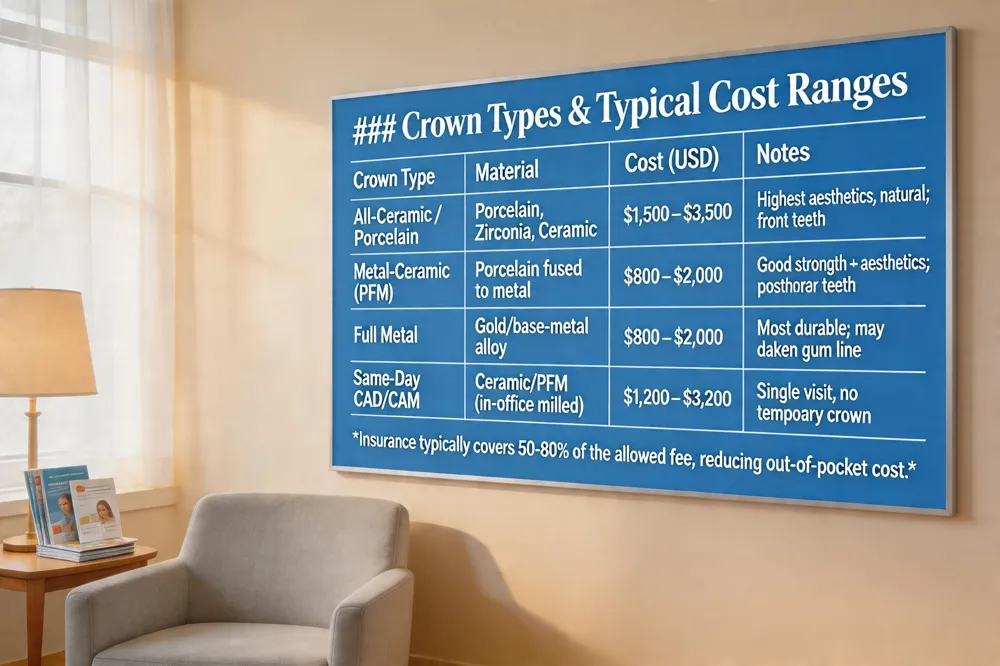 Porcelain or all‑ceramic crowns, which offer the most natural appearance, fall at the higher end of the range (about $1,500‑$3,500), while metal or PFM crowns usually fall between $800 and $2,000.
Most dental insurance plans cover a portion of the cost—often 50‑80 % of the allowed fee—so out‑of‑pocket expenses may be much lower after benefits are applied.
A $2,000 price tag falls squarely within the typical $1,500‑$3,000 range for a single‑tooth crown, reflecting higher‑quality material such as PFM or all‑ceramic, which offer better aesthetics and durability.
In Paterson, where practices use state‑of‑the‑art technology and a multilingual staff, the cost also includes expertise and convenience, including same‑day CAD/CAM crowns.
Typical dental procedure prices in Paterson range from $80‑$150 for a routine exam to $100‑$200 for a professional cleaning. Fillings cost $150‑$300, crowns $800‑$3,500, implants $2,500‑$5,000, and dentures $500‑$2,000. Major restorative procedures such as crowns, bridges, and implants generally cost between $1,200 and $5,000 per unit in New Jersey.
The Crown Placement Process: From Preparation to Final Cementation
Step‑by‑Step Crown Placement Workflow
| Step | Description | Key Points |
|---|---|---|
| 1. Exam & Radiographs | Comprehensive oral exam, X‑rays to assess tooth health | Determines suitability for crown |
| 2. Anesthesia | Local anesthetic administered | Ensures patient comfort |
| 3. Tooth Reduction | 1–2 mm of healthy enamel shaved and shaped | Provides space for crown, protects tooth from fracture |
| 4. Impression / Digital Scan | Physical impression or intra‑oral scan taken | Guides lab or CAD/CAM fabrication |
| 5. Temporary Crown Placement | Prefabricated temporary crown cemented | Maintains bite, protects prepared tooth |
| 6. Fabrication | Lab creates permanent crown or in‑office CAD/CAM mills it (same‑day) | Material choice determines aesthetics & strength |
| 7. Fit Check | Temporary crown removed, permanent crown tried in | Adjustments made for proper occlusion |
| 8. Cementation | Permanent crown permanently bonded | Finalizes restoration |
| 9. Follow‑Up | Post‑procedure instructions & check‑up visit | Addresses sensitivity, ensures comfort |
Same‑day CAD/CAM eliminates the need for a temporary prosthesis and reduces overall treatment time.
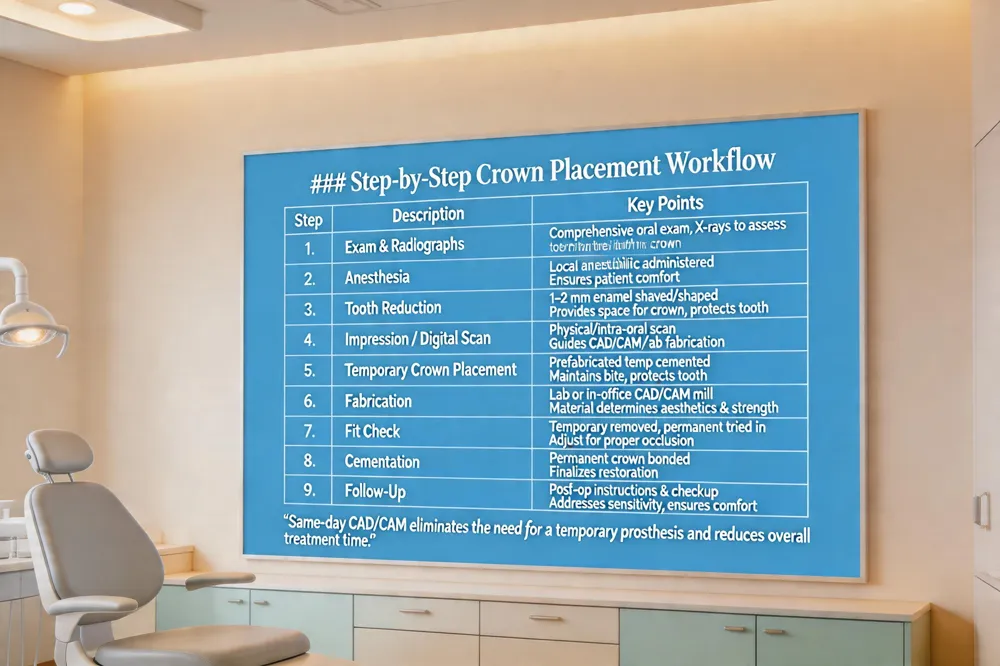 Dental crowns are a cornerstone of restorative dentistry, and the procedure follows a clear, step‑by‑step pathway that balances comfort, precision, and durability.
Preparing a tooth for a crown – The dentist first numbs the area with a local anesthetic. Decayed tissue, old restorations, and any structural damage are removed, and the remaining tooth is cleaned and disinfected. A small amount of healthy enamel (typically 1–2 mm) is then shaved down and smoothed to create a uniform surface that will accept the crown. This reshaping ensures a snug, stable fit and protects the tooth from future fracture.
Impression and temporary crown – Once the tooth is prepared, an impression or intra‑oral digital scan is taken. This record guides the dental laboratory (or an in‑office CAD/CAM system) in fabricating a custom permanent crown. While the final restoration is being made, a temporary crown is placed to shield the prepared tooth, maintain bite function, and preserve aesthetics.
Same‑day CAD/CAM options – Modern practices often offer same‑day crowns using CAD/CAM technology. After the digital scan, the crown is milled on site and placed in a single visit, eliminating the need for a temporary prosthesis and reducing overall treatment time.
Step‑by‑step dental crown procedure – The process begins with a comprehensive exam and radiographs, followed by anesthesia, tooth reduction, impression/scanning, temporary crown placement, laboratory or in‑office fabrication, final fit check, and permanent cementation. A brief follow‑up ensures comfort and provides post‑procedure care instructions.
Can dental crowns cause cancer? – Extensive research shows no link between dental crowns and cancer. Contemporary crowns are made from biocompatible materials such as porcelain, zirconia, ceramic, or approved metal alloys, all of which have passed rigorous safety testing and FDA clearance. The myth stems from outdated studies and has been disproven by modern peer‑reviewed evidence. Proper oral hygiene and regular dental visits remain the best safeguards for overall health.
Benefits and Potential Drawbacks of Dental Crowns
Benefits vs. Potential Drawbacks
| Aspect | Benefits | Potential Drawbacks |
|---|---|---|
| Protection | Restores strength to severely damaged teeth; prevents further decay | Requires removal of healthy enamel (permanent) |
| Aesthetics | Natural appearance especially with all‑ceramic crowns | Metal crowns may cause dark gum line |
| Durability | Long‑lasting (10‑15 years or more) with proper care | Possible chipping or fracture under high bite forces |
| Function | Restores bite, chewing efficiency | Temporary sensitivity to hot/cold after placement |
| Versatility | Can serve as anchor for bridges or implants | Higher cost ($1,000 +); insurance may only cover part |
| Biocompatibility | Materials are FDA‑cleared and safe | Rare metal allergies; poor fit can lead to gum irritation or decay underneath |
Overall, crowns are a prudent investment for teeth needing extensive restoration, provided the patient maintains good oral hygiene.
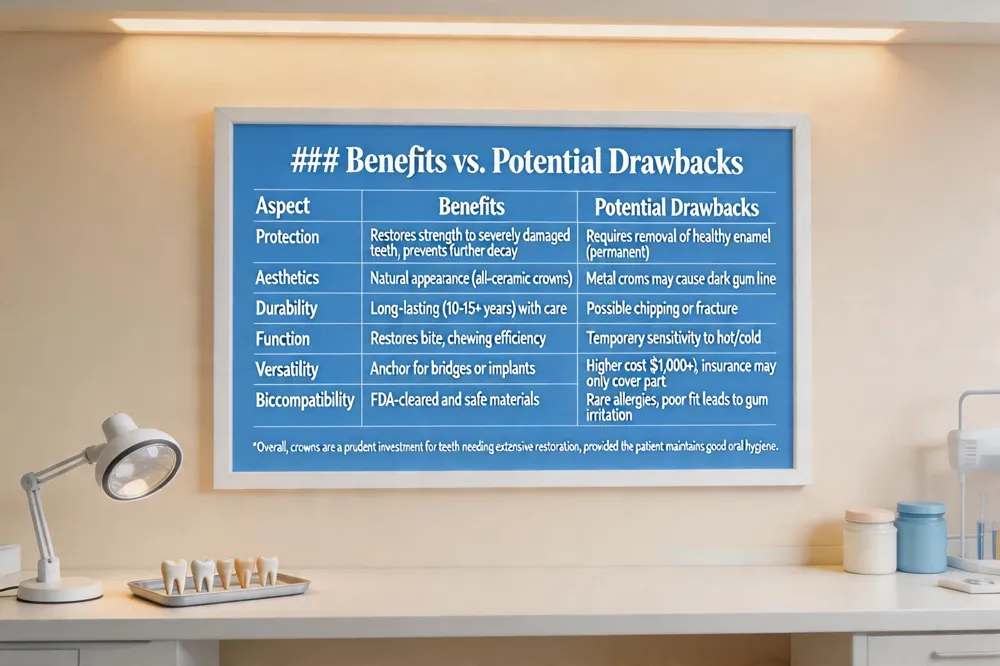 However, crowns have possible disadvantages. They often cost $1,000 or more and require the permanent removal of healthy enamel. Patients may experience temporary sensitivity to hot or cold, gum irritation, or, if the fit is poor, looseness, chipping, or detachment. Poor oral hygiene can allow decay beneath the crown, and metal‑based crowns may trigger allergies or create a dark gum line. An ill‑fitted crown can alter bite alignment and cause wear on neighboring teeth.
Is it worth getting crowns? For teeth that are severely decayed, cracked, or have undergone a root canal, the strength and support a crown offers can prevent further damage and preserve the tooth long‑term, making the investment a prudent choice for many patients.
Insurance, Financing, and Affordability
Major Restorative Procedure Costs & Insurance Impact (Paterson, NJ)
| Procedure | Typical Cost Range (USD) | Typical Insurance Coverage* | Out‑of‑Pocket (70 % coverage) |
|---|---|---|---|
| Porcelain Crown | $1,500 – $3,500 | 50‑80 % | $300 – $1,050 |
| Metal / PFM Crown | $800 – $2,000 | 50‑80 % | $160 – $600 |
| Bridge (per tooth) | $500 – $1,500 | 50‑80 % | $100 – $450 |
| Implant (incl. crown) | $2,500 – $5,000 | 50‑80 % | $500 – $1,500 |
| Full‑Arch Denture | $1,000 – $6,000 | 50‑80 % | $200 – $1,200 |
| Routine Exam | $80 – $150 | 100 % (preventive) | $0 |
| Professional Cleaning | $100 – $200 | 100 % (preventive) | $0 |
Coverage percentages vary by plan, deductible, and annual maximums.
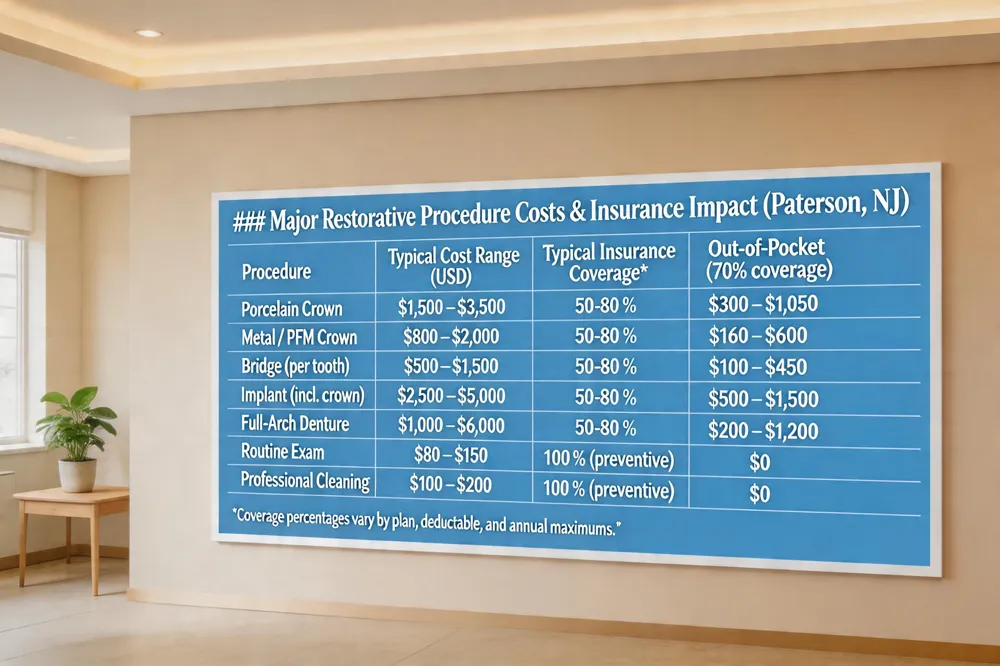 Restorative dental insurance in Paterson, NJ typically helps pay for procedures that repair or replace damaged teeth—such as crowns, bridges, implants, dentures, and root canals. Most plans cover 50 % to 80 % of the allowed fee after deductibles and co‑pays, while preventive care is often 100 % covered. Coverage limits, waiting periods and annual maximums vary by carrier, so reviewing your specific plan is essential. Choosing a PPO or DHMO network that includes our Paterson office ensures you can receive restorative treatment without unexpected out‑of‑pocket costs. Our multilingual team is happy to walk you through your benefits.
Major restorative dental cost – In New Jersey, crowns, bridges, implants and extensive denture work generally range from $1,200 to $5,000 per unit. A single porcelain crown falls between $500 and $2,000; metal‑based crowns are $500‑$1,500. Bridges cost $500‑$1,500 per tooth, and implants (including the crown) range $2,500‑$5,000. Full‑arch dentures start around $1,000 and can exceed $6,000 for premium or implant‑supported designs.
Dental crown cost in Paterson – Expect $800‑$3,500 per tooth. Porcelain or all‑ceramic crowns (the most natural‑looking) are $1,500‑$3,500, while metal or porcelain‑fused‑to‑metal crowns range $800‑$2,000. Insurance often covers 50‑80 % of the fee, reducing your out‑of‑pocket expense. We offer detailed estimates and financing options such as CareCredit to make crowns more affordable. Contact us today for a personalized quote and to explore your insurance benefits.
Choosing Between a Crown and Other Restorative Options
Decision Guide: Crown vs. Onlay/Inlay vs. Veneer vs. Bridge
| Option | Ideal For | Enamel Removal | Typical Cost Range (USD) | Pros | Cons |
|---|---|---|---|---|---|
| Full Crown | Severely decayed, cracked, root‑canal‑treated teeth; anchor for bridges/implants | 1–2 mm around entire tooth | $800 – $3,500 | Complete protection, long‑term durability | Highest cost, more tooth reduction |
| Onlay / Inlay (Tooth Cap) | Small‑to‑medium cavities, isolated cracks, large fillings | 1–2 mm on specific surfaces only | $300 – $800 | Preserves more natural tooth, cheaper than crown | Limited coverage, may not be sufficient for extensive damage |
| Veneer | Cosmetic improvement of front teeth (discoloration, minor chips) | Minimal (surface‑level) | $500 – $1,200 per tooth | Excellent aesthetics, minimally invasive | Not for structural reinforcement; may need future replacement |
| Bridge | Replaces missing tooth/teeth using adjacent healthy teeth as anchors | Requires preparation of adjacent teeth | $500 – $1,500 per unit | Restores function & appearance without implants | Requires reshaping healthy teeth; higher maintenance |
Key factors: extent of damage, aesthetic goals, bite forces, metal allergies, insurance coverage, and overall budget.
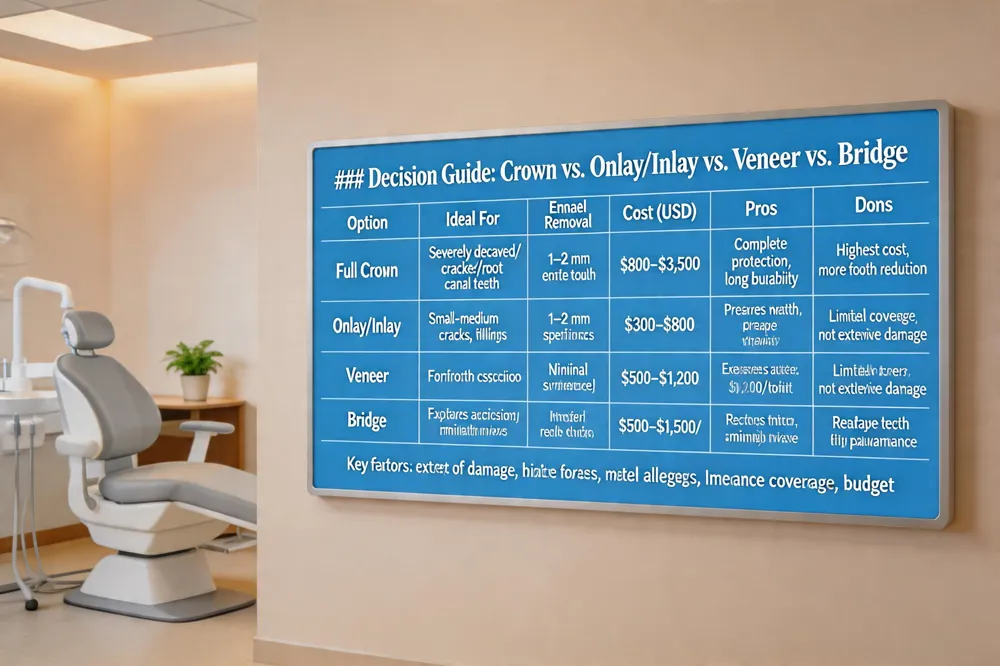 When deciding between a full‑coverage dental crown and a more conservative tooth cap (onlay or inlay), the extent of damage is the primary factor. A tooth cap restores only the damaged portion of a tooth—covering the biting surface and one or two sides—requiring minimal enamel removal (1‑2 mm) and typically costing less. It is ideal for small to medium cavities, isolated cracks, or a large filling that does not compromise the entire tooth structure. In contrast, a crown encases the whole visible tooth, providing full protection and strength for severely decayed, fractured, or root‑canal‑treated teeth, and it can serve as an anchor for bridges or implants.
Alternative restorations include veneers and bridges. Veneers are thin porcelain shells that cover only the front surface of a tooth for cosmetic improvement, while bridges replace missing teeth by anchoring a pontic to crowns on adjacent healthy teeth. Both options preserve more natural tooth structure than a crown but are limited to specific aesthetic or functional needs.
Factors influencing the decision encompass the location of the tooth (front vs. back), aesthetic goals, bite forces, patient’s oral‑hygiene habits, and any metal allergies. Insurance coverage and cost also play a role, as most plans consider crowns medically necessary when they protect a weakened tooth.
Tooth cap vs crown – A tooth cap (onlay/inlay) restores only the damaged portion, requiring less reduction and expense, while a crown encases the entire tooth, offering comprehensive protection for severely compromised teeth and serving as a bridge or implant anchor.
Front teeth crowns before and after – Before treatment, front teeth may appear discolored, chipped, or misshapen, creating an uneven smile. After placement of a custom‑matched porcelain or all‑ceramic crown, the tooth regains its natural shape, shade, and alignment, delivering a durable, lifelike restoration that blends seamlessly with the surrounding dentition.
Conclusion
Dental crowns are a proven, full‑coverage solution that restore a tooth’s shape, strength, and appearance while protecting it from further decay. Whether made from porcelain, zirconia, metal‑ceramic, or gold, crowns can last 10‑15 years—or longer—with proper oral hygiene, regular check‑ups, and avoidance of hard or sticky foods. For Paterson residents, the next step is to schedule a comprehensive exam with a local full‑service practice that offers multilingual staff and modern CAD/CAM technology. Discuss material options, insurance coverage, and any concerns about grinding or bite forces. A well‑fitted crown not only preserves natural tooth structure but also enhances chewing efficiency, speech clarity, and overall confidence.