Why Prompt Chip Care Matters
A chipped tooth may seem minor, but leaving it untreated can lead to serious health risks. Exposed dentin height pulp become vulnerable to bacterial invasion, causing decay, pulpitis, or even an abscess that may require root‑channel therapy or extraction. The injury also heightens sensitivity to temperature and pressure, making everyday eating uncomfortable. Beyond the physical effects, a visible chip can undermine confidence and self‑esteem, especially when it involves front teeth that are central to a smile. Patients often report embarrassment, social withdrawal, and heightened anxiety about speaking or laughing. Prompt, same‑day repair—whether through composite bonding, CAD/CAM‑fabricated crowns, or temporary onlays—halts disease progression, restores function, and immediately improves aesthetics. This rapid intervention reduces the need for multiple appointments, lowers overall treatment costs, and helps patients regain a natural‑looking, pain‑free smile in a single visit.
Understanding Chip Injuries and Immediate Home Care
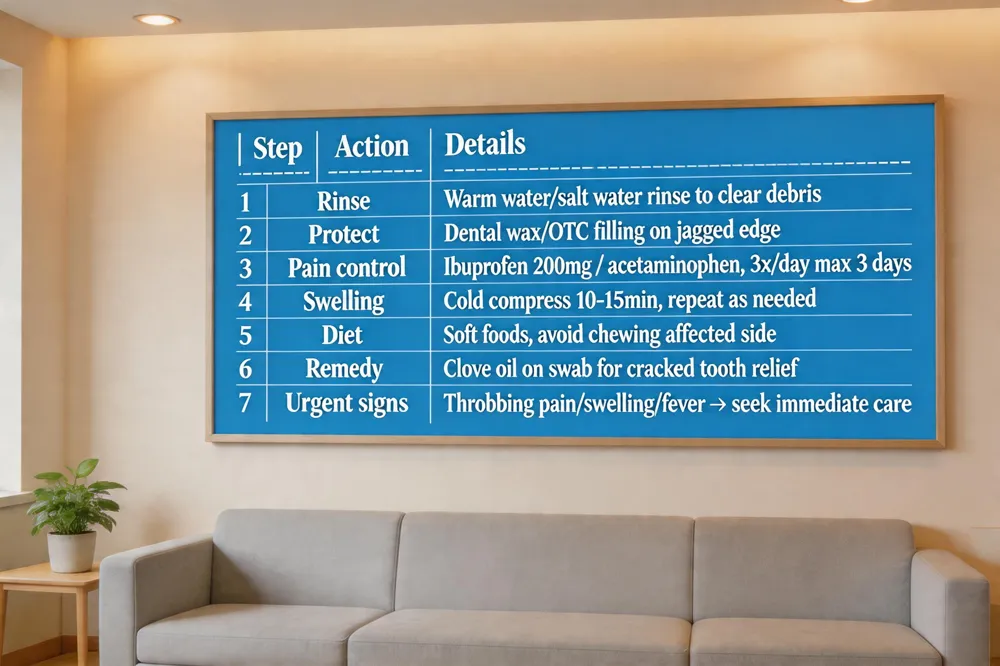
| Step | Action | Details |
|---|---|---|
| 1 | Rinse | Warm water or warm salt‑water rinse to clear debris |
| 2 | Protect | Apply dental/orthodontic wax or OTC temporary filling to jagged edge |
| 3 | Pain control | OTC ibuprofen (200 mg) or acetaminophen, 3‑times‑daily, max 3 days |
| 4 | Swelling | Cold compress 10‑15 min, repeat as needed |
| 5 | Diet | Soft foods, avoid chewing on affected side |
| 6 | Remedy | Clove oil dab on cotton swab for cracked tooth relief |
| 7 | Urgent signs | Persistent throbbing pain, swelling, fever, bleeding, pulp exposure → seek immediate care |
 Chipped teeth range from a tiny enamel fracture to a larger piece that exposes dentin or pulp. Small chips usually cause only a rough edge and mild sensitivity, while larger chips may reveal a dark spot, cause sharp pain, or bleed.
Temporary fixes to protect soft tissue – Rinse the mouth gently with warm water or a warm salt‑water solution to clear debris. Cover any jagged edge with dental wax, orthodontic wax, or an over‑the‑counter temporary filling material to shield the tongue and cheek.
Managing pain and swelling at home – Take an OTC pain reliever such as ibuprofen or acetaminophen. Apply a cold compress to the cheek for 10‑15 minutes, repeating as needed. Use a soft‑food diet and avoid chewing on the affected side.
Quick home remedies – For a cracked tooth, a warm salt‑water rinse, cold compress, and a dab of clove oil on a cotton swab can provide temporary relief. If a front tooth chips, follow the rinse‑wax‑pain‑relief steps and schedule a dentist visit promptly; a permanent restoration (bonding, crown, or veneer) will be needed.
When to seek urgent care – Persistent throbbing pain, swelling, fever, bleeding, or visible pulp exposure are warning signs that require immediate professional treatment. Same‑day emergency appointments, such as those offered by Buckeye Immediate Dental in Columbus, can place fillings, crowns, or bonding in one visit, preserving function and aesthetics.
Professional Repair Options: From Bonding to Crowns
| Damage Size | Recommended Treatment | Typical Visit | Notes |
|---|---|---|---|
| Tiny enamel chip | Dental bonding (composite resin) | 1 visit (often no anesthesia) | Color‑matched, minimal discomfort |
| Small–medium chip exposing dentin | Onlay / Inlay (composite or porcelain) | 1 visit (CAD/CAM) | Preserves most natural tooth |
| Large fracture / cusp loss | Full‑coverage crown (CAD/CAM) | 1 visit (scan, mill, place) | Strong, aesthetic, may need temporary crown |
| Front‑tooth chip (esthetic) | Porcelain veneer | 1‑2 visits (prep, place) | High aesthetics, may be same‑day with digital workflow |
| Pulp exposure | Root‑canal therapy + crown | 1‑2 visits | Treat infection, then restore strength |
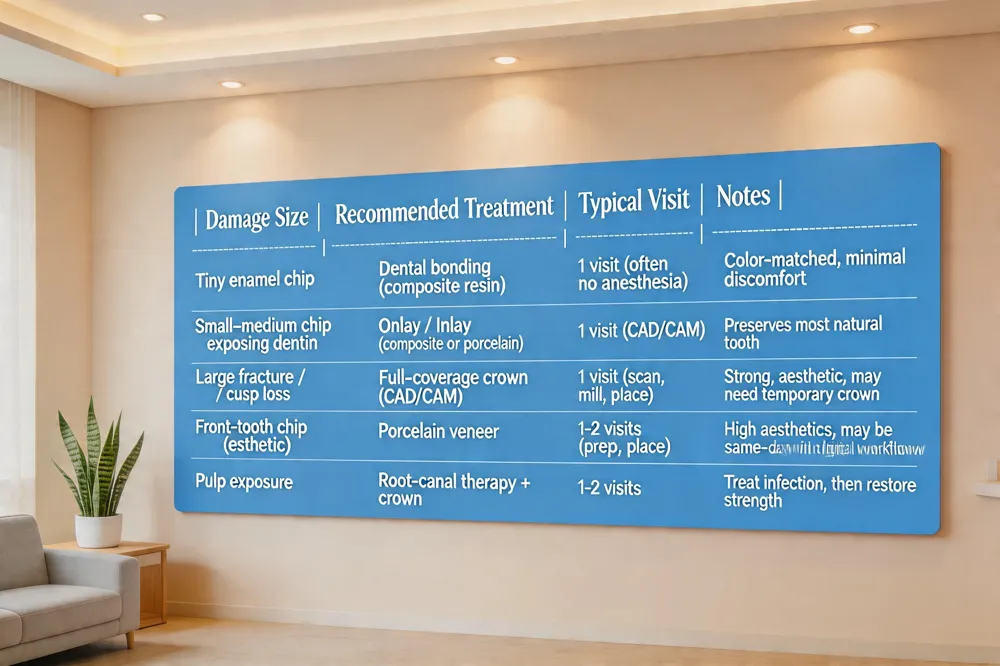 When a tooth chip is small, the fastest and most conservative solution is dental bonding. The dentist shapes a tooth‑colored resin to fill the missing enamel, cures it with a light, and polishes the surface—often without anesthesia—so the repair is virtually invisible. For slightly larger fractures that involve dentin or a cusp, onlays and inlays are fabricated from durable composite or porcelain and bonded in a single visit, providing strength while preserving most of the natural tooth.
If the damage is extensive, a full‑coverage crown or a porcelain veneer may be required. Modern CAD/CAM technology allows the practice to scan the tooth, mill a custom crown or veneer on‑site, and place it in the same appointment, eliminating the need for a temporary restoration and a second visit. Temporary crowns or provisional fillings can also be used to protect the tooth while a permanent piece is being fabricated.
Can a dentist fill in a small chip? Yes—bonding restores a minor chip in one visit, matching color and shape with minimal discomfort.
Very small chip in front tooth? Rinse, protect sharp edges, and schedule a same‑day bonding appointment; polishing may suffice if the chip is tiny.
How to fix a chipped tooth permanently? Evaluate the extent, then use bonding for small chips, crowns or veneers for larger defects, and root‑canal plus crown if the pulp is exposed.
Can a chipped tooth be fixed the same day? Absolutely—most minor to moderate chips can be repaired with bonding, onlays, or same‑day CAD/CAM crowns, preserving function and aesthetics quickly.
Cost Considerations and Insurance Coverage
| Procedure | Cost Range (USD) | Insurance Coverage | Notes |
|---|---|---|---|
| Composite bonding (tiny chip) | $100 – $400 | Often covered partially; HSA/FSA for out‑of‑pocket | Minimal discomfort |
| Medium Onlay / Inlay | $300 – $800 | May be covered if medically necessary | Durable restoration |
| Full crown (porcelain/metal) | $500 – $1,500 | Varies; many plans cover 50‑80% | CAD/CAM can reduce visits |
| Porcelain veneer (front tooth) | $800 – $2,000 per tooth | Usually considered cosmetic → limited coverage | High aesthetic value |
| Implant (severe loss) | $2,000 – $3,000+ | Covered for medically necessary cases (Medicaid) | Surgical procedure |
| Emergency visit (pain, infection) | $150 – $300 | Often covered as urgent care | May include temporary filling/crown |
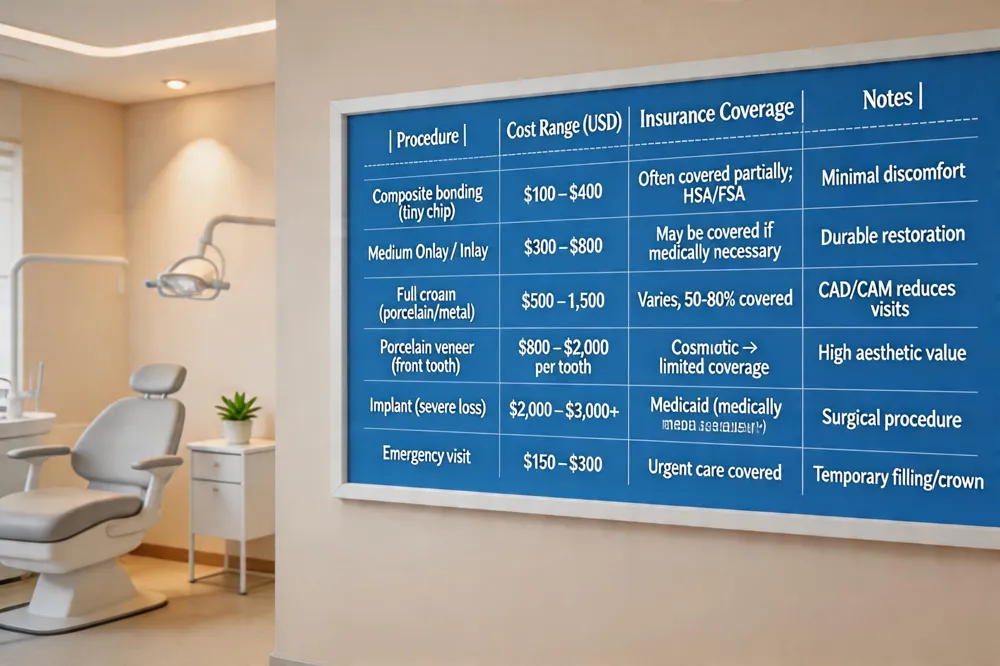 Repairing a chipped tooth can range widely in price. A minor enamel chip that is restored with composite bonding typically costs $100‑$400, while a medium‑size fracture requiring a crown runs $500‑$1,500. Porcelain veneers for front‑tooth chips are $800‑$2,000 per tooth, and a full implant for a severely damaged tooth can exceed $2,000‑$3,000. Most dental insurance plans cover a portion of these procedures, and patients can use HSAs or FSAs for the out‑of‑pocket portion.
Dental insurance and Medicaid/CHIP benefits: All CHIP programs must include preventive, restorative, and emergency dental services. Children enrolled in CHIP receive coverage for exams, cleanings, fillings, crowns, and urgent repairs, though exact benefits vary by state. Adult Medicaid plans, such as those administered by DentaQuest, focus on preventive care (exams, cleanings, fluoride, X‑rays) and basic restorative work (fillings, simple extractions). Major services like crowns, bridges, dentures, and medically necessary implants are also covered, while cosmetic dentistry is generally excluded.
DentaQuest Medicaid specifics: DentaQuest covers removable dentures at 100 % of the allowed charge (once every seven years) and includes crowns and bridges when medically indicated. Providers join the DentaQuest network through online enrollment and can be found via the DentaQuest "Find a Dentist" tool. For example, David M.ayer DDS in Paterson, NJ accepts DentaQuest Medicaid and offers same‑day chip repairs, bonding, and crowns. Patients can verify coverage and locate a nearby provider by visiting the DentaQuest portal or calling Provider Services at 888‑308‑2508.
Emergency Access in Ohio and Beyond
| Location | Clinic | Phone | Services | Hours |
|---|---|---|---|---|
| Westerville | Oral Health Center | 888‑888‑6811 | Same‑day severe toothache, broken crowns | Weekdays 8 am‑5 pm |
| Westerville | Schrock Dental | (614) 891‑6451 | Chipped/cracked teeth, abscesses | Mon‑Fri 9 am‑6 pm |
| Hilliard | Just Smiles General, Cosmetic & Implant Dentistry | 380‑300‑5750 | After‑hours advice, same‑day repairs | Extended hours, weekends |
| Columbus | Emergency Dental Columbus Ohio | 614‑721‑8282 | 24‑hr walk‑in for pain, lost crowns, extractions | 24/7 |
| Columbus | Ohio State Dental Center – First‑Floor Emergency Clinic | 614‑688‑3763 | First‑come, first‑served urgent care | Mon‑Thu 7:30 am‑12 pm; Fri 7:30 am‑10:30 am |
| Columbus | Buckeye Immediate Dental | (Phone on website) | Same‑day crowns, bonding, extractions, root canals | Open late (up to midnight weekends) |
| Central Ohio | Stowe Mission of Central Ohio (free clinic) | 614‑445‑8400 | Urgent extractions at no charge | Mondays 5 pm, 1st Fri 10 am, 3rd Thu 5:30 pm |
| Grove City | Ohio Urgent Dental Care | 614‑875‑7070 | Walk‑in urgent care | Mon‑Sat 9 am‑7 pm |
| Columbus | Emergency Dental of Columbus (Morse Rd.) | 403‑600‑9112 | Same‑day appointments, evenings & weekends | Sun 9 am‑7 pm, Mon/Thu 3 pm‑9 pm |
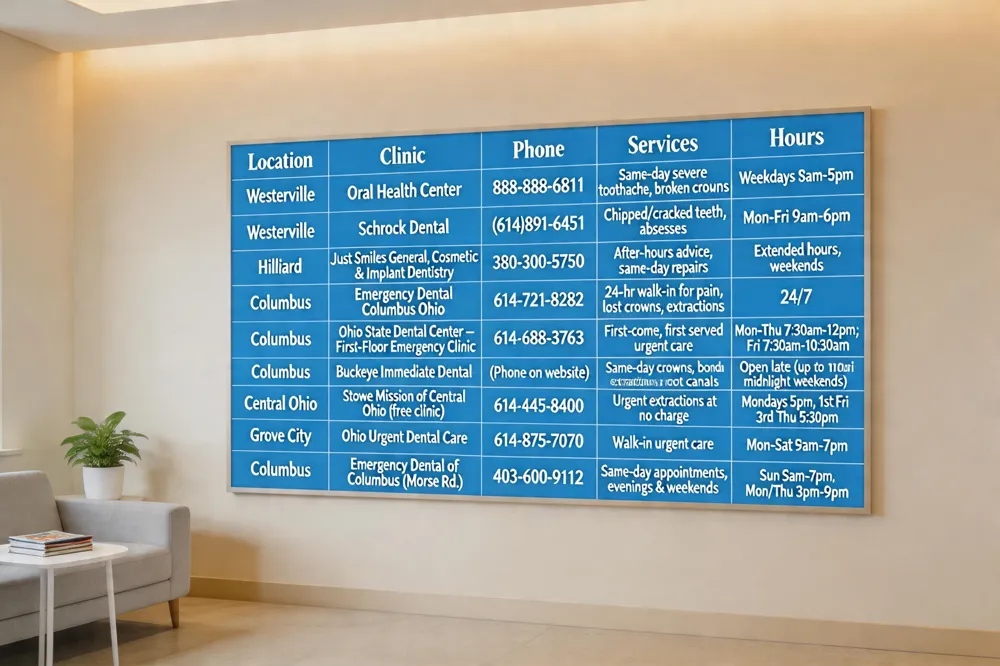 Ohio patients have multiple options for urgent and same‑day dental care across the region.
Westerville – The Oral Health Center (888‑888‑6811) offers same‑day appointments for severe toothaches, knocked‑out teeth, swelling, broken crowns and other urgent issues, prioritizing patients in pain. Schrock Dental (555 W Schrock Rd Suite 130, Westerville, OH 43081; (614) 891‑6451) also accepts emergency cases such as chipped or cracked teeth, abscesses, and lost fillings, and can see you the same day. True 24‑hour clinics are not listed in Westerville; for life‑threatening emergencies call 911 or go to the nearest emergency department.
Hilliard – Just Smiles General, Cosmetic & Implant Dentistry (380‑300‑5750) provides after‑hours advice and same‑day treatment for toothaches, broken teeth, abscesses and more, with a team of five dentists and advanced sedation options. Emergency Dental of Columbus (380‑600‑9112) at 4034 Morse Rd., Columbus, OH 43219 accepts walk‑ins and online bookings for urgent care, serving the greater Columbus area, including Hilliard.
Columbus – Emergency Dentist Columbus Ohio (614‑721‑8282) offers round‑the‑clock walk‑in appointments for severe pain, broken teeth, abscesses, lost crowns or dentures, with sliding‑scale pricing. The Ohio State Dental Center’s First‑Floor Emergency Clinic (7:30 a.m.–12:00 p.m. Mon‑Thu; 7:30 a.m.–10:30 a.m. Fri) provides first‑come, first‑served care without a referral. Buckeye Immediate Dental also accepts walk‑ins and stays open late (up to midnight on weekends), offering extractions, crowns, root canals, fillings and same‑day repairs.
Free Care – Stowe Mission of Central Ohio runs a volunteer‑staffed six‑chair clinic offering urgent extractions at no charge (optional $10 donation). Open Mondays at 5 p.m., the first Friday of each month at 10 a.m., and the third Thursday of each month at 5:30 p.m.; call 614‑445‑8400 to schedule.
Urgent Walk‑In Clinics – Emergency Dental of Columbus (4034 Morse Rd., 403‑600‑9112) accepts same‑day appointments evenings Sundays‑9 9 7 ‑ Saturdays and3‑9 PM on Mondays/Thursdays. The Ohio State Dental Center’s First‑Floor Emergency Clinic (305 W. 12th Ave., Postle Hall; 614‑688‑3763) offers first‑come, first‑served care for severe pain, bleeding or swelling. Ohio Urgent Dental Care in Grove City (4050 Gantz Rd.; 614‑875‑7070) provides similar services. Call ahead to confirm hours and patient limits before visiting.
Managing Pain and When to Seek Immediate Care
| Rule | Description | Action |
|---|---|---|
| 3‑3‑3 | Take three 200 mg ibuprofen tablets every three hours, up to three times a day, max three consecutive days | Use for acute tooth pain; if pain persists → see dentist |
| 2‑2‑2 | Brush twice daily for two minutes each time and visit dentist twice a year | Promote oral health; helps prevent emergencies |
| Emergency Signs | Severe, unrelieved pain; swelling, fever, pus, difficulty breathing, visible pulp exposure | Seek immediate professional treatment |
| Trauma | Knocked‑out, cracked, broken tooth | Urgent dental care (same‑day) to prevent infection and preserve tooth |
| Home Measures Failure | Warm rinse, cold compress, OTC analgesics ineffective | Contact emergency dentist or go to emergency department |
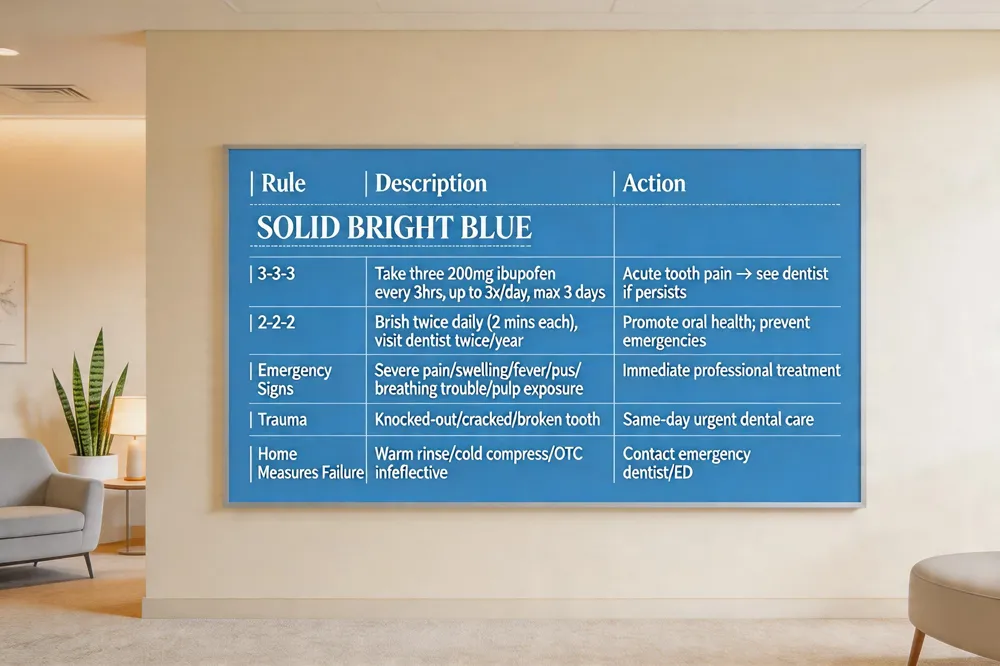 The 3‑3‑3 rule helps control acute tooth pain: take three 200 mg ibuprofen tablets every three hours, up to three times a day, for no more than three consecutive days. If pain persists, see a dentist. The 2‑2‑2 rule promotes oral health: brush twice daily for two minutes each time and visit the dentist twice a year. A toothache becomes an emergency when pain is severe, unrelieved by OTC meds, or accompanied by swelling, fever, pus, or difficulty breathing. Trauma such as a knocked‑out, cracked or broken tooth also warrants urgent care. When home measures—warm rinses, cold compresses, OTC analgesics—fail to reduce pain or swelling, seek immediate professional treatment to prevent infection and further damage.
Restorative Options for Severe Damage
| Damage Level | Procedure | Benefits | Typical Cost |
|---|---|---|---|
| Extensive loss (root exposure) | Root‑canal therapy + crown | Eliminates infection, restores strength | $500‑$1,500 (crown) + $300‑$800 (root canal) |
| Moderate loss (cusp, dentin) | Onlay / Inlay (composite or porcelain) | Preserves tooth structure, strong, aesthetic | $300‑$800 |
| Severe damage (whole crown needed) | Full‑coverage crown (CAD/CAM) | Single‑visit placement, durable, natural look | $500‑$1,500 |
| Missing tooth | Implant with crown | Restores function, prevents bone loss | $2,000‑$3,000+ |
| Multiple missing teeth | Bridge (fixed partial denture) | Restores multiple teeth, stable | $1,200‑$2,500 |
| Edentulous (no teeth) | Denture (removable) | Affordable, restores chewing | $500‑$1,500 |
| Cosmetic enhancement (front teeth) | Porcelain veneer | High aesthetics, minimal prep | $800‑$2,000 per tooth |
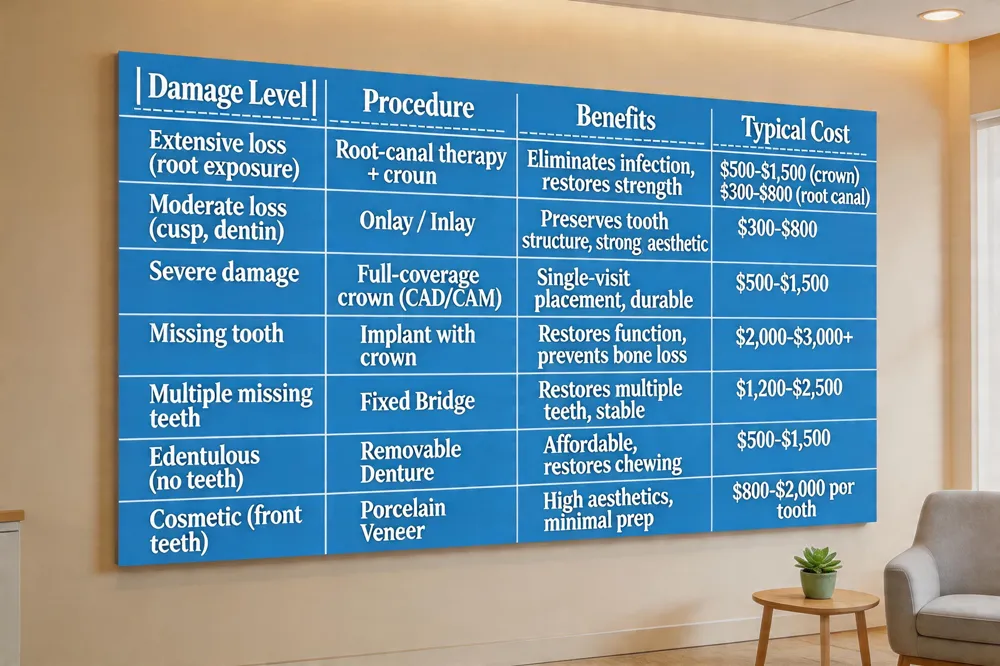 Severe tooth damage often requires major restorative dental treatment, which goes beyond simple fillings and includes crowns, bridges, dentures, implants, and on‑on/onlay restorations. These procedures restore function, strength, and aesthetics, allowing patients to chew comfortably and speak clearly.
Root canal therapy is paired with a crown when the pulp is infected or exposed; the tooth is cleaned, filled, and then capped with a CAD/CAM‑fabricated crown in a single visit, preserving the natural structure.
For intermediate damage, onlays and inlays serve as custom‑fit restorations that replace lost tooth material without a full crown. Modern digital impressions and chair‑side milling enable same‑day placement, reducing appointments and enhancing patient comfort.
Major restorative dental treatment refers to extensive procedures that repair or replace damaged or missing teeth beyond basic fillings and root canals, such as crowns, bridges, dentures, implants, and in‑on/onlay restorations. These services are classified as Class 3 (major) care by insurers and help maintain a healthy, functional smile.
Financing, Community Resources, and Multilingual Support
| Resource Type | Example | Cost | Language Support |
|---|---|---|---|
| Sliding‑scale clinic | Federally Qualified Health Center (FQHC) | Reduced fee based on income | English, Spanish, sometimes other languages |
| Dental school teaching site | Ohio Dental Association Dental School | Low cost (materials only) | Primarily English; interpreter services on request |
| Charity day / free event | Mission of Mercy, Give Kids A Smile | Free or donation‑based | Multilingual volunteers often available |
| Public insurance | Medicaid / CHIP (Ohio) | Covered procedures (preventive, basic restorative) | Materials assistance, Spanish, Arabic, etc. |
| Health savings accounts | HSA / FSA | Use pre‑tax dollars for out‑of‑pocket | N/A |
| Non‑profit network | Dental Lifeline Network | Free emergency care for qualifying patients | Multilingual support via partner clinics |
| Community health center | Stowe Mission of Central Ohio | Free urgent extractions | English, Spanish, some other languages |
| Online discount plan | Membership dental plans (e.g., Careington) | Annual fee $99‑$199 for discounted services | English; some plans have multilingual hotlines |
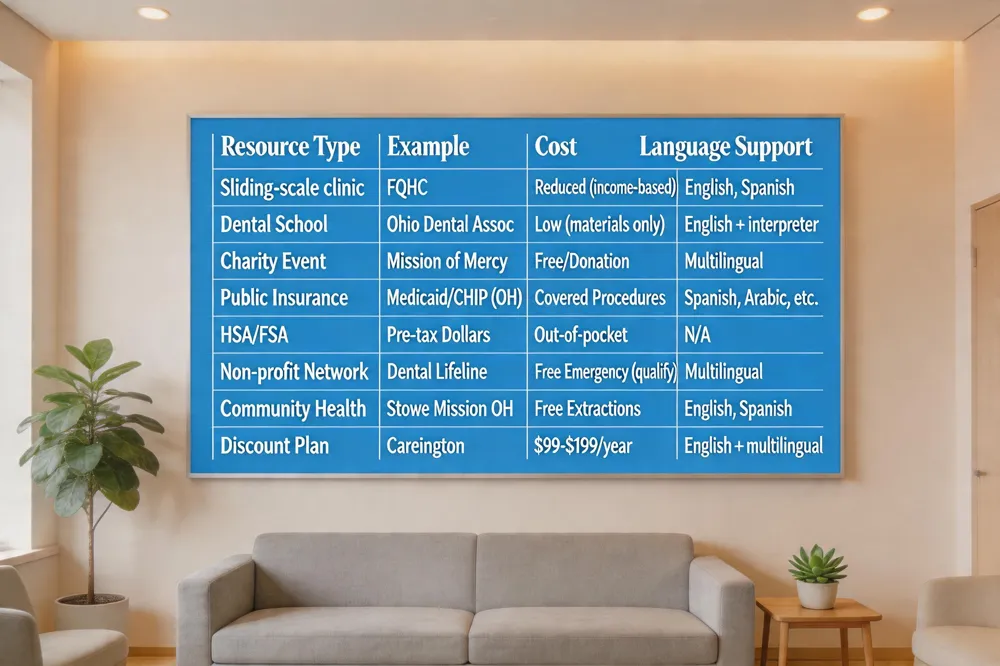 For patients without a dental budget, Ohio offers several low‑cost and sliding‑scale options. Federally qualified health centers, community clinics and dental‑school teaching sites provide care at reduced fees, often limited to the cost of materials. Public programs such as Medicaid and CHIP cover many emergency and routine procedures, and many private offices run “charity days” or membership‑discount plans. Non‑profit groups—Dental Lifeline Network, Mission of Mercy, Give Kids A Smile, and local free‑dental events—regularly offer free screenings, cleanings and restorative work.
How can I fix my teeth if I don't have money? Look for free or low‑cost community programs, sliding‑scale clinics, dental‑school services, and charitable events; also check Medicaid/CHIP eligibility and membership discount plans.
How do poor people get their teeth fixed? They use sliding‑scale health centers, public insurance (Medicaid/CHIP), teaching clinics, and charitable organizations that provide free or reduced‑fee dental care, often with multilingual staff to ensure clear communication.
Take Action Today – Don’t Let a Chip Destroy Your Smile
If you notice a chipped or broken tooth, seek a prompt professional evaluation. A quick exam, often with digital X‑rays or an intra‑oral scanner, determines whether the damage is limited to enamel or has reached dentin or pulp, guiding the appropriate treatment plan. Same‑day repair options—such as composite bonding for minor chips, CAD/CAM‑fabricated crowns for larger fractures, or temporary onlays—allow patients to leave the office with a restored tooth in a single visit, reducing pain, infection risk, and the inconvenience of multiple appointments. Financial barriers are less daunting when practices accept Medicaid, CHIP, or other dental insurance, and many offer on‑site financing, Care Credit, or sliding‑scale fees. Community resources, including local non‑profits and dental clinics, further expand access to urgent care, ensuring that everyone can protect their smile without delay.