Understanding the Stakes
An emergency dental problem is urgent when pain, swelling, bleeding, or trauma threatens the tooth’s integrity or the patient’s overall health. Severe pain may signal pulp infection; rapid swelling can indicate an abscess that could spread to the jaw, sinuses, or bloodstream, leading to cellulitis, osteomyelitis, or sepsis. A knocked‑out tooth loses viability after 30‑60 minutes, and a cracked tooth can progress to pulp necrosis, requiring root‑canal therapy or extraction. Beyond health, delays raise costs. A simple filling that costs $150‑$300 can become a root canal and crown exceeding $1,500, while untreated infections often demand after‑hours visits, antibiotics, and hospitalization. Prompt evaluation also allows dentists to address gum disease before it escalates. Hour of postponement can add fees for appointments, imaging, and stronger antibiotics, turning a expense into a procedure.
Immediate Steps When Disaster Strikes
| Step | Action |
|---|---|
| 1 | Call dentist’s after‑hours line (or 911/ER for life‑threatening situations) |
| 2 | Rinse gently with warm water; apply clean gauze with pressure to control bleeding |
| 3 | For knocked‑out tooth, keep moist in milk, saliva, or storage medium; handle only crown |
| 4 | Avoid eating/chewing; use OTC ibuprofen or acetaminophen as directed |
| 5 | Follow dentist‑provided instructions (antibiotics, pain control, appointment) and update on symptom changes |
| 6 | If no dentist, call urgent‑care dental hotline or local ER; rinse, remove debris, cold compress, keep tooth moist |
| 7 | Weekend: warm salt water rinse, cold compress, OTC pain relief; call 24/7 emergency line or go to ER for severe symptoms |
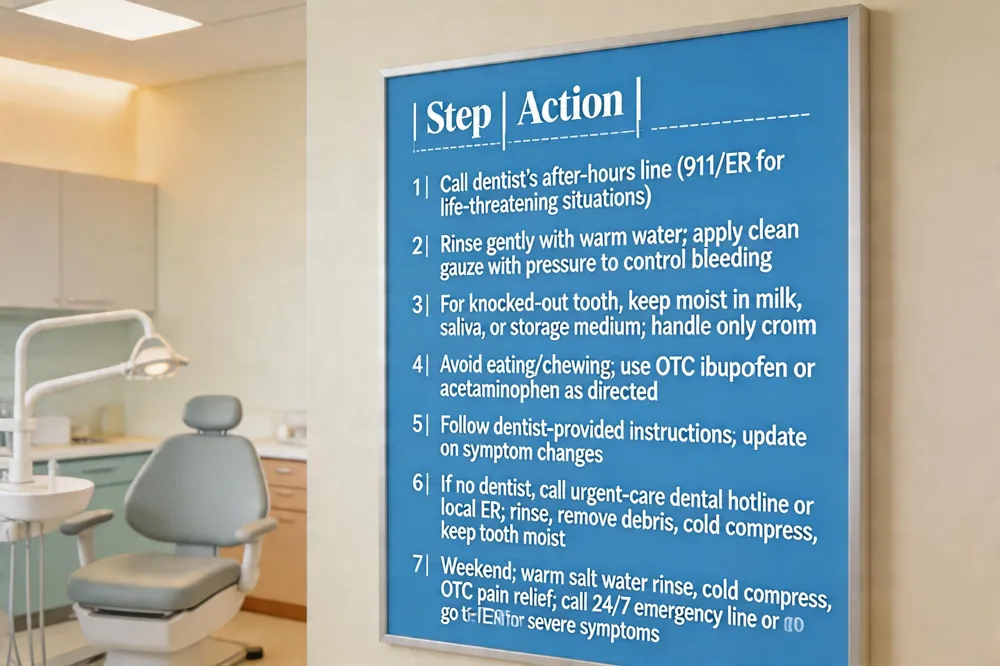 Dental emergency guidelines: 1) Contact your dentist’s after‑hours line immediately; for life‑threatening situations call 911 or go to the nearest ER for life‑threatening dental situations. 2) Rinse gently with warm water; apply a clean gauze pad with gentle pressure to control bleeding. 3) For a knocked‑out tooth, keep it moist in milk, saliva, or a special storage medium and handle only the crown. 4) Avoid eating or chewing until evaluated, and use OTC pain relievers (ibuprofen or acetaminophen) as directed. 5) Follow any dentist‑provided instructions on antibiotics, pain control, and appointment timing, updating the office of any symptom changes.
What to do if you have a dental emergency and no dentist: Call an urgent‑care dental hotline or your local ER for immediate guidance. Rinse, remove debris, apply a cold compress, and keep a knocked‑out tooth moist. Use OTC analgesics and arrange a dental appointment as soon as possible.
Weekend emergencies: Stay calm, rinse with warm salt water, apply a cold compress, and take OTC pain relief. Call our 24/7 emergency line for on‑call dentist instructions and same‑day/overnight appointment. For severe bleeding, facial swelling, fever, or breathing difficulty, go to the nearest ER or call 911 or go to the nearest ER for life‑threatening dental situations. Our multilingual team will guide you through each step.
Common Emergencies You Might Face
| Emergency | Typical Signs |
|---|---|
| Severe toothache | Throbbing pain not relieved by OTC meds |
| Cracked/fractured tooth | Visible pulp exposure, sharp pain |
| Knocked‑out tooth | Tooth missing, socket empty |
| Lost/broken restoration | Filling, crown, or denture broken |
| Dental abscess | Facial swelling, fever, pus |
| n | Gum cuts/bruises |
| Tooth cannot be saved | Severe fracture, infection, persistent pain |
Recommended care: Call Paterson, NJ office (555‑123‑4567) for same‑day appointment; digital imaging, same‑day crowns/implants, 24‑hour extractions available.
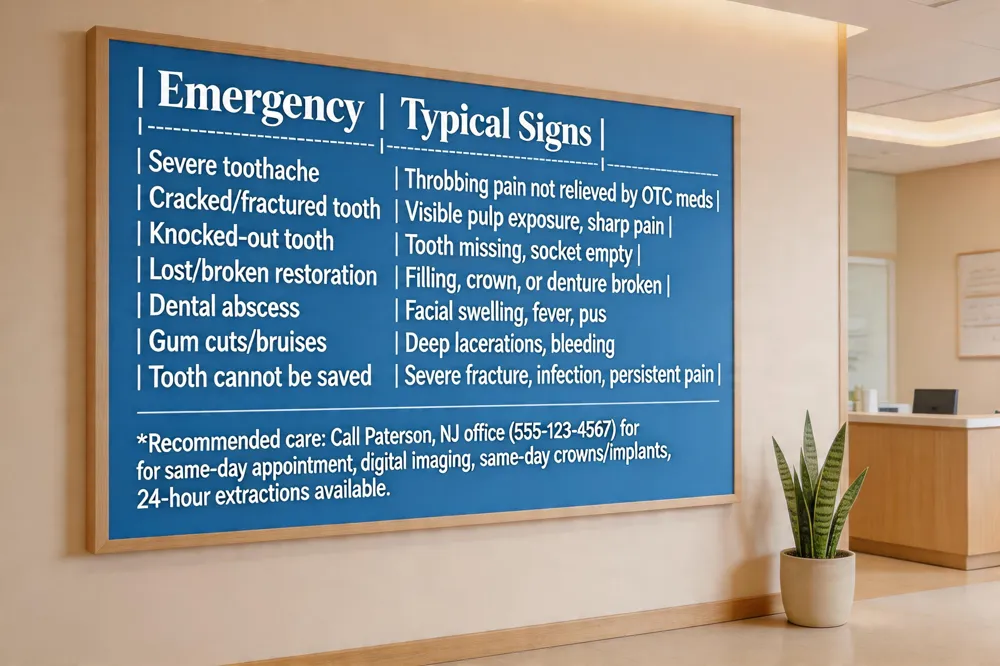 Dental emergencies include severe, throbbing toothache that won’t improve with OTC medication, a cracked or fractured tooth exposing the pulp, or a knocked‑out tooth that must be re‑implanted quickly. Lost or broken restorations (fillings, crowns, dentures), dental abscesses with facial swelling, and gum tissue cuts or deep bruises also require urgent care. If you need 24‑hour emergency dental care near you, our Paterson, NJ office is ready around the clock. Call (555) 123‑4567 and our multilingual team will arrange a same‑day appointment, equipped with digital imaging, same‑day crowns, implants, and compassionate staff to relieve pain and prevent further damage. For teeth that cannot be saved—severely fractured, infected, or painful—we provide 24‑hour emergency extractions using local anesthesia and sedation options. Quick intervention not only eases discomfort but also reduces the risk of infection, bone loss, and costly restorative work.
Financial Barriers and How We Help
| Barrier | Assistance Options |
|---|---|
| Limited funds | Payment plan, sliding‑scale fee, CareCredit financing |
| No insurance | Community health center, hospital ER for antibiotics, dental‑school low‑cost care |
| Immediate symptom relief | Warm salt‑water rinses, OTC pain relievers |
Insurance rules:
- 2‑year rule: Max two years between dental visits (not a substitute for 6‑month check‑up).
- 3‑3‑3 rule: 3×600 mg ibuprofen every 3 hrs, max 3 days, until dentist seen.
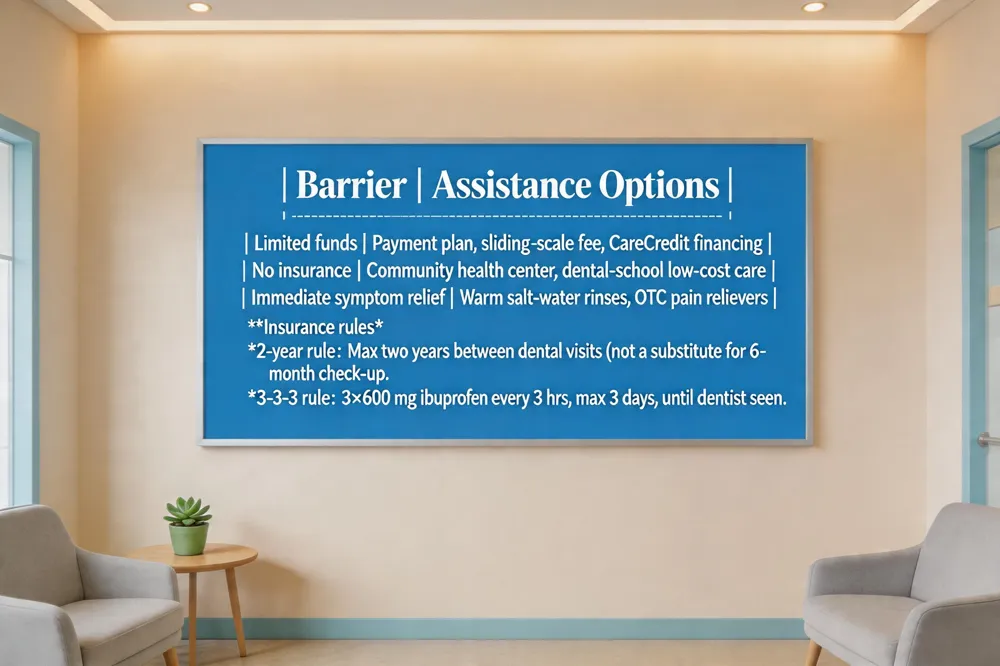 When a dental emergency strikes and funds are tight, act quickly. Call our Paterson office so we can set up a payment plan, sliding‑scale fee, or CareCredit financing. In the meantime, seek temporary relief at a community health center, hospital ER (for antibiotics), or dental‑school clinic, which often offers low‑cost care. Follow home‑care steps such as warm salt‑water rinses and OTC pain relievers to manage symptoms.
The "2‑year rule" is an insurance guideline suggesting patients should not go more than two years without a dental visit. It is not a substitute for the recommended six‑month check‑up, which allows early detection of decay, gum disease, and other problems.
The "3‑3‑3 rule" for a tooth infection advises taking three 600 mg ibuprofen tablets every three hours, for no more than three days, to control pain and swelling until you can see a dentist. It is only a temporary measure; definitive treatment such as a root canal, extraction, or prescribed antibiotics is still required.
Prevention Is Better Than Cure
| Preventive Habit | Why It Helps |
|---|---|
| Custom‑fit mouthguard during sports | Protects teeth from impact |
| Avoid chewing hard objects (ice, pens, popcorn kernels) | Reduces risk of cracks/chipping |
| Limit sugary/sticky foods | Lowers decay risk |
| Brush twice daily with fluoride toothpaste, floss, antimicrobial mouthwash | Controls plaque & bacteria |
| Routine cleanings/exams twice a year | Early detection of cavities, gum disease |
| Basic emergency dental kit (gauze, temporary cement, toothbrush) at home | Handles minor issues promptly |
| Rule of 7 (pediatric) | First tooth by 7 mo, permanent tooth by age 7, orthodontic eval by age 7 |
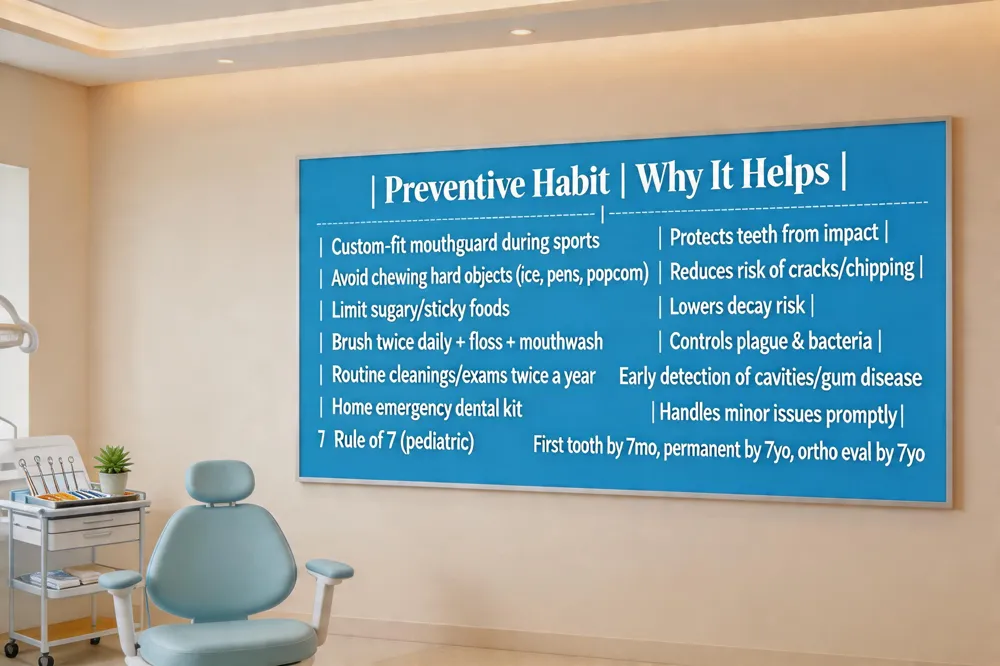 Dental emergencies are often avoidable with simple daily habits and timely care. To prevent an emergency, wear a custom‑fit mouthguard during sports or any high‑impact activity, avoid chewing hard objects (ice, pens, popcorn kernels) and limit sugary or sticky foods that promote decay. Maintain diligent oral hygiene—brush twice daily with fluoride toothpaste, floss regularly, and use an antimicrobial mouthwash—to keep plaque and bacteria in check. Schedule routine cleanings and exams at least twice a year ; any cavities, cracked teeth, or early gum‑disease signs should be treated promptly. Keep a basic emergency dental kit (gauze, temporary cement, toothbrush) at home for minor issues. The Rule of 7 in dentistry guides pediatric care: a child’s first tooth appears by 7 months, the first permanent tooth erupts around age 7, and an orthodontic evaluation should occur by age 7, helping catch problems early and protect lifelong oral health.
When Emergency Care Is Truly Critical
| Critical Sign | Recommended Action |
|---|---|
| Uncontrolled facial bleeding | Call 911 or go to nearest ER |
| Facial swelling impairing breathing/vision | ER for medical stabilization |
| High fever, systemic infection signs | ER (risk of cellulitis, sepsis, endocarditis) |
| Knocked‑out tooth >30–60 min untreated | ER if cannot re‑implant promptly |
| Severe pain with spreading infection | ER for antibiotics, imaging before dental treatment |
Typical emergencies (can be handled by dentist): avulsed tooth (if stored properly), cracked/chipped tooth, acute pain – contact dentist’s emergency line for same‑day care.
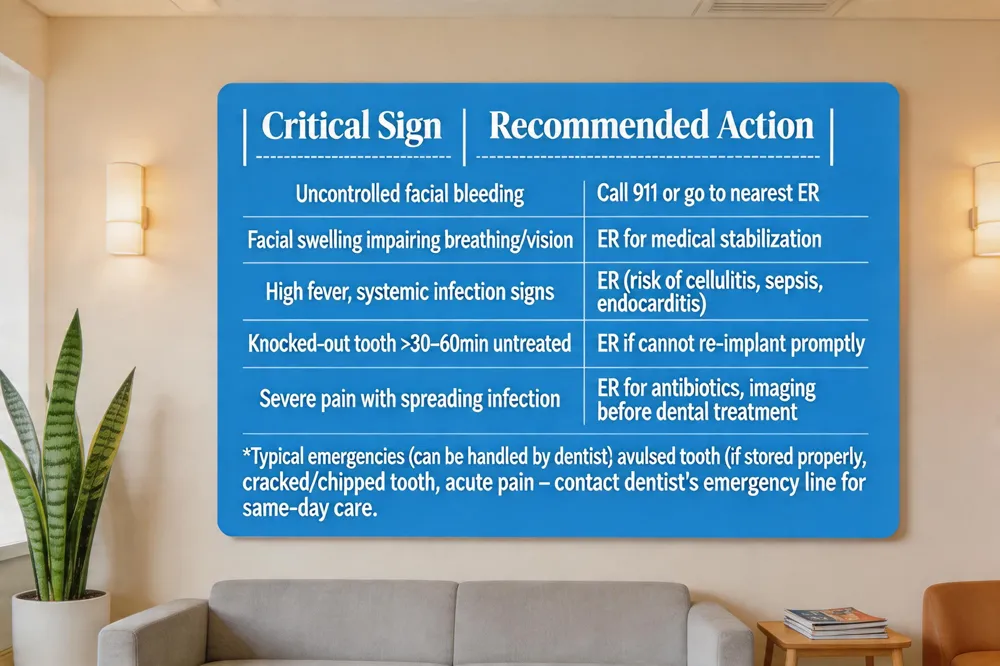 Dental emergencies range from a broken tooth or a cracked crown to severe, throbbing pain. In most cases, prompt treatment by an emergency dentist—often the same day—can relieve pain, prevent infection, and preserve the natural tooth. However, when an infection spreads, it can enter the jawbone, sinuses, or bloodstream, posing systemic risks such as cellulitis, sepsis, or endocarditis. Signs that warrant immediate emergency‑room care rather than a dental office include uncontrolled facial bleeding, facial swelling that impedes breathing or vision, high fever, or a knocked‑out tooth that cannot be replanted within 30–60 minutes. These conditions require medical stabilization before definitive dental treatment. For typical emergencies—avulsed teeth (if stored properly), cracked or chipped teeth, and acute pain—contact your dentist’s emergency line for same‑day or after‑hours care. Acting quickly reduces complications, lowers costs, and protects overall health.
Choosing the Right Emergency Dental Partner
| Feature | Benefit |
|---|---|
| Same‑day after‑hours walk‑ins | Immediate evaluation, pain relief |
| Digital imaging & on‑site lab | Faster diagnosis, same‑day crowns/root canals |
| Multilingual staff (English, Spanish, Arabic) | Clear communication, reduced delays |
| Advanced equipment | higher success rates for bonding, re‑implantation |
| Compassionate care | Reduced anxiety, better patient experience |
Location: Paterson, NJ – equipped for urgent dental needs with 24/7 availability.
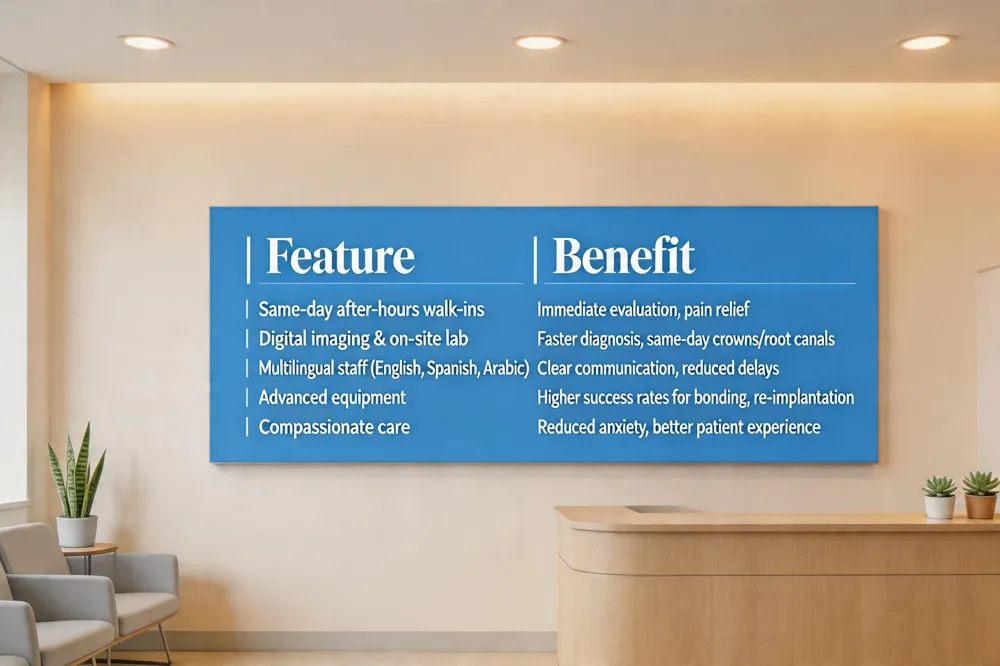 When a dental crisis strikes, same‑day emergency services can mean the difference between preserving a tooth and facing extensive, costly procedures. Immediate evaluation limits infection spread, reduces pain, and often allows simple treatments—such as bonding a chipped tooth or re‑implanting an avulsed tooth—to succeed, saving both time and money. In Paterson, NJ, our office is equipped for after‑hours walk‑ins, equipped with digital imaging, on‑site lab technology, and a full range of restorative options from crowns to root‑canal therapy. A multilingual team further enhances care: English, Spanish, and Arabic‑speaking staff ensure clear communication, quickly triage symptoms, and eliminate language‑related delays. Together, rapid access, advanced equipment, and culturally competent service create a trustworthy emergency dental partner that protects oral health and minimizes long‑term expenses.
Take Action Today
Regular dental check‑ups are the cornerstone of oral health. By visiting your dentist every six months, early decay, gum disease, or structural problems are caught before they become emergencies, saving you pain and costly procedures. If an urgent issue arises, our 24/7 emergency line connects you directly with a qualified emergency dentist who can assess the problem, prescribe antibiotics if needed, and arrange same‑day treatment to prevent infection spread or tooth loss. Maintaining daily oral hygiene—brushing twice daily with fluoride toothpaste, flossing daily, and limiting sugary snacks—reduces plaque buildup and the risk of cavities, cracks, and gum inflammation. Our team offers support, ensuring communication for all patients and reducing delays caused by language barriers. Combine routine visits, rapid emergency access, and diligent home care to protect your smile and overall well‑being.