Why Speech Matters in Denture Care
Missing teeth disrupt the delicate balance of tongue, lip, and teeth contact, especially for fricative sounds such as f, v, s, z, and s consonants like j, ch, sh. The resulting lisp, whistling, or muffled speech can be noticeable in everyday conversation. When a partial denture restores the lost tooth, it re‑establishes proper articulation points, allowing clearer pronunciation and smoother airflow. This improvement boosts confidence, reducing anxiety about speaking in work, school, or social settings. Patients often report greater willingness to engage in meetings, phone calls, and social gatherings once speech clarity returns, improving overall quality of life for patients.
Speech Impact of Partial Dentures
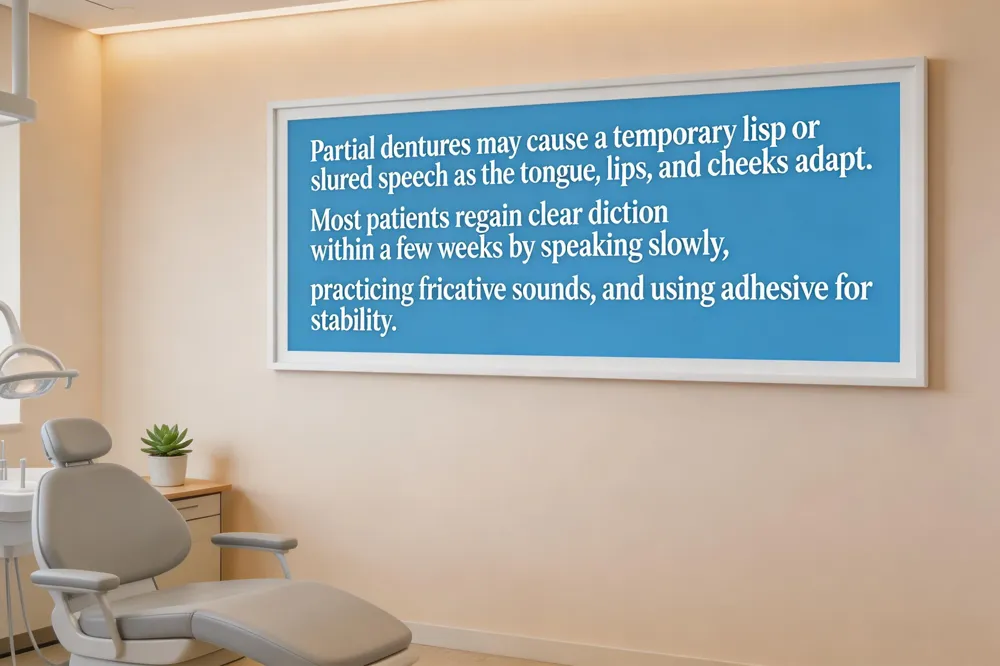 Partial dentures can temporarily affect speech because the tongue, lips, and cheeks must learn to move around a new prosthesis. Missing front teeth often cause a lisp or whistling on fricative sounds such as “s,” “f,” “sh,” and “ch.” A well‑fitted partial denture restores clear diction, and most patients regain confident speech within a few weeks of wear.
How to talk with upper dentures: Speak slowly and deliberately at first. Before a sentence, gently bite down and swallow to seat the denture, then take a calm breath. Practice trouble sounds—especially “s,” “f,” “v,” and “th”—using tongue‑twisters or reading aloud in front of a mirror. If the denture shifts, a thin layer of denture adhesive can improve stability and reduce clicking.
Is it hard to talk with a partial denture? Initially many wearers notice a mild lisp or slurred words as the oral muscles adapt. This adjustment period usually lasts only a few weeks. Consistent practice, slow speech, and occasional adhesive use help the mouth develop the needed muscle memory, resulting in a rapid return to clear speech.
What teeth affect speech the most? The anterior incisors and canines are critical. They provide the contact points for the lower lip on “f” and “v” sounds and guide the tongue for “s,” “z,” and “th.” Restoring these teeth with a partial denture, crowns, or implants greatly improves articulation.
Do dentures cause speech problems? New dentures can cause temporary speech changes because they alter tongue‑lip‑palate dynamics. Most issues resolve within days to a few weeks with practice and proper fit. Persistent difficulties beyond a month should be evaluated for possible adjustments.
Same‑Day Denture Solutions
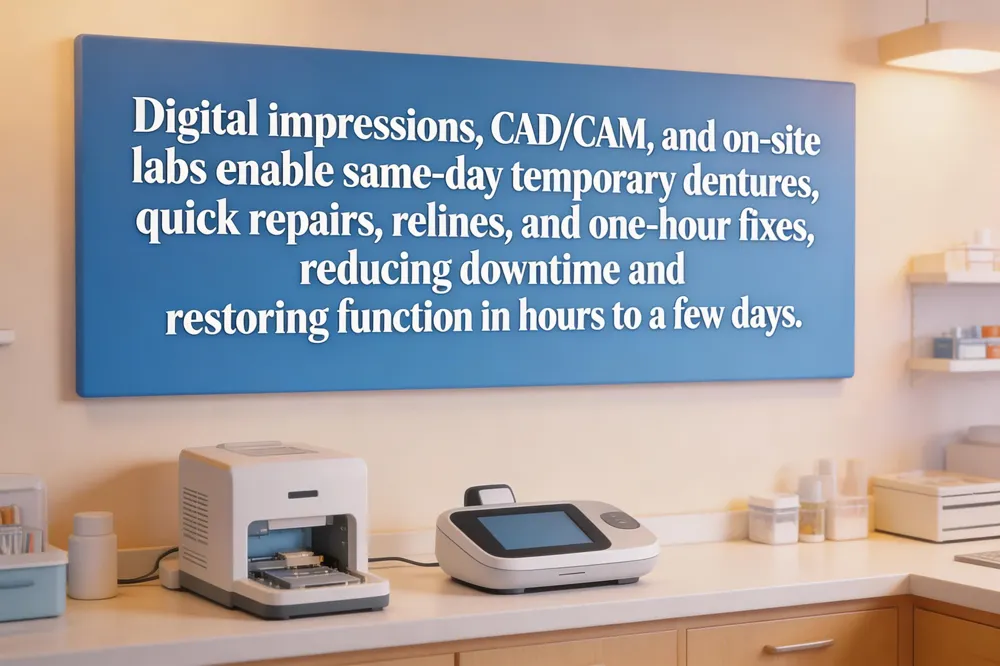 Can you get a partial denture in one day? Yes. Using digital impressions or quick‑set molds, many offices fabricate a temporary partial on‑site or through a rapid‑turnaround lab, placing it within a few hours. The appliance is usually an interim “immediate” piece that protects gums and restores function while a permanent, custom‑fit denture is later refined after a short healing period.
Can dentures be repaired on the same day? Most minor problems—cracks, snapped bases, or missing teeth—can be fixed the same day with an on‑site laboratory. Larger fractures may need a 1‑2‑day lab turnaround, but patients are back to comfortable chewing quickly.
Same‑day denture reline near me Our Paterson office uses intra‑oral scanning, CAD/CAM design, and 3‑D printing to reline dentures in a few hours. The new lining material is applied on the spot, eliminating multiple visits.
Walk‑in denture repair near me Walk‑ins are welcome for urgent repairs. Minor issues are completed the same day; more extensive work may require a short lab turnaround, still within a few days. Multilingual staff (English, Spanish, Arabic) ensure clear communication.
One‑hour denture repair near me Many simple fixes—re‑attaching a tooth, sealing a crack, or adjusting a clasp—are finished in about one hour using rapid‑set acrylics and in‑office equipment.
How long does it take to repair a partial denture? Minor repairs can be done in a single visit; most others are finished within 1‑3 days. Full rebasing may take up to a week, with a temporary set provided.
Can you temporarily fix a broken denture? Over‑the‑counter kits can hold minor cracks, but for significant damage you should see a dentist promptly. Keep the pieces clean and schedule professional repair to avoid injury and speech problems.
Clinical Benefits for Speech Clarity
 Research shows that patients who receive same‑day partial denture repairs report measurable speech improvements within 24‑48 hours, and most regain normal articulation within 15‑30 days. The rapid return is largely because a well‑fitted denture restores proper tongue and lip support, allowing precise placement for fricatives (s, f, v, z) and sibilants (sh, ch).
How long does it take to talk normally with partial dentures? Most wearers speak confidently after a few weeks; the first week may include a mild lisp, but regular speaking practice shortens adjustment. Some adapt in as little as three days when only a few teeth are replaced.
How to fix lisping caused by dentures? Ensure a snug fit—schedule adjustments or use a denture adhesive. Practice slowly in front of a mirror, emphasizing s‑ and z‑sounds, and use swallowing or a brief bite before speaking to position the denture. Persistent lisps merit a dental or speech‑therapy consult.
Hard words to say with dentures – s, f, th, and v sounds are challenging (e.g., “sassy,” “thorough,” “measure”). Break each word into syllables, exaggerate mouth movements, and repeat daily.
Tongue twisters for new dentures – start with simple lines such as “She sells sea shells by the seashore” and progress to “Six sleek swans swam swiftly.” Perform 5‑10 repetitions each day, checking a a mirror for slurring. Consistent practice reinforces muscle memory, restores confidence, and ensures clear speech.
Managing Discomfort and Oral Health
 Can dentures cause throat problems? Yes. An ill‑fitting or over‑extended denture can rub the soft palate and pharynx, causing irritation, gagging, sore throat, and swallowing pain. Continuous wear may also promote denture‑related stomatitis, which can extend into the throat. Adjustments, relining, regular cleaning, and removing the denture at night usually resolve the discomfort.
What is ‘monkey mouth’ with dentures? “Monkey mouth” (or “denture face”) occurs when a denture is too large or improperly positioned, pushing the lips, cheeks, and chin outward into a puffy, ape‑like appearance. Over‑extension of the denture base and bone loss contribute to this aesthetic issue.
How to avoid ‘monkey mouth’ dentures? Ensure a precise impression, correct bite registration, and a denture that fits within the neutral zone. Relining with a soft liner, implant‑supported options, and regular check‑ups help maintain natural facial contours.
What is Kelly syndrome in dentures? Kelly’s (combination) syndrome arises when a complete maxillary denture opposes a mandibular distal‑extension partial denture, leading to bone loss, tuberosity overgrowth, and an ill‑fitting prosthesis. Early implant‑supported treatment can prevent progression.
Is a broken denture an emergency? A broken denture can impair eating, speech, and cause gum irritation, so it is treated as a dental emergency. Seek same‑day repair; do not attempt DIY fixes.
Emergency dentist Paterson, NJ For urgent care in Paterson, NJ, call (973) 291‑2715. Our multilingual team offers same‑day appointments, walk‑ins, and rapid denture repairs using modern CAD/CAM technology, ensuring swift relief and restored speech.
Practical Considerations & Costs
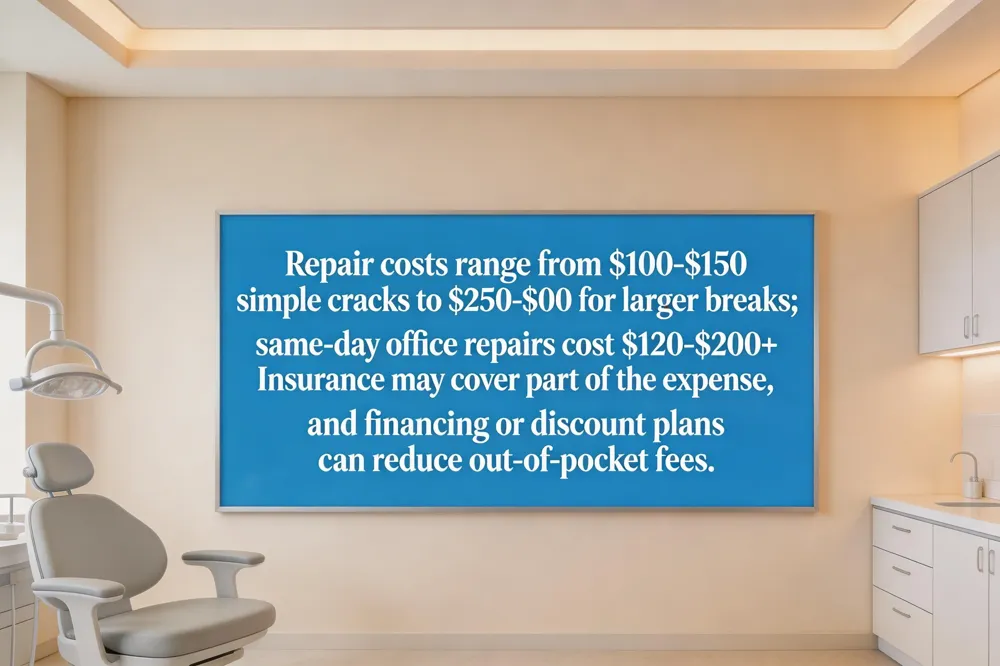 Fixing a broken denture varies: simple cracks $100‑$150, half‑broken pieces $250‑$500, and same‑day office repairs $120‑$200 or more, especially when lab work is needed. Insurance often covers only part of the expense; discount plans can shave 15‑50 % off the bill. If you dislike a new denture, schedule a follow‑up for fit adjustments, relining, or a trial of denture adhesive; implant‑supported options are also available for permanent stability. Local providers such as West Broadway Dental (Paterson, NJ) accept Medicaid and offer same‑day repairs with a multilingual staff, while Union Dental and Marc Schwartz DDS provide affordable, on‑site partial‑denture repairs. Many offices offer flexible financing and free exams, making it easier to restore speech and confidence without breaking the bank.
Embrace Clear Speech Today
Missing or broken partial dentures can cause lisping, slurring, and a loss of confidence when speaking. Modern same‑day repair services—using scanning, CAD/CAM milling and acrylics—restore the denture’s fit within an appointment, eliminating gaps that disturb airflow and tongue placement. Patients report articulation of s, f, t, and z sounds within hours, and relief from embarrassment. Don’t let speech issues linger; call your dental office today and schedule a same‑day repair to regain confident, natural communication in daily life and work.